Blog

Shadow AI and High-Risk AI Resources

Guides, frameworks, and insights for security teams detecting Shadow AI, mapping AI risk, and preventing High-Risk AI exposure.

You're on the list! We'll be in touch.
Oops! Something went wrong while submitting the form.
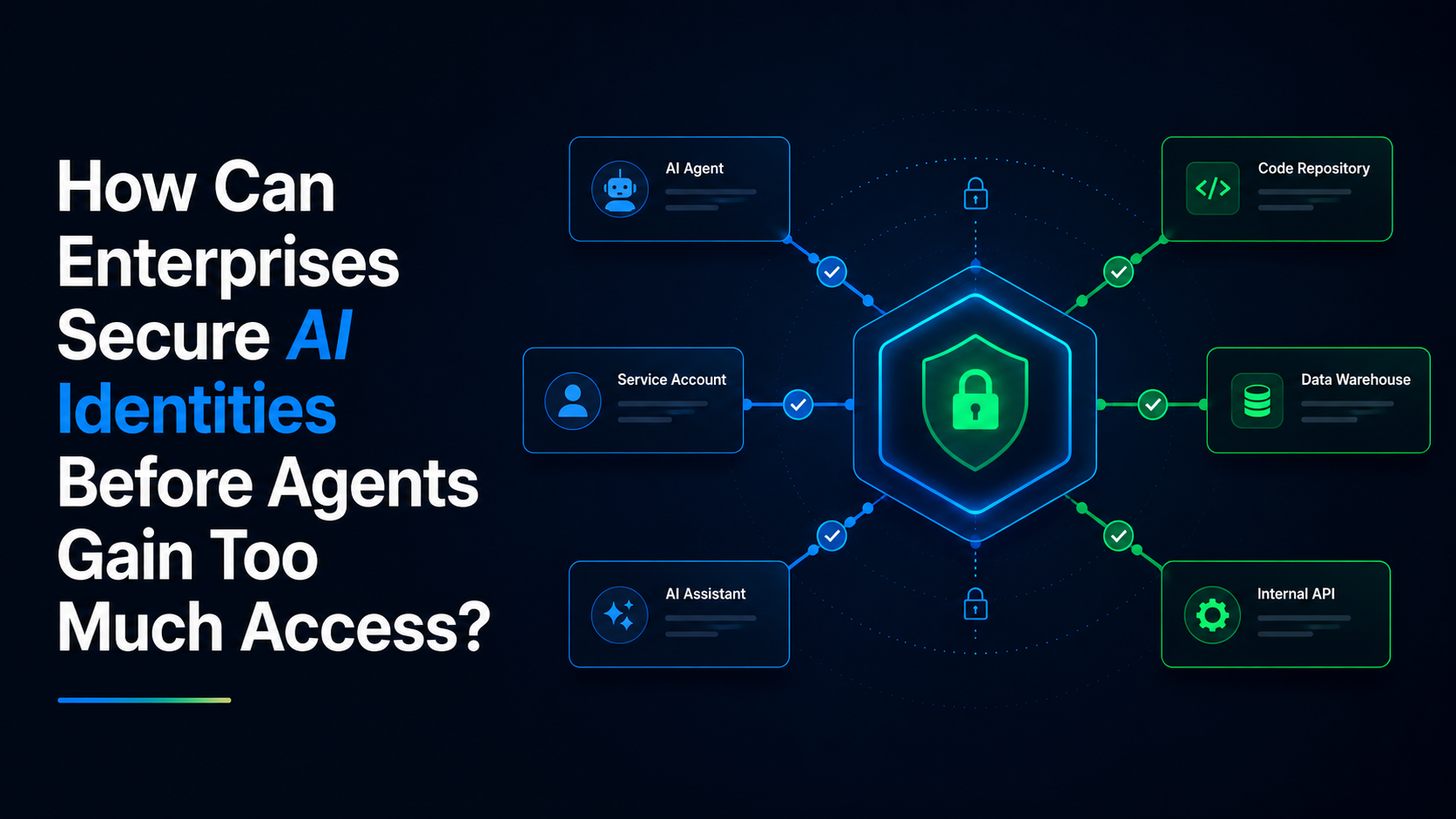
How Can Enterprises Secure AI Identities Before Agents Gain Too Much Access?
Articles
1
min read

How Can Enterprises Secure AI Identities Before Agents Gain Too Much Access?

July 22, 2026
Read more

Artificial intelligence is no longer operating only as a tool that waits for a person to type a prompt. Across modern enterprises, AI assistants and agents are beginning to authenticate to applications, access internal information, call APIs, use plugins, and complete tasks on behalf of employees and business systems.

That shift makes identity one of the most important control points in enterprise AI security. An AI system may appear harmless when viewed only as an application name. Its real risk becomes visible when security teams identify the user, service account, role, token, or machine identity under which it operates and then examine what that identity is permitted to do.

A writing assistant with access only to public content presents a very different exposure from an autonomous agent using a privileged account across production repositories. The model may be similar, but the authority behind it is not.

AIBound’s YouTube video 5 Steps to Discover, Score, and Prevent High-Risk AI places “Expose AI Identities” immediately after discovery. That order matters. Finding an AI resource tells security teams that it exists. Mapping its identity begins to reveal what it can actually reach and change.

Enterprises that want to adopt AI safely therefore need a structured program for discovering AI identities, reducing unnecessary permissions, monitoring access changes, and preserving human approval for high-impact actions.

What Is an AI Identity?

An AI identity is any human or non-human identity through which an AI application, model, assistant, agent, extension, or automated workflow accesses enterprise resources. Sometimes the AI acts directly through a dedicated service account. In other cases, it inherits the permissions of an employee, an OAuth application, a cloud role, an API key, or a shared integration account.

The identity may be obvious in a cloud console, or it may be hidden several layers deep. An employee signs into a SaaS platform. The platform activates an AI assistant. The assistant calls a plugin. The plugin uses a service account to query a database. The visible user is only one part of the chain.

Security teams should therefore document both the top-level identity and the downstream identities involved in the workflow. A useful inventory distinguishes between:

  • Individual employee accounts used by AI-enabled applications
  • Shared accounts used by teams or departments
  • Service accounts created for agents and automations
  • OAuth applications and delegated authorization grants
  • Cloud roles and workload identities
  • API keys, access tokens, and integration secrets
  • Local machine identities used by developer tools
  • Agent-to-agent identities in multi-agent workflows

This inventory is the foundation for answering a more meaningful question than “Who launched the tool?” The more important question is “Whose authority is the tool using at every step?”

Security teams can explore additional AIBound AI security resources covering Shadow AI, governance, agents, and emerging attack-surface risks.

Why AI Identity Risk Is Different From Ordinary Access Risk

Traditional identity and access management assumes that a person or workload requests access to a defined resource for a relatively predictable purpose. AI agents introduce more uncertainty because they may interpret natural-language instructions, select tools dynamically, chain multiple actions, and act on outputs generated during the workflow.

An identity that was acceptable for a fixed automation may become too powerful when attached to an adaptive agent. The agent may be able to choose among many functions, repeat actions, combine information from different systems, or respond to content that contains malicious instructions.

OWASP describes “Excessive Agency” as the risk created when an LLM-based system has excessive functionality, permissions, or autonomy. In practical terms, an agent does not need to exploit a software vulnerability if the organization has already given it more authority than the task requires.

This is why the permission review cannot stop at the model or application. Security teams must examine the complete chain:

  • What functions can the agent invoke?
  • Which identity authorizes each function?
  • Can the agent read, create, modify, delete, publish, or transfer data?
  • Can it access credentials or generate new tokens?
  • Can it trigger financial, operational, or customer-facing actions?
  • Does a person review the action before execution?
  • Can downstream systems independently verify authorization?

A companion AIBound video walkthrough is available at AIBound enterprise AI security walkthrough. It can be linked beside this article to help readers explore the wider enterprise AI security context.

The Four Identity Patterns That Create the Most Risk

1. Agents That Inherit Broad Employee Permissions

An assistant operating through an employee session may gain access to everything that person can reach in email, cloud storage, collaboration platforms, customer systems, and internal dashboards. The employee may understand the sensitivity of those systems, but the agent may process instructions or external content without the same judgment.

2. Shared Service Accounts With No Clear Owner

Shared accounts are difficult to govern because activity cannot be attributed cleanly to one person or one use case. When several automations and agents use the same credentials, security teams may not know which workflow performed an action or whether removing access will break another process.

3. Long-Lived Tokens and API Keys

Long-lived credentials can remain valid after a pilot ends, a developer changes roles, or an integration is no longer needed. If an agent stores those credentials locally or passes them through plugins, the potential exposure grows.

4. Privileged Machine Identities

Agents connected to administrative roles, production repositories, deployment systems, HR databases, or financial platforms can create a large blast radius. A single incorrect or manipulated action may affect many records, users, or systems before a person notices.

AI identity risk is created by the complete permission path, not by the model name alone.

A Seven-Step Framework for Securing AI Identities

Step 1: Discover the AI Resource and Its Identity

Begin by identifying AI applications, agents, extensions, models, MCP servers, and embedded AI features across browsers, endpoints, networks, code environments, and cloud services. For every resource, record the human and machine identities involved.

Step 2: Map the Complete Permission Path

Document the systems, datasets, tools, and actions accessible through each identity. Include inherited permissions, delegated OAuth scopes, plugin permissions, cloud roles, and any credentials stored by the agent or workflow.

Step 3: Assign an Owner and Business Purpose

Every material AI identity should have a named owner who can explain why it exists, what task it supports, what data it handles, and how long the access is needed. Unowned identities should be treated as higher risk until ownership is established.

Step 4: Apply Least Privilege

Reduce permissions to the minimum required for the specific task. Prefer read-only access where possible, restrict access to selected repositories or datasets, separate testing from production, and avoid broad administrative roles.

Step 5: Limit Credential Lifetime

Use short-lived tokens, managed workload identities, and automated credential rotation. Remove access when a pilot ends or an agent is retired. Avoid embedding reusable secrets in prompts, local files, extensions, or agent memory.

The NIST AI Risk Management Framework also provides a practical structure for governing, mapping, measuring, and managing AI risk as identities and permissions change.

Step 6: Require Human Approval for High-Impact Actions

Human review is especially important when an AI system can send payments, deploy code, delete records, change permissions, communicate externally, or act on regulated information. The reviewer should see the proposed action, the target system, the data involved, and the identity that will execute it.

Step 7: Monitor Identity and Permission Changes Continuously

AI workflows evolve quickly. New plugins are installed, scopes expand, service accounts are reused, models change, and agents gain new functions. A quarterly access review is unlikely to capture the pace of change. Security teams need continuous monitoring for new identities, new grants, dormant credentials, unusual access, and changes in the blast radius.

How AIBound Connects Identity to Risk

AIBound positions AI identity as part of a five-stage control process: discover Shadow AI, expose the identities it uses, map the data connections available to those identities, measure the resulting risk, and prevent high-risk activity. The platform states that it combines telemetry from browser, endpoint, network, cloud, and existing security tools rather than relying on a separate view of each layer.

The value of this approach is correlation. A browser event may show that an employee opened an AI tool. Identity telemetry may show the user’s role. Cloud and data-security information may show that the role can access sensitive records. When these signals are connected, security teams can distinguish routine use from a dangerous combination.

AIBound's AI governance framework for CISOs explains how identity controls fit into a broader enterprise governance program.

A Practical AI Identity Policy

A useful policy should be specific enough to guide technical decisions without preventing legitimate experimentation. It can establish the following rules:

  • Every production AI agent must use a dedicated, identifiable account.
  • Shared credentials are prohibited for high-impact AI workflows.
  • AI identities must have a documented owner and expiration or review date.
  • Administrative access requires written justification and additional monitoring.
  • Agents should receive read-only access unless write access is essential.
  • High-impact actions require human confirmation or an independently enforced approval step.
  • Credentials must be stored in approved secret-management systems.
  • Unused tokens, OAuth grants, and service accounts must be revoked promptly.
  • New plugins, skills, tools, and MCP connections require permission review.
  • Identity and access events must be retained for investigation and audit.

The policy should also define a fast path for low-risk use cases. An employee using an approved assistant with public information should not face the same review process as a developer connecting an autonomous agent to production infrastructure.

Metrics That Show Whether Identity Controls Are Working

Security leaders can track the number of AI identities discovered, the percentage with named owners, privileged AI identities, shared accounts used by agents, long-lived credentials, identities with access to sensitive data, agents operating without human approval, average time to revoke unused access, permission reductions completed, and high-risk identity combinations prevented.

These measurements help leadership understand whether the organization is reducing exposure while AI adoption grows. The goal is not to produce fewer AI identities. It is to make every identity visible, owned, appropriately scoped, and continuously monitored.

Frequently Asked Questions

Should every AI agent have a separate identity?

Production agents and high-impact automations should generally use dedicated identities so permissions, ownership, and activity can be traced. Low-risk features embedded inside an approved application may continue to operate through user sessions, provided the inherited access is understood and controlled.

Is multifactor authentication enough to protect AI identities?

Multifactor authentication protects the login process, but it does not reduce excessive permissions, limit autonomy, or prevent an authenticated agent from taking an unsafe action. It should be combined with least privilege, short-lived credentials, approval controls, and monitoring.

What identity should be investigated first?

Prioritize identities that combine administrative privileges, sensitive data access, broad system reach, long-lived credentials, weak ownership, and autonomous action. These characteristics create the largest potential blast radius.

Can existing IAM tools manage AI identity risk?

Identity platforms provide essential data and enforcement, but they may not know which accounts belong to AI resources or how an agent, model, plugin, and data connection combine into one risk. An AI-specific control layer can add that context while using existing IAM tools for enforcement.

Conclusion

The enterprise AI security problem is not only about which models employees use. It is also about the authority those models and agents receive. Identity determines what AI can access, which actions it can take, and how far an error or attack can spread.

By discovering AI identities, mapping permission paths, applying least privilege, limiting credential lifetimes, preserving human approval, and monitoring changes continuously, organizations can support ambitious AI adoption without giving autonomous systems unchecked authority.

The safest AI identity is not necessarily the one with the fewest permissions. It is the one whose purpose, owner, access, behavior, and risk are clearly understood.

To identify unmanaged agents, exposed identities, and risky permission paths, request an AIBound Shadow AI Risk Report.

How Can Security Teams Control the Hidden AI Attack Surface?
Articles
1
min read

How Can Security Teams Control the Hidden AI Attack Surface?

July 22, 2026
Read more

The enterprise AI attack surface is expanding beyond the chatbots employees open in a browser. AI agents now connect to internal tools, browser extensions can read the pages employees visit, coding assistants operate inside development environments, and Model Context Protocol servers expose data and actions to AI clients.

Each component may appear legitimate when viewed alone. The risk emerges when the components are connected. A browser extension may pass information to an external model. An agent may use an MCP server to reach a database. A coding tool may inherit repository credentials. A plugin may add a new action that security teams never reviewed.

This creates a visibility problem for security teams. Endpoint tools see installations. Network tools see traffic. Identity platforms see accounts and roles. Cloud tools see workloads. Yet no single traditional control necessarily shows the complete AI workflow from user to model to connector to sensitive system.

AIBound’s YouTube and website materials describe a five-step response: discover AI resources, expose the identities they use, map their data connections, measure risk, and prevent high-risk activity. AIBound explains this process in its YouTube video, 5 Steps to Discover, Score, and Prevent High-Risk AI, which provides a concise visual introduction to that operating model.

To secure the hidden AI attack surface, enterprises must treat agents, extensions, plugins, models, skills, and MCP servers as first-class security assets rather than informal add-ons.

What Is the Hidden AI Attack Surface?

The AI attack surface includes every component through which an AI system receives instructions, accesses information, authenticates to services, invokes tools, stores context, and produces actions. The visible AI application is only the front end.

Common components include:

  • Public and enterprise AI applications
  • AI-powered browser extensions
  • Coding copilots and IDE extensions
  • Local and cloud-hosted models
  • Autonomous and semi-autonomous agents
  • Plugins, tools, and reusable agent skills
  • MCP clients and MCP servers
  • Model APIs and AI gateways
  • Service accounts, OAuth grants, and API keys
  • Vector databases, data pipelines, and retrieval systems
  • Workflow platforms that trigger downstream actions

A security review that inventories only approved models will miss much of this environment. The same model can be used safely in one workflow and dangerously in another, depending on the connector, identity, data, and permissions involved.

AIBound’s resource on MCP servers, AI agents, and browser extensions frames the problem as a distributed attack surface. An agent may run in the cloud, connect to an MCP server in a developer environment, use SaaS APIs, and be accessed through a browser extension. Each part may be visible in a different tool, while the complete chain remains hidden.

For a deeper technical overview, read AIBound’s guide to MCP servers, AI agents, and browser-extension risk.

Why MCP Servers Require Security Attention

Model Context Protocol makes it easier for AI clients to connect with tools and data sources. That interoperability can accelerate useful automation, but it also means that an MCP server can become a bridge between an AI system and sensitive enterprise capabilities.

The official MCP security guidance emphasizes authorization, secure implementation, and protection against attack paths such as confused-deputy problems, token misuse, and unsafe local server installation. The core lesson is that a connector should never be treated as trusted simply because it uses a standard protocol.

Security teams should understand what each MCP server exposes, which client can call it, which identity it uses, what permissions it grants, where it sends data, and whether high-impact actions require approval.

High-risk MCP patterns include:

  • Servers exposed to the public internet without a clear business need
  • Connectors that request broad OAuth scopes
  • Local servers installed through opaque commands
  • Servers that pass tokens to downstream systems unnecessarily
  • Tools that can modify or delete records without confirmation
  • Connectors without a named owner or review date
  • MCP servers that expose regulated or highly confidential data
  • Third-party servers that change functionality without enterprise review

Why Browser Extensions Are Easy to Miss

Browser extensions sit close to the employee’s daily work. Depending on their permissions, they may read webpage content, observe browsing activity, access forms, modify pages, or communicate with external services. When AI is added, the extension may summarize, classify, rewrite, or transmit information from internal applications.

The security concern is not that every AI extension is malicious. It is that employees can add extensions quickly, permissions are often broad, and the business context may be invisible to the security team. An extension used on public websites presents a different risk from the same extension operating inside an HR portal, customer database, or administrative console.

A complete review should examine the extension publisher, requested permissions, update behavior, external endpoints, data-retention practices, enterprise account controls, user population, and the internal sites on which it operates.

Why AI Agents Change the Impact of a Security Failure

Agents can make decisions about which tools to call and which steps to perform. This creates efficiency, but it also means a manipulated or poorly configured agent may take a series of actions rather than produce one unsafe output.

OWASP’s guidance on Excessive Agency highlights three root causes: excessive functionality, excessive permissions, and excessive autonomy. An agent becomes especially dangerous when all three are present. It can reach many systems, perform high-impact operations, and act without meaningful human confirmation.

The attack surface therefore includes not only software vulnerabilities but also natural-language instructions, tool descriptions, stored memory, retrieved documents, peer agents, and external content that may influence the agent’s behavior.

The hidden AI attack surface appears where agents, extensions, connectors, identities, and sensitive data intersect.

The Six Questions That Reveal Hidden AI Risk

1. What AI Resources Exist?

Inventory applications, extensions, models, APIs, agents, plugins, skills, MCP servers, and embedded AI features. Discovery should span browsers, endpoints, networks, cloud environments, code repositories, and SaaS applications.

2. Who or What Operates Them?

Map every resource to employees, departments, service accounts, API keys, OAuth applications, cloud roles, and machine identities. Ownership should be explicit.

3. What Can They Reach?

Identify datasets, applications, repositories, files, infrastructure, and external services. Include indirect access through connectors and inherited user permissions.

4. What Can They Do?

Distinguish between read, write, modify, delete, publish, deploy, transfer, and financial actions. A tool that can only retrieve public information is not equivalent to one that can change production systems.

5. How Autonomous Are They?

Determine whether a person approves each action, approves only the goal, or is not involved. Review whether the downstream application independently enforces authorization and transaction limits.

6. What Is the Potential Blast Radius?

Estimate the number of users, systems, records, customers, or workflows that could be affected. This context helps security teams prioritize risk rather than treating every discovered tool as equally urgent.

A Five-Step Program for AI Attack Surface Security

Step 1: Establish Continuous Discovery

Connect telemetry from browser, endpoint, network, identity, code, and cloud systems. Continuous discovery matters because AI resources appear and change faster than annual assessments can capture.

Step 2: Build a Relationship Map

Create a graph of AI resources, identities, connectors, datasets, and actions. The goal is to see the entire workflow, not isolated assets. This is where dangerous combinations become visible.

Step 3: Classify and Score Risk

Consider resource security, data sensitivity, identity privilege, permissions, autonomy, exposure, ownership, and blast radius. AIBound describes A–F risk grades designed to turn large inventories into prioritized decisions.

Step 4: Apply Proportionate Controls

Allow low-risk tools, monitor uncertain uses, restrict sensitive data, require enterprise accounts, reduce permissions, disable unsafe connectors, require human approval, or block resources whose risk cannot be reduced.

Step 5: Monitor for Change

Track new extensions, server updates, expanded scopes, new tools, changed model providers, unusual traffic, dormant credentials, and new data connections. Approval should be treated as a monitored state, not a permanent conclusion.

The NIST AI Risk Management Framework offers a useful governance structure for turning this discovery data into repeatable risk decisions.

Additional AIBound resources cover Shadow AI discovery, governance, risk scoring, and real-time prevention.

How to Secure Each Layer Without Replacing the Security Stack

Browser and Endpoint

Use existing browser management and endpoint controls to identify applications, extensions, local models, and agents. Correlate installation data with the user, department, internal sites accessed, and resource risk.

Network

Monitor DNS, proxy, gateway, and API traffic for AI services, model endpoints, connector communication, and unexpected data movement. Network visibility can reveal services that leave no installed application on a managed device.

Identity

Map AI resources to human and machine identities. Review OAuth grants, cloud roles, service accounts, shared accounts, API keys, and token lifetimes. Reduce access according to task and business impact.

Code and Development

Identify coding assistants, IDE extensions, model SDKs, agent frameworks, and MCP configurations. Protect secrets, separate test and production access, and require review before agents can modify or deploy code.

Cloud and SaaS

Inventory hosted models, AI services, data pipelines, embedded copilots, and autonomous workflows. Watch for vendors activating new AI features inside applications that were approved before those features existed.

Workflow and Governance

Push findings into existing ticketing, SIEM, orchestration, and governance platforms. The security team should not need to manage a separate manual process for every AI resource. Evidence of ownership, review, policy, and remediation should be retained for leadership and audit needs.

A 60-Day Action Plan

Days 1–15: Discover and Prioritize

Connect available telemetry, create the first inventory, and identify resources that combine privileged identities, sensitive information, external exposure, or autonomous action. Do not wait for perfect coverage before investigating obvious high-risk combinations.

Days 16–30: Assign Ownership and Map Connections

Name business and technical owners. Document MCP servers, plugins, tools, identities, datasets, permissions, and external model providers. Remove abandoned resources and unnecessary credentials.

Days 31–45: Implement Guardrails

Reduce permissions, restrict browser extensions, require enterprise accounts, apply data controls, isolate test environments, add approval checkpoints, and block clearly unacceptable resources.

Days 46–60: Operationalize Monitoring

Create alert thresholds, ticket workflows, exception processes, executive reporting, and recurring reviews. Publish approved alternatives so employees can continue using AI productively without creating new blind spots.

Metrics Security Leaders Should Track

Useful metrics include total AI resources discovered, resources without owners, AI extensions with broad permissions, publicly exposed MCP servers, agents with privileged access, tools connected to sensitive data, resources without human approval controls, average remediation time, repeated policy violations, newly discovered connections, and changes in risk grades over time.

These measures help leadership understand whether the attack surface is becoming more visible and controlled, even as the organization adopts more AI.

Frequently Asked Questions

Is every MCP server high risk?

No. Risk depends on exposure, identity, permissions, data sensitivity, actions, ownership, and monitoring. A narrowly scoped internal server with strong authorization presents a different risk from a public server connected to confidential systems.

Are enterprise-approved AI applications automatically safe?

Approval reduces uncertainty, but risk can change when a vendor adds new models, plugins, permissions, data uses, or autonomous features. Sanctioned AI should remain continuously monitored.

Can an organization secure AI using only network controls?

Network controls are valuable, but they may not explain which identity is involved, what a browser extension can read, which permissions an agent inherited, or what an MCP server exposes. Multiple telemetry layers need to be correlated.

What should be blocked immediately?

Prioritize resources with clearly unacceptable combinations, such as unowned public connectors to sensitive systems, agents using administrative credentials without approval, extensions transmitting confidential data, or tools designed to bypass policy. Other resources may be restricted or reviewed rather than blocked automatically.

Conclusion

The hidden AI attack surface is not one new category of software. It is a connected ecosystem of applications, agents, identities, extensions, models, tools, skills, MCP servers, and enterprise data.

Security teams need to see how those components work together. Discovery creates the inventory. Identity and connection mapping reveal authority and exposure. Contextual scoring identifies the risks that matter most. Proportionate controls allow safe use to continue while dangerous combinations are stopped.

As AI becomes more autonomous, the central security question will not be only “Which model is in use?” It will be “Which system is acting, under whose authority, with access to what, and how quickly can we intervene?”

To see which agents, extensions, models, and MCP servers are operating in your environment, request an AIBound Shadow AI Risk Report.

How Can Enterprises Control Shadow AI Without Slowing Innovation?
Articles
1
min read

How Can Enterprises Control Shadow AI Without Slowing Innovation?

July 20, 2026
Read more

Artificial intelligence is spreading through enterprises faster than most IT and security teams can document it.

Employees are experimenting with AI writing assistants, coding copilots, meeting tools, browser extensions, research platforms, design applications, and automated agents. Developers are connecting models to repositories, cloud services, and internal APIs. Business teams are enabling AI features inside software that the organization approved years ago.

Much of this activity begins with a legitimate goal: completing work faster.

The security problem begins when organizations cannot answer basic questions about that activity. Which AI applications are employees using? Who is using them? What information can those tools access? Which identities or service accounts are involved? Where is enterprise data being sent? Which uses are approved, and which create unacceptable risk?

This is the challenge of Shadow AI.

Controlling Shadow AI does not mean prohibiting every unfamiliar tool. It means creating sufficient visibility, context, and enforcement to enable safe AI adoption while stopping activity that could expose sensitive information or create compliance risk.

What Is Shadow AI?

Shadow AI is the use of AI applications, models, agents, extensions, or services without the organization’s IT and security functions' complete approval, visibility, or governance.

The category is much broader than employees opening a public chatbot. It can include a browser extension that summarizes confidential webpages, a coding assistant connected to private repositories, an AI meeting tool that retains transcripts, an autonomous agent using a privileged service account, a SaaS application that activates a new AI feature by default, a developer running an open-source model locally, an unreviewed Model Context Protocol server, or an AI assistant with plugins that can access email, files, and cloud applications.

Organizations therefore need to discover AI applications, agents, models, extensions, and connectors across the enterprise, create a usable inventory, and understand the information and systems connected to each resource. This makes Shadow AI an environment-wide visibility challenge, not simply a browser-control problem.

Why Traditional Shadow IT Controls Are Not Enough

Traditional Shadow IT programs usually concentrate on unsanctioned software, unmanaged devices, or unapproved cloud services. Those controls remain useful, but AI introduces additional layers of risk.

A conventional application generally performs functions defined by its code and configuration. An AI agent can interpret instructions, select tools, call external systems, and take actions based on generated output. Its behavior may depend on its prompt, model, plugins, permissions, memory, connected data, and the identity under which it operates.

Consequently, knowing that an AI tool exists does not tell a security team whether it is safe. Two employees could use the same application with entirely different risk levels. One may use it to improve public marketing copy. Another may connect it to a repository containing proprietary code. The application name is the same, but the data sensitivity, permissions, identity, and potential impact are completely different.

The Direct Answer: Control the Risk, Not AI Adoption

Enterprises can control Shadow AI without slowing innovation by building a continuous process that discovers AI activity, creates a living inventory, connects every resource to users and identities, maps accessible data and systems, scores risk using technical and business context, applies proportionate policies, gives employees approved alternatives, and monitors changes continuously.

This approach separates productive experimentation from genuinely dangerous activity. A low-risk application used with public information may be approved quickly. A tool processing regulated records may require additional controls. An autonomous agent with administrative access may need immediate restriction, regardless of whether the underlying model comes from a trusted vendor.

The goal is not one universal AI policy. The goal is a defensible process for making different decisions about different risks.

Step 1: Discover AI Across Every Relevant Layer

The first requirement is comprehensive discovery. AI activity can appear across browsers, endpoints, network traffic, cloud environments, development tools, and existing SaaS applications. Looking at only one layer creates predictable blind spots.

Endpoint management may reveal an installed coding assistant but miss a web-based chatbot. Network logs may identify traffic to an AI service but fail to explain which browser extension initiated it. Cloud monitoring may identify deployed models but overlook employees using consumer AI accounts.

A complete discovery program should combine signals from browser, endpoint, network, identity, and cloud environments to identify AI applications, extensions, agents, models, MCP servers, plugins, and other connected resources.

Discovery should run continuously. A spreadsheet created during an annual assessment will become outdated as employees install new extensions, vendors release AI features, and developers introduce new agents.

Step 2: Build a Living AI Inventory

Discovery results must be converted into an inventory that security, IT, privacy, and compliance teams can use.

An AI inventory should contain more than the vendor name. Useful records include the application, model, or agent name; resource category; vendor and hosting model; browser, endpoint, network, or cloud location; users and business departments; business owner; approval status; connected identities; accessible systems and datasets; permissions; data-retention practices; model-training practices; risk rating; required remediation; review history; and current enforcement status.

The difference between a list and an operational inventory is ownership. Every material AI resource should have someone responsible for explaining why it is needed, what information it processes, and what controls are in place.

Step 3: Map Users, Service Accounts, and AI Identities

The next step is understanding identity. Security teams should determine whether the AI resource acts as an individual employee, a shared account, a service account, a cloud role, an API key, an OAuth application, a machine identity, an autonomous agent, or a plugin operating through another assistant.

The identity determines what the AI can reach. An AI summarization tool running in a user’s browser may have access to pages the user can view. A coding agent using a service account could reach multiple repositories. An assistant connected to email, cloud storage, and a CRM may be able to combine information from previously separate systems.

Identity mapping moves the conversation from “Which AI tool is this?” to “What could this AI do inside our environment?” That second question is far more important.

Step 4: Understand Data Exposure and Permissions

An AI tool becomes materially risky when it combines access to sensitive information with the ability to act.

Security teams should examine whether prompts contain confidential information, whether uploaded documents include personal or regulated data, whether outputs are stored or used for model improvement, whether the tool can index internal repositories, whether it can send information outside the organization, whether plugins can modify or delete records, whether access is limited to the minimum required, whether the application uses personal or enterprise accounts, and whether administrators can audit activity.

Risk often comes from combinations rather than individual findings. An unapproved assistant may be relatively low risk when used with public information. The same assistant becomes high risk when connected to employee records, financial data, proprietary code, or administrative credentials.

Step 5: Score Risk Using Business Context

Not every unknown tool deserves the same response. A practical risk-scoring system should consider the tool’s security posture, the identities involved, the type of data being processed, the permissions available, the level of autonomy, the business impact of misuse, regulatory implications, and the potential blast radius.

Tool risk asks what is known about the application, vendor, model, and security posture. Identity risk asks which user, service account, or machine identity is used to run the AI. Data risk asks what information it can access, process, or transmit. Permission risk asks whether it can only read information or also modify, delete, publish, or transfer it. Autonomy risk asks whether a person approves of actions or whether the agent can act independently.

The value of scoring is prioritization. Security teams do not need to investigate every AI event with equal urgency. They need to focus first on the combinations most likely to create meaningful harm.

Step 6: Apply Proportionate Policies

Once context is available, the enterprise can choose an appropriate response. A tool may be allowed because it meets organizational requirements. It may be allowed with monitoring because the use is acceptable, but it should remain visible. Certain data types, departments, identities, or features may be restricted. The organization may require enterprise licensing instead of personal accounts. High-impact actions may require human approval. Permissions may be reduced to read-only or narrowly scoped access. A resource may be quarantined while security completes its assessment or blocked when its risk cannot be reduced to an acceptable level.

A blanket prohibition may prompt employees to resort to workarounds. Proportionate controls give the organization more options. Security can approve a useful design tool while preventing uploads of confidential product material. It can permit an AI coding assistant while limiting access to selected repositories. It can allow an agent to draft changes while requiring a person to approve deployment.

Step 7: Give Employees a Secure Path to “Yes”

Shadow AI frequently grows when the approved process is too slow, unclear, or disconnected from what employees need. A mature program should make safe adoption easier than unapproved adoption.

That may involve publishing a searchable catalog of approved tools, offering enterprise accounts for common use cases, creating a rapid review process for low-risk applications, providing clear data-handling rules, explaining why certain tools are restricted, suggesting approved alternatives, allowing time-limited pilots, giving developers secure testing environments, and defining escalation paths for urgent business requirements.

The best outcome is not always blocking an application. Sometimes, the best outcome is turning Shadow AI into sanctioned AI.

Step 8: Monitor Continuously

Approval is not the end of the process. AI tools change. Vendors introduce new models. Plugins gain functionality. Permissions expand. Employees connect new datasets. Autonomous workflows become more complex. A resource that was low risk during its original assessment may become high risk later.

Continuous monitoring should detect changes in user adoption, data access, permissions, plugins, skills, connected systems, vendor practices, model versions, risk scores, policy violations, unusual activity, and autonomous actions.

Without continuous monitoring, yesterday’s approval can become tomorrow’s blind spot.

A Practical 90-Day Shadow AI Control Plan

During the first 30 days, connect existing browser, endpoint, network, identity, and cloud telemetry. Identify the most widely used AI applications and the departments adopting them. Create an initial inventory and classify resources as approved, unapproved, or unknown. Prioritize applications interacting with sensitive information or privileged identities.

During days 31 through 60, assign business owners to material AI resources. Map users, service accounts, permissions, and connected systems. Document the business purpose of each high-use tool. Introduce a contextual risk-scoring model and create response thresholds.

During days 61 through 90, approve low-risk use cases that meet policy. Restrict high-risk permissions and block clearly unacceptable applications. Publish approved alternatives and give employees a clear request process. Create executive reporting that shows adoption, risk trends, remediation progress, and major exposures.

Metrics Security Leaders Should Track

A Shadow AI program should measure more than the number of applications discovered. Useful metrics include total AI resources detected, percentage with identified owners, approved versus unapproved resources, users of sanctioned and unsanctioned AI, high-risk applications, AI resources accessing sensitive data, agents using privileged identities, average assessment time, average remediation time, policy violations by department, repeated use after restriction, percentage of employees with approved alternatives, and changes in risk posture over time.

These metrics show whether governance is becoming more effective, not merely more restrictive. They also help leadership distinguish between growing AI adoption and growing unmanaged AI exposure.

Frequently Asked Questions

Should enterprises block all unapproved AI tools?

No. Unapproved does not automatically mean dangerous. It means the tool has not yet received sufficient review. Organizations should evaluate data access, identity, permissions, autonomy, and business context before choosing whether to approve, restrict, or block it.

Can existing security tools discover Shadow AI?

Existing tools often contain valuable signals, but those signals may be distributed across endpoints, browsers, network, identity, and cloud platforms. An AI security control layer can consolidate them into a single inventory and risk model.

Is Shadow AI primarily an employee-training problem?

Training matters, but education alone cannot provide complete visibility or enforcement. Employees may not know that an existing SaaS feature uses AI, what a browser extension sends externally, or which permissions an agent has inherited. Training should support technical controls, not replace them.

What should be investigated first?

Begin with AI resources that combine sensitive data, privileged identities, broad permissions, and autonomous actions. These combinations create a larger potential impact than ordinary productivity tools used with public information.

How can security avoid becoming the department of no?

Provide approved alternatives, explain risk decisions, publish fast review timelines, and distinguish low-risk experimentation from high-risk access. Employees are more likely to follow policy when secure options support the work they are trying to complete.

Conclusion

Shadow AI is not a temporary problem that will disappear when employees become more familiar with generative AI. It is a structural result of decentralized technology adoption.

The organizations that manage it successfully will not attempt to stop every experiment. They will provide continuous visibility, connect AI activity to identities and sensitive systems, score risk based on context, and enforce policies proportionately.

That approach protects the enterprise while preserving the productivity and innovation that made employees adopt AI in the first place.

AIBound provides an AI security control plane that discovers Shadow AI across browsers, endpoints, networks, and cloud environments, maps its connections, assesses risk, and helps security teams prevent high-risk use.

The first step is understanding what is already operating inside the organization. Once that visibility exists, security teams can replace uncertainty with a governed, secure approach to AI adoption.

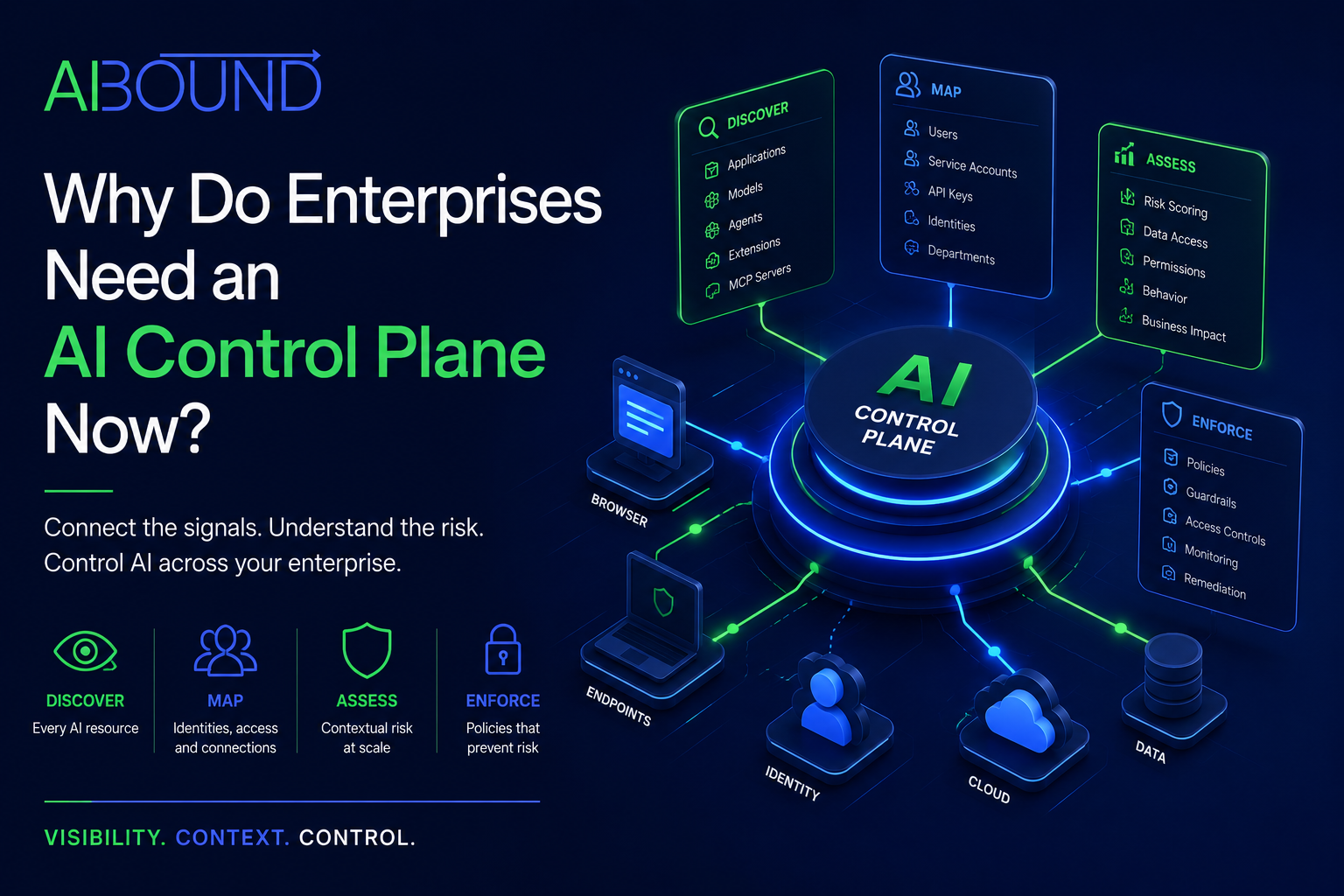
Why Do Enterprises Need an AI Control Plane Now?
Articles
1
min read

Why Do Enterprises Need an AI Control Plane Now?

July 20, 2026
Read more

Most enterprise security teams already own tools for endpoints, browsers, networks, identities, cloud environments, data protection, incident response, and compliance.

Yet many still cannot answer a fundamental question: Which artificial intelligence systems are operating inside the organization, and what are they capable of doing?

The difficulty is not necessarily a lack of telemetry. The information may already exist in endpoint events, DNS records, browser activity, cloud logs, identity platforms, and security alerts.

The problem is fragmentation. One tool may identify an AI application. Another may contain information about the employee, using it. A third may display the service account associated with it. A fourth may know that the associated repository contains sensitive code. Unless those signals are connected, the security team sees isolated events rather than the complete risk.

An AI control plane provides the missing coordination layer. Its purpose is not to replace every existing security tool. It is to connect their signals so the organization can understand and control AI-specific risk.

What Is an AI Control Plane?

An AI control plane is the centralized layer through which an organization can discover AI resources, maintain an enterprise AI inventory, connect AI activity to users and machine identities, map data access and system relationships, evaluate application, model, and agent risk, prioritize remediation, apply AI usage policies, produce governance evidence, monitor changes continuously, and prevent high-risk activity.

The concept is similar to other control-plane architectures in technology. Individual systems continue performing their operational roles, while a central layer provides coordinated policy, visibility, and management.

For enterprise AI, the control plane should span more than applications officially deployed by the organization. It must account for public AI services, embedded SaaS features, local models, coding assistants, agents, extensions, plugins, skills, APIs, and MCP servers.

A useful operational model moves through five connected stages: discover AI, identify its users and identities, map its data and system connections, measure the resulting risk, and prevent dangerous activity. These stages clearly distinguish an AI inventory product from an operational AI security platform.

Why AI Discovery Alone Is Not Enough

Discovery answers, “What is present?” Security also needs to answer who or what is operating it, which credentials it uses, what information it can access, which actions it can perform, what happens if it is manipulated, how large the potential impact is, whether the use complies with policy, and whether the organization can stop it.

An inventory containing hundreds of AI tools does not automatically explain which few require immediate action.

Consider three applications. The first is an unapproved writing assistant used with public marketing content. The second is an approved coding assistant connected to a single test repository. The third is an autonomous development agent using an administrative service account across production repositories.

A discovery-only product may identify all three. A risk-aware AIcontrol plane should reveal that the third has the most dangerous combination of autonomy, permissions, sensitive assets, and potential blast radius.

The New Security Challenge: AI Can Act

The most important change introduced by agentic AI is that the technology may do more than generate text or images.

AI agents can call tools, query databases, modify files, create tickets, send messages, execute code, manage workflows, and interact with other agents. Their effective authority depends on their identities, permissions, plugins, and systems.

This creates a fundamental security question: What is the agent allowed to do, and under whose authority?

Excessive agency can result from excessive functionality, permissions, or autonomy. An AI system may cause harm when it responds incorrectly, follows manipulated instructions, or takes action without sufficient human oversight.

The most effective protections include limiting functionality and permissions, preserving user-context authorization, enforcing least privilege, and requiring human approval for high-impact actions.

A model assessment cannot answer every operational question. The enterprise needs to evaluate the complete chain of identity, access, behavior, and impact.

From AI Resource to Business Impact

An effective AI control plane connects five layers of context.

The first layer is the resource. Security must identify whether the technology is a public application, enterprise copilot, model API, local model, browser extension, coding assistant, autonomous agent, plugin, skill, or MCP server.

The second layer is identity. The organization must determine which employee, service account, API key, cloud role, OAuth application, or machine identity is used to operate the resource. This reveals the authority under which the AI acts.

The third layer is access. Teams need to know which systems, repositories, datasets, applications, tools, and functions the AI can reach. Access may be direct, inherited through a user, or exposed through a connector.

The fourth layer is behavior. Security must understand what the AI is actually doing. Relevant behavior may include reading documents, indexing files, generating code, modifying records, transferring information, invoking external services, or triggering another agent.

The fifth layer is impact. Teams must estimate what could happen if the AI is misused, compromised, manipulated, or incorrectly configured. Potential consequences include information disclosure, unauthorized changes, regulatory exposure, operational disruption, financial loss, and loss of intellectual property.

Without this chain of context, security teams receive alerts without understanding their importance.

Why Existing Security Tools Create an Incomplete Picture

Existing controls remain essential. The challenge is that each sees only part of the AI environment.

Endpoint platforms may detect installed applications, browser extensions, and local processes. They may not understand whether the application is an AI resource, how risky it is, or which cloud systems it can reach.

Network security logs may identify connections to AI domains or APIs. They may not reveal the business purpose, user identity, prompt content, or the application's permissions.

Browser security can identify web applications and extensions, but may have limited visibility into agents operating through cloud workloads or development environments.

Identity systems show users, roles, applications, and authentication events. They may not classify an identity as belonging to an AI agent or understand the model and tools behind it.

Cloud security platforms can reveal AI services, models, workloads, and permissions within a particular environment. They may miss employee use of external applications or AI embedded inside SaaS products.

Data-security products may identify sensitive information movement but may not connect that movement to a specific AI model, agent, plugin, or business use case.

An AI control plane correlates these perspectives. It turns existing telemetry into an AI-specific inventory, relationship map, risk model, and enforcement process.

The Five Operational Functions of an AI Control Plane

1. Continuous Discovery

The control plane should identify new applications, agents, extensions, models, AI services, plugins, skills, and MCP servers as they appear.

Discovery should cover sanctioned and unsanctioned resources. It should also recognize AI functionality that vendors add to applications the organization already uses.

The result should be a continuously updated inventory rather than an annual spreadsheet. Security teams should be able to see which resources are active, where they were detected, which departments use them, whether they have an owner, and whether their use has increased or changed.

2. Identity and Relationship Mapping

Every material AI resource should be connected to human users, machine identities, business departments, data repositories, cloud services, applications, plugins, skills, APIs, MCP servers, and business owners.

Relationship mapping is what reveals dangerous combinations. An agent may appear harmless until security discovers that it operates through a service account with broad repository access. A meeting assistant may appear low risk until it is found retaining confidential transcripts. A browser extension may become critical when it can read internal administrative pages.

The application name alone rarely tells the complete story. Its relationships determine the real exposure.

3. Contextual Risk Scoring

Risk scoring should consider more than vendor reputation. A mature model evaluates security posture, data sensitivity, permissions, identity privileges, autonomy, deployment location, business criticality, regulatory relevance, number of affected users, potential blast radius, known vulnerabilities, policy status, and compensating controls.

Explainable scoring is essential. Security teams, application owners, executives, and auditors should be able to understand why a resource received its rating and which change would reduce the risk.

A coding assistant with read-only access to a test repository may be low risk. The same assistant, connected to production repositories via an administrator account, may be critical.

4. Policy Enforcement

The control plane must turn insight into action. Depending on the context, security teams may approve an application, monitor its use, require enterprise authentication, prevent uploads of sensitive data, restrict access to certain departments, remove unnecessary permissions, disable a plugin, revoke a token, require human approval, block an application, generate a remediation ticket, or escalate an incident.

Enforcement should integrate with the tools the enterprise already uses. Existing browser, endpoint, identity, network, cloud, and workflow controls can often execute the action once the AI control plane has provided the context and decision.

5. Governance and Evidence

Enterprise AI governance requires defensible records. Security and compliance teams may need to demonstrate which AI systems are in use, who owns them, how risks were assessed, which data they process, which controls are applied, when approvals occurred, how incidents were handled, whether high-risk systems are monitored, and how risk has changed over time.

Why MCP Servers, Plugins, and Skills Need Special Attention

The AI ecosystem increasingly relies on connectors that enable models to interact with external tools and data. MCP servers, plugins, and skills can make AI significantly more useful. They can also expand what an assistant can reach and what actions it can perform.

The security issue is not limited to whether the primary AI vendor is trusted. A trusted assistant may load an untrusted connector. That connector may request excessive permissions, contain malicious instructions, expose credentials, or send information to an external system.

Harmful instructions may be expressed in ordinary language rather than conventional code. That can make them difficult for tools designed primarily to identify code-based vulnerabilities.

A control plane should therefore inventory the components inside the AI system, not only the top-level application.

Security teams should ask which connectors are installed, who installed them, what permissions they request, what external services they contact, whether they can access credentials, whether they can modify or export information, whether their instructions are reviewed, whether one compromised component can affect other agents, whether a defined owner exists, and whether access can be revoked centrally.

What High-Risk AI Looks Like in Practice

High-risk AI is defined by context rather than a single product category. Examples include a coding agent with administrative access to production repositories; an HR assistant connected to employee records through an unreviewed MCP server; a public AI application processing customer financial information; a model using credentials shared across departments; an agent able to send payments without human approval; or a plugin that can read and export cloud-storage files.

The underlying risk pattern is consistent. AI becomes more dangerous when it combines broad access, sensitive information, weak ownership, and the ability to act.

How an AI Control Plane Supports Enterprise Leaders

For CISOs

For a CISO, the control plane provides prioritization and defensibility. Instead of reporting only how many AI applications were found, the security team can explain which resources create the greatest exposure, which identities have excessive privileges, which data connections require attention, which high-risk tools were restricted, which risks remain accepted, and whether the organization’s posture is improving.

For CIOs and IT Leaders

CIOs need visibility into adoption, duplication, cost, and business value. A control plane can help identify which departments use AI most heavily, which tools perform similar functions, which applications lack ownership, where enterprise licenses may replace personal accounts, which tools employees repeatedly request, and where Shadow AI reveals an unmet business requirement.

For Privacy, Risk, and Compliance Teams

Privacy and compliance teams need evidence about data processing, ownership, risk classification, and control effectiveness. An AI control plane can provide records showing which applications process personal information, where AI activity occurs, which departments are responsible, what permissions exist, whether assessments were completed, which policies were enforced, and how exceptions were approved.

How to Evaluate an Enterprise AI Control Plane

Begin with discovery coverage. Can the platform identify AI across browsers, endpoints, networks, cloud services, code environments, SaaS applications, and local deployments? Does it recognize applications, models, agents, extensions, plugins, skills, and MCP servers?

Then examine identity context, data, and permission mapping, explainable risk scoring, enforcement capabilities, integrations, deployment effort, governance evidence, and continuous monitoring. These questions help distinguish a complete control plane from a narrow discovery dashboard.

A Practical Implementation Roadmap

The first phase is connecting existing telemetry. Begin with endpoint, browser, network, identity, and cloud sources already available. The immediate objective is to conduct an initial inventory and identify the most obvious high-risk combinations.

The second phase is establishing ownership. Assign owners to important AI resources. Determine why each resource exists, what information it processes, and whether its current access is necessary. Resources without ownership should be subject to additional scrutiny.

The third phase is defining risk thresholds. Create criteria for low, moderate, high, and unacceptable risk. Document which combinations require immediate restriction, such as privileged identities, regulated data, autonomous action, or unreviewed external connectors.

The fourth phase is integrating response workflows. Push findings into the systems security teams already use. Create tickets, notify owners, track exceptions, preserve evidence, and automate repeatable actions where appropriate.

The fifth phase is enabling approved adoption. Publish approved tools, review standards, and request procedures. Use discovery data to understand what employees need and where existing options are inadequate.

The sixth phase is reporting and improving. Track adoption, high-risk activity, remediation times, policy exceptions, and changes in exposure. Use the data to refine policies and identify where the business needs better enablement.

Frequently Asked Questions

Is an AI control plane the same as an AI gateway?

Not necessarily. An AI gateway commonly manages traffic between applications and model providers. It may handle authentication, routing, logging, cost controls, and prompt security. An AI control plane has a broader enterprise role. It identifies AI resources across multiple environments, maps identities and data connections, assesses risk, coordinates governance, and supports enforcement through existing security infrastructure.

Does an AI control plane replace endpoint or network security?

No. It should use and enrich the signals produced by those systems. Endpoint, browser, network, identity, cloud, and data platforms remain important sources for enforcement and telemetry.

Can an AI control plane help with sanctioned AI?

Yes. Approved applications can still become risky when permissions, integrations, data access, or behavior change. The control plane should monitor both sanctioned and unsanctioned resources.

Why is identity important in AI security?

Identity determines authority. It reveals which information and functions the AI can access and whether it acts as an individual, shared account, service account, application, or privileged machine identity.

Should every autonomous agent be classified as high risk?

Not automatically. Risk depends on access, permissions, autonomy, data sensitivity, business impact, and compensating controls. An agent operating in an isolated test environment presents a different risk from one with production administrative access.

How quickly should an organization deploy an AI control plane?

Organizations should begin by connecting the telemetry they already possess and identifying their highest-risk activity. Perfect governance is not required before improving visibility. Early discovery can help define priorities for the broader program.

Conclusion

AI security cannot stop at finding tools.

Enterprises need to understand the identities behind those tools, the systems and data they can reach, the permissions they possess, and the actions they may take. They then need a consistent way to measure risk, enforce decisions, and provide evidence to leadership and regulators.

An AI control plane brings these functions together. It converts fragmented security telemetry into a living inventory. It connects resources to identities and sensitive systems. It distinguishes ordinary AI use from dangerous combinations. It helps security teams act before an exposure becomes an incident.

AIBound was built around this model: discover AI, expose its identities, map its connections, measure the risk, and prevent high-risk activity.

As AI becomes more autonomous and deeply integrated with enterprise systems, this coordinated control layer will become increasingly important. The organizations that establish it early will be better positioned to accelerate AI adoption without losing visibility, accountability, or control.

AI Governance in the Enterprise: A Framework for the Full AI Ecosystem
Articles
1
min read

AI Governance in the Enterprise: A Framework for the Full AI Ecosystem

July 10, 2026
Read more
AI Governance Framework for Enterprise CISOs | AIBound
Articles
1
min read

AI Governance Framework for Enterprise CISOs | AIBound

July 7, 2026
Read more

AI is no longer experimental. It is embedded across enterprise workflows, development environments, and decision-making systems. But while adoption has accelerated, governance has not.

For CISOs, this creates a new mandate: enable AI innovation—without introducing unmanaged risk. This guide outlines a practical AI governance framework designed specifically for security leaders in 2026.

What Is AI Governance?

AI governance is the set of processes, controls, and technologies used to understand where AI is being used, manage risk associated with AI systems, enforce policies on AI usage, and ensure compliance with internal and external standards. Unlike traditional governance, AI governance must account for dynamic and evolving systems, autonomous agents and workflows, and data exposure across multiple environments.

Why Traditional Approaches Fail

Many organizations attempt to apply legacy governance models to AI—and fail. Common pitfalls include: (1) Policy Without Visibility—you can't enforce what you can't see. (2) Manual Processes—AI moves too fast for spreadsheets and audits. (3) Fragmented Tooling—visibility is split across endpoint tools, network tools, and cloud platforms. (4) Reactive Security—most teams discover AI usage after risk has already occurred.

The 5 Pillars of an AI Governance Framework

Pillar 1: AI Discovery & Inventory

Objective: Create a complete inventory of all AI usage across the organization. Key capabilities: discover AI apps, agents, and models; identify where AI is used (browser, endpoint, cloud, code); map users and systems interacting with AI. Outcome: A real-time, continuously updated AI inventory.

Pillar 2: AI Visibility & Context

Objective: Understand how AI interacts with your environment. Key capabilities: track data access and movement, monitor permissions and integrations, map relationships between AI systems and business assets. Outcome: Full visibility into AI behavior and impact.

Pillar 3: Risk Assessment & Scoring

Objective: Determine which AI usage is safe—and which is not. Key capabilities: evaluate security posture of AI tools, assess data exposure risk, understand business impact. Outcome: Actionable risk scores that prioritize what matters.

Pillar 4: Policy Enforcement & Controls

Objective: Control AI usage in real time. Key capabilities: allow, restrict, or block AI tools; enforce data usage policies; apply controls dynamically based on context. Outcome: Real-time enforcement of AI governance policies.

Pillar 5: Continuous Monitoring & Reporting

Objective: Maintain ongoing governance as AI evolves. Key capabilities: monitor AI usage continuously, detect new risks as they emerge, generate audit-ready reports. Outcome: Sustained governance aligned with business and regulatory needs.

How the Framework Works Together

These pillars are not independent—they form a continuous loop: Discover → Understand → Assess → Control → Monitor → Repeat. Governance is not a one-time effort—it's an ongoing system.

Mapping to Industry Frameworks

This approach aligns with emerging standards including the NIST AI Risk Management Framework (AI RMF), ISO/IEC AI governance standards, and enterprise risk management practices. However, most frameworks define what to do, not how to do it. This is where operational platforms become essential.

Key Challenges CISOs Must Solve

Four challenges define the AI governance landscape today:

(1) Shadow AI—unauthorized AI usage across the organization.

(2) AI Agent Risk—autonomous systems interacting with critical infrastructure.

(3) Data Exposure—sensitive data flowing into AI models.

(4) Lack of Visibility—no centralized understanding of AI usage.

From Governance to Control

AI governance is not just about policies—it's about execution. Leading organizations are shifting from static policies to dynamic controls, from periodic audits to real-time monitoring, and from fragmented tools to unified platforms. The goal is to move from awareness to control.

How AIBound Enables AI Governance

AIBound was built to operationalize AI governance for security teams. With AIBound, CISOs can: Discover—identify every AI app, agent, and model and build a complete AI inventory. Understand—see how AI interacts with data and systems and map relationships across environments. Assess—score risk automatically using Nucleus AI and prioritize high-impact exposures. Control—enforce policies in real time, block, allow, or coach users. Report—generate executive-ready insights and support compliance and audits. All from a single AI Control Plane.

Key Takeaways

AI governance is now a core responsibility for CISOs. Traditional governance models are insufficient for AI. Effective governance requires visibility, automation, and control. The five-pillar framework provides a practical approach. Organizations must move from policy to enforcement.

Ready to Operationalize AI Governance?

If you're looking to build or mature your AI governance framework, AIBound is the platform security teams trust to go from shadow AI to managed AI—in under 24 hours. Visit aibound.com or book a demo to see AIBound in action.

Shadow AI Statistics for 2026 | What Every CISO Should Know
Articles
1
min read

Shadow AI Statistics for 2026 | What Every CISO Should Know

July 3, 2026
Read more

AI adoption is exploding across enterprises—but much of it is happening outside the view of security teams. This growing phenomenon, known as shadow AI, is quickly becoming one of the most critical risks organizations face in 2026.

Below are the most important shadow AI statistics every CISO, CIO, and security leader should understand—along with what they mean for your organization.

Key Shadow AI Statistics (2026)

1. 78% of Employees Use Unapproved AI Tools

The majority of employees are already using AI tools without formal approval. AI tools are being adopted bottom-up, not top-down. Employees prioritize productivity over policy. Security teams often discover usage after the fact. What it means: Shadow AI is no longer an edge case—it's the default.

2. AI Usage Has Grown Over 60% Year-Over-Year

Enterprise AI adoption is accelerating rapidly. New AI tools and agents are emerging daily, AI is being embedded into existing workflows, and adoption is happening across every business function. What it means: Your attack surface is expanding faster than traditional controls can keep up.

3. 1 in 3 AI Interactions Involve Sensitive Data

A significant portion of AI usage involves customer data, internal documents, proprietary code, and financial or strategic information. What it means: Shadow AI is not just usage—it's data exposure risk.

4. Over 50% of Organizations Have No AI Visibility

Most enterprises cannot answer basic questions: What AI tools are being used? Who is using them? What data is being shared? What it means: Security teams are operating without visibility into one of the fastest-growing risk areas.

5. Thousands of AI Tools Are in Use Across Enterprises

Organizations are not dealing with a handful of tools—they're dealing with hundreds to thousands of AI apps, AI agents operating across workflows, and AI embedded in SaaS platforms. What it means: Manual tracking is impossible. AI inventory must be automated.

6. AI Agents Are the Fastest-Growing Risk Surface

Beyond tools, organizations are now seeing autonomous AI agents, API-connected AI workflows, and AI systems making decisions and taking actions. What it means: Shadow AI is evolving into shadow autonomy.

7. Detection Lag Can Be Weeks or Months

In many organizations, AI usage is discovered long after it begins, security reviews happen retroactively, and policies are applied too late. What it means: Real-time detection is becoming essential.

8. Traditional Security Tools Miss Most AI Activity

Legacy tools were not built for AI: SIEMs lack AI-specific context, CASBs don't identify AI behavior deeply, and endpoint tools miss browser-based AI usage. What it means: New approaches to AI security are required.

Why Shadow AI Is Growing So Fast

The data tells a clear story—but why is this happening? First, AI delivers immediate value—employees see instant productivity gains. Second, barriers to entry are low: most AI tools are free, easy to access, and require no installation. Third, governance is lagging adoption—organizations are still defining policies, understanding risks, and building frameworks. The result: usage outpaces control.

The Real Risk Behind the Numbers

These statistics are not just trends—they represent real business risk: data leakage into AI models, unauthorized integrations with internal systems, compliance violations (GDPR, HIPAA, etc.), and untracked decision-making by AI systems. Shadow AI is not just an IT issue—it's a board-level concern.

What CISOs Need to Do in 2026

Based on these trends, leading security teams are focusing on five priorities: (1) AI Visibility First—you cannot secure what you cannot see. (2) Build a Complete AI Inventory—track every app, agent, and model. (3) Monitor AI Usage Continuously with real-time, automated, context-aware detection. (4) Implement Policy Enforcement—move beyond detection to allow, restrict, or block. (5) Align AI Governance with Business Risk, focusing on data exposure, operational impact, and regulatory compliance.

How AIBound Helps Address Shadow AI

AIBound is built to address exactly these challenges. With AIBound, organizations can discover every AI app, agent, and model in real time; build a complete AI inventory across all environments; understand how AI tools interact with data and systems; score risk automatically using the Nucleus AI engine; and enforce policies instantly—block, allow, or coach users. AIBound turns shadow AI from an unknown risk into a managed system.

Final Takeaways

Shadow AI is now widespread across enterprises. Most organizations lack visibility into AI usage. AI adoption is accelerating faster than governance. Traditional tools are not designed for AI risk. CISOs must move from detection to real-time control.

Want to Understand Your Shadow AI Exposure?

See how AIBound helps you detect shadow AI in real time, build your complete AI inventory, and enforce AI policies instantly. Visit aibound.com to get your AI inventory in under 24 hours—no agents, no network taps, no disruption.

How to Detect Shadow AI in Your Organization | AIBound
Articles
1
min read

How to Detect Shadow AI in Your Organization | AIBound

June 26, 2026
Read more

AI adoption is accelerating faster than any technology shift in the past decade. But with that speed comes a new and rapidly growing risk: shadow AI.

Employees are using AI tools, agents, and models—often without approval, visibility, or security controls. For CISOs and security teams, the challenge is clear: You can't secure what you can't see.

In this guide, we'll break down exactly how to detect shadow AI across your organization—and how leading security teams are staying ahead of it in 2026.

What Is Shadow AI?

Shadow AI refers to any AI tool, application, agent, or model used within your organization without security or IT approval.

This includes: employees using ChatGPT, Claude, or other AI tools in browsers; AI agents connected to internal systems; developer use of AI copilots or APIs without governance; and unauthorized AI integrations in SaaS platforms.

Unlike shadow IT, shadow AI is more dangerous because it interacts with sensitive data, can autonomously take actions, and evolves quickly and unpredictably.

Why Detecting Shadow AI Is So Difficult

Traditional security tools were not built for AI. Here's why shadow AI detection is challenging:

1. AI usage is fragmented. AI tools span browsers, endpoints, cloud environments, and developer tools. There's no single control point.

2. AI traffic looks like normal traffic. AI usage often blends into HTTPS traffic, SaaS applications, and API calls—making it hard to distinguish from legitimate activity.

3. New tools appear daily. Thousands of AI tools and agents are emerging rapidly. Static allow/block lists can't keep up.

How to Detect Shadow AI (Step-by-Step)

Step 1: Monitor Browser Activity

Most shadow AI starts in the browser. Look for usage of AI tools (ChatGPT, Gemini, Claude, etc.), AI browser extensions, and copy/paste behavior involving sensitive data. Browser visibility is your first detection layer.

Step 2: Analyze Endpoint Telemetry

Endpoints reveal installed AI applications, local LLM usage, and developer tools using AI. Key signals include unknown processes, AI-related binaries, and API calls to model providers.

Step 3: Inspect Network Traffic

AI usage often leaves network traces: requests to AI APIs (OpenAI, Anthropic, etc.), traffic to AI SaaS platforms, and data exfiltration patterns. Use network logs to identify high-frequency API calls and large data transfers to AI endpoints.

Step 4: Audit SaaS and Cloud Integrations

Shadow AI is increasingly embedded in SaaS tools. Look for AI plugins and integrations, automated workflows using AI, and AI-powered features enabled without approval.

Step 5: Build a Complete AI Inventory

This is the most critical step. You need to discover all AI apps, agents, and models; map where they exist (endpoint, cloud, browser); and understand who is using them. This becomes your AI inventory—the foundation of AI security.

What Modern Shadow AI Detection Looks Like

Leading organizations are moving beyond fragmented detection methods toward a unified approach that includes centralized AI visibility (a single view of all AI tools, users, and environments), real-time discovery, contextual risk analysis, and continuous automated monitoring.

From Detection to Control

Detection is only the first step. Once shadow AI is identified, security teams need to assess risk (Is this safe?), enforce policy (Allow, restrict, or block), and guide users through education and coaching. This is where organizations move from reactive security to proactive AI governance.

The Future of Shadow AI Detection

In 2026 and beyond, shadow AI detection is evolving into AI Security Control Planes—platforms that discover every AI asset, map relationships across systems, score risk automatically, and enforce policies in real time. This shift is critical as AI becomes embedded across every layer of the enterprise.

How AIBound Helps Detect Shadow AI

AIBound was built specifically to solve this problem. With AIBound, security teams can discover every AI app, agent, and model in real time; build a complete AI inventory across browser, endpoint, network, and cloud; understand what each AI tool accesses and touches; score risk automatically using the Nucleus AI engine; and prevent unauthorized AI usage instantly—all from a single AI Control Plane.

Key Takeaways

Shadow AI is one of the fastest-growing enterprise risks in 2026. Traditional tools can't detect AI usage effectively. Detection requires visibility across browser, endpoint, network, and cloud. AI inventory is the foundation of AI security. Organizations must move from detection to real-time control.

Ready to See It in Action?

If you want to understand how shadow AI exists in your environment today, AIBound can show you—in under 24 hours, with no agents, no network taps, and no disruption. Book a demo to get your complete AI inventory now.

Agentic AI in Security Operations | AIBound
Articles
1
min read

Agentic AI in Security Operations | AIBound

June 12, 2026
Read more

Agentic AI is no longer on the horizon for enterprise security teams, it is already inside the building. According to the Cyber Security Tribe Annual Report, 73% of organizations are already using or developing agentic AI within cybersecurity, up from 59% the prior year. The conversation has shifted from "should we?" to "how far should we go?"​

That's a harder question. And it's exactly the one Cyber Security Tribe put to senior security leaders at RSAC 2026. AIBound CEO and co-founder Niall Browne was among the experts who responded — and his perspective cuts to the heart of what makes agentic AI both a force multiplier and a governance challenge at the same time.

The Trajectory Is Clear, and Irreversible

Niall's starting point is direct: the 73% of organizations using agentic AI today will become 100%. This isn't speculation — it's the natural trajectory of where enterprise software is headed. Just as the average smartphone user now runs close to 80 apps, every employee will soon operate alongside a comparable number of AI agents. The capability is coming regardless of whether security teams are ready for it.​

That reality creates both enormous opportunity and genuine risk. Agents are, by their very nature, autonomous and nondeterministic. As Niall notes, "you are never entirely sure what you will get." The question isn't whether to adopt agentic AI — it's whether your organization has the controls in place to govern it responsibly as adoption accelerates.​

The Right Access. The Right Guardrails. The Right Balance.

The governance challenge Niall articulates is not a binary one. You want agents to have the right access, data, and identities to do their jobs effectively — but you need guardrails that prevent them from acting beyond their remit. Getting that balance wrong in either direction is costly: over-restrict agents and you lose the operational efficiency gains; under-restrict them and you introduce cascading risk into your environment.​

Absolute technical security controls for AI don't yet exist, and waiting for a perfect solution isn't a viable strategy. The practical path forward is smart, adaptive governance: scoped identities with least-privilege access, runtime behavioral monitoring, and human-in-the-loop checkpoints for high-risk actions. Organizations that build these guardrails now — rather than waiting — will be the ones who can safely accelerate as agentic capability matures.​

This is exactly the problem AIBound was designed to solve. The AI Control Plane gives security teams the visibility and enforcement layer they need to govern agent identities, monitor runtime behavior, and enforce policy boundaries — making it possible to say yes to agentic AI without losing control of it.

Where Agents Belong — and Where They Don't

Niall draws a clear line between use cases where agentic autonomy creates strategic advantage and those where it introduces unacceptable risk:​

High-value, lower-risk use cases:

  • SOC triage — high-volume, pattern-driven work that benefits from machine speed and consistency
  • Threat hunting — continuous analysis across large data surfaces where agents outperform human analysts on volume
  • Automated vulnerability scanning — repeatable, structured work with well-understood decision criteria

High-risk use cases requiring human oversight:

  • Autonomous access revocation — wrong decisions can lock out legitimate users at critical moments
  • Production infrastructure changes — errors can propagate faster than any human can intervene
  • Any action that is difficult to reverse — when the blast radius of a mistake is large, human judgment must stay in the loop

This framework aligns closely with what security leaders across the Cyber Security Tribe article consistently described: the line isn't "AI can do this" versus "AI can't do this" — it's between decisions where being wrong is recoverable and decisions where being wrong creates cascading damage.

Perfection Is the Enemy of Good

Perhaps the most important message in Niall's perspective: don't let the absence of a perfect solution become a reason to delay governance. The risk of inaction is just as real as the risk of moving too fast.

Organizations that build their AI governance framework incrementally — starting with scoped identities, behavioral monitoring, and clear escalation paths — are far better positioned than those waiting for a comprehensive solution that may never fully arrive. Every agent deployed without governance is a risk that compounds as the number of agents grows.

What This Means for Your Security Program

The organizations that will get the most from agentic AI are the ones that treat governance as a prerequisite, not an afterthought. That means:

  • Establishing agent identity infrastructure before scale — every agent needs its own scoped identity with least-privilege access, not borrowed credentials from a human user
  • Instrumenting runtime behavior so you know what agents are actually doing, not just what they were designed to do
  • Drawing explicit lines between autonomous actions and those that require human confirmation, and enforcing those lines through policy
  • Measuring outcomes continuously — agentic AI should be held to the same accountability standards as any other security control

Agentic AI is one of the most consequential capability shifts in enterprise security in years. Getting the governance right now — while adoption is still accelerating — is the difference between a strategic advantage and a systemic liability.

AIBound is the AI Control Plane for enterprise security teams — providing the visibility, governance, and enforcement needed to deploy AI agents safely at scale. Learn more →

Read the full Cyber Security Tribe article →

AI as a Force Multiplier for Security Hiring | AIBound
Articles
1
min read

AI as a Force Multiplier for Security Hiring | AIBound

June 12, 2026
Read more

Every CISO has been in that room. You've mapped the gaps, you know where the exposure is, and you have a clear-eyed view of what an additional hire would do for your program. Then the CFO pushes back — not because they don't believe the risk is real, but because they want to know one thing first: have you tried doing this with AI?

That question isn't going away. And according to AIBound CEO and co-founder Niall Browne, security leaders who haven't yet built their answer to it are walking into budget conversations underprepared.

Niall was recently featured in a Cyber Security Tribe article "Making the Business Case for Security Hiring" alongside senior security leaders from Zenity, Sumo Logic, Aviatrix, Checkmarx, and Nile. The piece, grounded in data from the Cyber Security Tribe Annual Report (455 practitioners surveyed, December 2025–January 2026), tackled one of the clearest workforce signals from that research: budget restrictions are now the #1 obstacle to security hiring.

Here's what Niall had to say — and why it matters for how your team thinks about building out security capability in 2026.

The CFO Has Changed the Question

The traditional pitch "we need more headcount to reduce risk" has stopped landing the way it used to. That's not because CFOs are ignoring risk. It's because the calculus has changed.

As Niall put it:

"The old adage of 'risk minus new headcount equals reduced risk' is no longer the answer the CFO is looking for. Today, before approving even one additional hire, every CFO will ask: how can we augment that headcount with AI so the company becomes more efficient?"

This is the new baseline expectation in every board and finance conversation. Security leaders who come in asking for headcount without first demonstrating AI-driven efficiency are, in effect, leaving budget on the table, or worse, losing the argument entirely.

Reframe the Ask: Force Multiplication, Not Headcount

The shift Niall is advocating isn't about accepting understaffed security teams as the new normal. It's about reframing what a security investment actually looks like.

Instead of "we need three analysts," the pitch becomes: "here's how one analyst, paired with the right AI platform, delivers the output you'd expect from three."

That means presenting budget requests that tie people to AI-driven capability - automated playbooks, intelligent alert correlation, AI-integrated SDLC tooling, and AI copilots for triage. The business case becomes concrete and measurable rather than abstract.

Teams already deploying AI copilots for alert triage are reporting 80% reductions in mean time to triage, the equivalent of adding four FTEs without a single new hire. That's the kind of number that moves a CFO.

Where AIBound Fits

This is the problem AIBound was built to solve — not by replacing your security team, but by giving them the AI control plane they need to operate with precision and scale.

When security leaders can demonstrate to the board that their team has visibility into every AI asset, automated enforcement of governance policies, and measurable reduction in alert noise and response time, the hiring conversation changes. They're no longer asking for more bodies to cover gaps. They're showing a program that's already operating efficiently  and making the case for strategic, targeted investment to go further.

The CFO doesn't want to hear that more people reduce risk. They want to see that the team is maximizing every available efficiency first. AIBound gives security leaders the data and the platform to make that case credibly.

The Bottom Line

The security workforce challenge is real, and budget constraints aren't disappearing. But the leaders who will win these budget conversations in 2026 are the ones who walk in with a different kind of business case , one built around force multiplication, measurable outcomes, and AI as an integrated part of the security operating model.

Niall Browne's perspective in the Cyber Security Tribe article is a sharp articulation of that shift. We'd encourage any CISO preparing for their next board conversation to read it in full.

Read the full Cyber Security Tribe article →

AIBound is the AI Control Plane for enterprise security teams giving organizations the visibility, governance, and enforcement they need to deploy AI safely at scale. Learn more →

Shadow AI vs Shadow IT | Browser & Endpoint Risk
Articles
1
min read

Shadow AI vs Shadow IT | Browser & Endpoint Risk

May 29, 2026
Read more

For the past two decades, security leaders have battled a familiar adversary: Shadow IT.

Employees adopted SaaS tools faster than IT could govern them. Marketing spun up new analytics platforms. Developers deployed cloud services outside approved workflows. Security teams responded with CASB tools, SaaS governance platforms, and cloud security posture management.

But today, a new — and far more complex — version of Shadow IT has emerged.

Shadow AI

Unlike the SaaS tools of the past, AI tools are appearing across every surface of the enterprise simultaneously: browsers, IDEs, copilots, extensions, agents, APIs, and internal models. Many of these tools connect directly to enterprise data and systems.

And most security teams have little to no visibility into how they are being used.

The AI Explosion Inside the Enterprise

AI adoption inside organizations is happening faster than any previous technology wave. Developers are integrating large language models into applications. Employees are using copilots to generate content and analyze data. Teams are experimenting with AI-powered automation and agents.

This innovation is incredibly powerful. But it also creates a reality security leaders are starting to confront: AI is already everywhere inside the enterprise — whether security teams can see it or not.

Consider how AI typically enters an organization today: a developer integrates an LLM API into an internal service; a sales team installs an AI Chrome extension to summarize emails; a product manager uses an AI research assistant to analyze documents; an engineer deploys an AI agent to automate support workflows; a team experiments with internal models connected to sensitive data.

Individually, each action seems harmless. But collectively, they create a rapidly expanding AI ecosystem that is difficult to track, govern, or secure.

Why Shadow AI Is Harder Than Shadow IT

Shadow IT was primarily a SaaS governance problem. Security teams needed visibility into which cloud applications were being used and what data they accessed.

Shadow AI is fundamentally different. AI tools often operate across multiple layers simultaneously.

1. Browser Extensions and Desktop Apps

AI assistants now live directly in the browser — summarization tools, email copilots, AI research assistants, and productivity copilots. These tools can access emails, documents, CRM data, and customer records. In many cases, these integrations happen without security review.

2. Developer Tools and IDE Copilots

AI development assistants are rapidly becoming standard in engineering teams. These tools can access source code, internal APIs, proprietary models, and infrastructure configurations.

3. AI Agents and Automation

The next wave of AI adoption involves autonomous AI agents. These systems can access internal tools, interact with APIs, retrieve enterprise data, and trigger workflows. An AI agent connected to internal systems can quickly become a privileged digital identity inside the organization.

4. Internal Models and AI Services

Organizations are increasingly deploying internal AI models in cloud platforms, internal infrastructure, data science pipelines, and AI experimentation environments. Security teams often discover these models only after they are already in production.

The Real Risk: AI + Data + Access

The biggest risk from Shadow AI isn't simply the presence of AI tools. It's the interaction between AI systems and sensitive enterprise data.

A typical risky scenario: an employee installs an AI extension, it accesses internal documents, sensitive customer information is included in prompts, and data is transmitted to an external AI provider. In many organizations, this interaction happens thousands of times per day.

This combination creates what security teams call toxic combinations: AI systems interacting with sensitive data, identities, and infrastructure in ways that were never intentionally designed.

Why Most Security Tools Can't See AI Risk

Traditional security platforms were not designed for AI ecosystems. EDR covers endpoints. CASB covers SaaS. CSPM covers cloud infrastructure. AppSec covers application vulnerabilities.

AI systems operate across all of these environments simultaneously. A single AI workflow might involve a browser extension, an external model provider, internal APIs, enterprise data, and cloud infrastructure. Security teams may see fragments of this activity in different tools — but they rarely see the full picture.

The Three Questions CISOs Are Now Asking

1. What AI exists inside our organization? This includes models, agents, extensions, APIs, and internal AI services. Many organizations discover hundreds or thousands of AI assets once they begin investigating.

2. What data and systems can these AI tools access? A model connected to public data may present minimal risk. A model connected to customer data or financial systems may present a major exposure.

3. Which AI risks actually matter? Security teams already face alert overload. What CISOs need is prioritization based on real business risk, not just technical vulnerabilities.

A New Approach to AI Security

To manage Shadow AI effectively, organizations need to discover AI everywhere — models, agents, extensions, and AI-enabled services across code, cloud infrastructure, enterprise tools, and developer environments.

They must map the AI ecosystem, understanding relationships between models, data sources, APIs, identities, and infrastructure. Without this visibility, it's impossible to understand attack paths or exposure chains.

And they must prioritize real risk. The most dangerous scenarios typically involve toxic combinations of sensitive data, privileged identities, exposed interfaces, and vulnerable dependencies.

The Future of Security Is AI Ecosystem Security

Organizations are no longer securing only infrastructure, applications, and endpoints. They must now secure entire AI ecosystems — models, agents, data pipelines, APIs, identities, and automation systems.

AI innovation is moving fast. Security cannot afford to slow it down — but it also cannot afford to operate blindly. The organizations that succeed will be those that gain visibility into how AI actually operates across their enterprise.

Because the first step to controlling AI risk is simple: you must first be able to see it.

Enterprise AI Telemetry and Risk Insights | AIBound
Articles
1
min read

Enterprise AI Telemetry and Risk Insights | AIBound

May 22, 2026
Read more

AI adoption inside the enterprise is accelerating at a pace few security teams expected.

In the past year alone, organizations have introduced AI tools across nearly every function: software development, marketing, customer support, finance, and operations. From large language model APIs to AI-powered copilots and autonomous agents, the enterprise technology stack is quickly becoming an AI ecosystem.

But for security leaders, one question remains difficult to answer: How is AI actually being used inside our organization?

AI Adoption Is Happening Faster Than Governance

Most organizations did not plan for the speed of AI adoption. Unlike traditional enterprise software, AI tools are often introduced bottom-up.

Developers experiment with new model APIs. Teams install AI browser extensions. Business units adopt AI copilots for productivity. Many of these tools can be deployed in minutes. Security reviews, governance policies, and architecture reviews rarely move that fast.

The result is an environment where AI adoption spreads organically across the organization, often without centralized oversight.

What Enterprise AI Telemetry Shows

When organizations begin mapping their AI usage, several patterns quickly emerge.

1. The Number of AI Tools Is Much Higher Than Expected

Most security teams initially assume their organization uses a small number of AI platforms. In reality, once discovery begins, organizations commonly uncover dozens of AI browser extensions, multiple LLM APIs used by developers, internal AI models running in experimentation environments, and AI-powered SaaS tools embedded in existing platforms.

In some enterprises, security teams discover hundreds of AI-enabled services interacting with enterprise systems.

2. AI Usage Is Distributed Across the Entire Organization

AI is not confined to engineering teams. Marketing teams use AI to generate campaigns. Customer support teams deploy AI assistants. Sales teams use AI tools to research accounts. Operations teams use AI to automate workflows.

Each use case introduces new AI systems interacting with enterprise data. From a security perspective, this creates a challenge: AI adoption is decentralized.

3. AI Identities Are Growing Rapidly

One of the most overlooked aspects of enterprise AI adoption is the rise of non-human identities. AI agents accessing internal APIs, models querying enterprise databases, and automation systems triggering workflows — each represents a digital identity operating inside the organization.

In many environments, these AI identities accumulate permissions over time, often without the same governance applied to human accounts.

4. Sensitive Data Is Frequently Involved

Another common discovery is the frequency with which AI tools interact with sensitive enterprise data — internal documents, customer records, financial data, intellectual property, and product roadmaps.

Many employees use AI tools to summarize documents, generate reports, or analyze datasets. In some cases, this data is transmitted to external AI services without clear visibility.

The Gap Between Visibility and Action

Discovering AI usage is only the first step. The real challenge is: which of these risks actually matter?

Large enterprises may identify thousands of AI-related findings — exposed model endpoints, unapproved AI tools, vulnerable dependencies, data access risks, identity misconfigurations. If every issue receives equal priority, security teams quickly become overwhelmed.

This is the same problem organizations faced during the early days of cloud security. Thousands of alerts were generated — but few were tied to real business impact.

Why AI Security Requires Context

Not every AI system represents the same level of risk. A chatbot analyzing public marketing data presents a very different risk profile than an AI system connected to production customer records.

Understanding AI risk requires evaluating what data the system can access, what permissions it has, where it runs, whether it is exposed externally, and how it connects to other systems. The most dangerous scenarios involve combinations of conditions — what security teams call toxic combinations.

Turning AI Telemetry Into Risk Intelligence

Organizations need to discover AI assets — models, agents, and AI-enabled tools across code repositories, developer environments, cloud infrastructure, SaaS applications, and employee endpoints.

They must map relationships between models, data sources, APIs, identities, and infrastructure. A model connected to sensitive data may be safe if it operates within a secure environment. But if that same model also has internet exposure, weak authentication, and privileged access, the risk profile changes dramatically.

And they must score risk in business context — evaluating data sensitivity, identity permissions, exposure level, regulatory implications, and operational dependencies.

Moving From Awareness to Control

AI will continue transforming how organizations operate. Security teams cannot — and should not — attempt to stop this innovation.

But they must ensure that AI adoption occurs with visibility, governance, and control. The organizations that succeed will be those that move beyond basic discovery and develop the ability to understand how AI systems interact with enterprise data, prioritize risks based on real business context, and enable AI innovation while maintaining security discipline.

In other words, they will move from telemetry to action.

MCP Servers and Browser Extensions as AI Risks | AIBound
Articles
1
min read

MCP Servers and Browser Extensions as AI Risks | AIBound

May 15, 2026
Read more

The Rise of AI Agents

Enterprise AI adoption is entering a new phase. The first wave focused on chat interfaces and copilots. But a second wave is now emerging: AI systems that act on behalf of humans.

These systems take the form of AI agents that automate workflows, browser extensions that embed AI into daily work, MCP servers that connect models to enterprise systems, and AI-powered automation frameworks.

Together, these technologies are quietly creating a new enterprise attack surface — one that most security stacks were never designed to monitor.

Unlike traditional scripts or bots, AI agents can interpret instructions, reason through tasks, and interact with multiple systems. They retrieve information from internal databases, query APIs, update records in SaaS systems, analyze documents, and trigger operational workflows. An AI agent with access to internal systems effectively becomes a new digital identity inside the organization.

Introducing MCP: The New Connectivity Layer for AI

A growing number of AI systems are now using Model Context Protocol (MCP) to connect models with tools and data sources. MCP allows AI models to interact with external systems in a standardized way.

Instead of building custom integrations for every tool, developers can expose enterprise services through MCP servers. These servers can provide access to internal APIs, databases, SaaS platforms, file storage systems, and automation workflows.

From the model's perspective, these systems become available tools. From a security perspective, MCP creates a powerful — but potentially risky — connectivity layer.

MCP Servers: The New AI Infrastructure

In many organizations, MCP servers are now emerging as a critical part of the AI infrastructure stack. They function as intermediaries between AI systems and enterprise resources.

A typical architecture: an AI agent receives a request, the model determines which tools are needed, it interacts with MCP servers to access those tools, and the MCP server retrieves data or triggers actions in enterprise systems.

This architecture is powerful because it enables models to interact dynamically with the enterprise environment. But if MCP servers are misconfigured, an AI system may gain access to resources far beyond what developers originally intended.

The Overlooked Role of Browser Extensions

At the same time that AI agents and MCP servers are expanding automation capabilities, another AI surface is quietly growing: AI browser extensions.

Employees are increasingly installing AI-powered extensions that summarize emails, analyze documents, draft responses, research topics, and extract insights from web content. These tools often request permissions such as reading page content, accessing browser data, and interacting with enterprise SaaS platforms.

In many organizations, these extensions are deployed without security review.

When These Systems Combine

Individually, AI agents, MCP servers, and browser extensions may appear manageable. The real complexity arises when these systems interact.

Consider a typical workflow: a user installs an AI browser extension, the extension connects to an AI agent platform, the agent uses MCP servers to access enterprise systems, and data from internal tools is retrieved and processed by external models.

At each step, new permissions and connections are introduced. Without proper visibility, security teams cannot answer which AI agents exist, what tools they can access, which MCP servers connect to enterprise systems, or what data is flowing through these workflows.

Why Traditional Security Tools Miss This

Most enterprise security tools were built for earlier technology models — monitoring endpoints, applications, cloud infrastructure, and SaaS platforms. AI ecosystems do not fit neatly into these categories.

An AI agent may run in a cloud container, connect to an MCP server in a developer environment, interact with SaaS APIs and enterprise databases, while employees interact with it through browser extensions. Each component may appear in a different security tool, but no single platform sees the entire AI workflow.

The Real Risk: Privileged AI Systems

The most significant risks involve privileged AI systems — agents that can retrieve sensitive information, modify enterprise data, trigger operational workflows, and interact with infrastructure services.

If that agent also connects to external model providers, the organization may have limited visibility into how information is processed. Similarly, MCP servers may expose internal capabilities never intended to be accessible through AI systems.

Securing the AI Attack Surface

Organizations must discover AI resources — models, agents, MCP servers, extensions, and AI-enabled applications across both code and cloud environments.

They must map the AI ecosystem, understanding how agents interact with MCP servers, how models access enterprise data, how extensions connect to AI services, and how identities control access to AI workflows.

And they must prioritize high-risk combinations — AI agents with privileged access, MCP servers exposed to the internet, models connected to sensitive datasets, and vulnerable dependencies in AI services.

The enterprise attack surface is expanding beyond traditional applications and infrastructure. Security leaders must begin viewing these systems as first-class components of their security architecture. Because in the age of AI-driven automation, the question is no longer simply 'What software is running in our environment?' It is: 'What autonomous systems are acting inside our enterprise?'

How to Govern AI Without Slowing the Business | AIBound
Articles
1
min read

How to Govern AI Without Slowing the Business | AIBound

May 8, 2026
Read more

Artificial intelligence is moving into the enterprise faster than almost any technology before it. Developers are integrating models into applications. Business teams are adopting AI assistants. Autonomous agents are beginning to automate workflows.

Across industries, leaders are asking the same question: How do we secure AI without slowing down innovation?

Blocking AI adoption is not realistic. Employees will continue experimenting with new tools, and developers will continue building AI-powered systems. The challenge for CISOs is not stopping AI. It is governing it intelligently.

Why Traditional Governance Models Fail

Most enterprise governance models were designed for technologies that evolve slowly. New systems were introduced through formal procurement processes, architecture reviews, and deployment approvals.

AI adoption doesn't follow that pattern. Today, AI tools can appear through browser extensions, SaaS platforms, developer frameworks, APIs, and AI agents. Many can be deployed in minutes while security review cycles take weeks.

By the time governance processes begin, AI systems may already be embedded in operational workflows.

The CISO's New Role in the Age of AI

Historically, security leaders were seen as gatekeepers. In the AI era, this model no longer works. Innovation is happening too quickly and too broadly.

Instead of acting as gatekeepers, CISOs must evolve into strategic enablers of safe AI adoption — helping organizations answer: Where is AI being used? What risks does it introduce? How do we manage those risks without slowing the business?

A Five-Step Framework for AI Governance

Organizations that successfully manage AI risk typically follow a governance model built around five core capabilities.

Step 1: Discover AI Across the Enterprise

The first step in governing AI is simple: you must know where AI exists. This includes identifying AI usage across developer environments, cloud infrastructure, SaaS platforms, employee endpoints, internal AI services, and external AI APIs.

In many organizations, this discovery process reveals far more AI activity than expected — dozens of AI-enabled SaaS tools, internal model experimentation environments, AI-powered browser extensions, and agents connected to internal APIs.

Without this visibility, governance is impossible. You cannot secure what you cannot see.

Step 2: Understand AI Access to Data and Systems

Once AI assets are identified, the next step is understanding what they can access — internal documents, enterprise databases, SaaS applications, APIs, cloud infrastructure, and automation systems.

Understanding these relationships helps answer: Which AI systems can access sensitive data? Which AI identities have privileged permissions? Which systems interact with external model providers?

Step 3: Map the AI Ecosystem

AI systems rarely operate in isolation. A single AI workflow may involve a model, a data source, an API, an automation service, and an identity controlling access.

A model connected to a database may appear safe on its own. But if that same model is exposed through an API and accessed by an external agent, the risk profile changes significantly. Mapping these relationships creates a clearer picture of the AI ecosystem.

Step 4: Prioritize Real Business Risk

Not every AI issue requires immediate attention. Security teams must prioritize AI risks based on business context — data sensitivity, identity permissions, internet exposure, regulatory requirements, and operational impact.

The most dangerous scenarios often involve toxic combinations: AI systems with privileged access to sensitive data, exposed model endpoints connected to internal resources, vulnerable dependencies in AI workloads, and automation agents interacting with production systems.

Step 5: Apply Guardrails Without Blocking Innovation

Once high-priority risks are identified, organizations must implement appropriate controls that enable safe AI usage rather than restrict innovation.

Policy controls define approved AI tools, data usage guidelines, and access permissions. Technical guardrails include monitoring AI usage, enforcing identity permissions, restricting access to sensitive datasets, and auditing AI interactions.

And continuous monitoring ensures governance remains effective as new models, tools, and integrations appear.

The Goal: Enable Safe AI Innovation

The purpose of AI governance is not to slow progress. It is to enable organizations to adopt AI confidently.

Companies that successfully implement these practices reduce the risk of data exposure, provide leadership with greater assurance, empower teams to innovate while maintaining security discipline, and build the trust required to scale AI across the organization.

The CISOs who succeed will be those who move early to establish visibility, context, and risk prioritization across their AI environments. Because in the AI era, governance is no longer about stopping innovation. It is about making innovation safe.

Why AI Risk Requires Classification and Scoring | AIBound
Articles
1
min read

Why AI Risk Requires Classification and Scoring | AIBound

May 1, 2026
Read more

Security teams are used to alerts. Over the past decade, organizations have deployed dozens of security tools designed to detect threats, vulnerabilities, and misconfigurations. These tools generate thousands — or sometimes millions — of signals every day.

The problem has never been a lack of alerts. The problem has always been understanding which ones actually matter.

Now, as artificial intelligence spreads across enterprise environments, the same challenge is emerging again — only this time, the stakes are even higher.

The AI Risk Visibility Problem

As organizations begin discovering AI usage, they encounter an unexpected reality. AI adoption is rarely limited to a handful of projects.

Enterprises typically uncover a rapidly expanding ecosystem: internal machine learning models, external AI APIs, AI agents and automation tools, browser extensions and AI copilots, developer tools integrated with large language models, and data pipelines connected to AI systems.

But not every AI system represents the same level of risk. A chatbot analyzing public marketing content does not present the same exposure as an AI model connected to customer financial data.

Why AI Risk Is Different

AI risk is not simply another category of application security.

AI systems interact with data dynamically — through prompts, retrieval systems, and automated actions. This makes it harder to anticipate how data may be accessed or used.

AI systems accumulate permissions over time. AI agents, models, and automation systems often operate through service accounts, tokens, or API credentials that may end up with privileged access to sensitive resources.

AI systems depend on complex supply chains — open-source model packages, third-party APIs, external model providers, container images, and automation frameworks. A vulnerability in one component may impact multiple systems.

The Problem With 'Flat' Security Alerts

When security tools generate alerts without context, they treat each issue independently.

A model endpoint exposed to the internet triggers an alert. A dataset containing sensitive information triggers another. An AI service running with elevated permissions triggers a third.

Viewed individually, each finding may appear manageable. But the true risk may lie in the combination: an exposed model endpoint connected to a sensitive dataset and operating with privileged access represents a very different level of risk.

Introducing AI Risk Classification

To manage AI risk effectively, organizations must begin by classifying AI assets across several dimensions.

AI Asset Type: models, agents, APIs, AI-powered SaaS tools, developer frameworks, and automation services. Each introduces different risk considerations.

Data Sensitivity: from public data to internal operational data, confidential business information, and regulated or personal data. AI systems interacting with sensitive datasets require stronger controls.

Access and Identity Permissions: Does the AI system use a service account? What APIs can it access? Does it interact with production systems?

Exposure Level: Some AI systems operate entirely within internal environments. Others expose APIs to external users or interact with third-party platforms.

From Classification to Risk Scoring

Classification provides the foundation. But to prioritize effectively, organizations need a risk scoring model that evaluates the combination of factors for each AI asset.

An effective AI risk score considers data sensitivity, identity and access permissions, exposure level, supply chain dependencies, and regulatory implications.

The most dangerous scenarios — toxic combinations — emerge when multiple high-risk factors converge: a model with privileged access to sensitive data, exposed externally, with vulnerable dependencies.

By scoring these combinations, security teams can focus on the risks most likely to result in real business impact rather than chasing thousands of low-priority alerts.

Building an Operational AI Risk Program

The shift from flat alerts to classification and scoring represents a fundamental evolution in how organizations approach AI security.

Security teams must discover all AI assets across the enterprise, classify them by type, data sensitivity, access level, and exposure, score risk based on the combination of these factors, and continuously monitor as the AI ecosystem evolves.

This approach mirrors the maturity curve organizations followed in cloud security — moving from basic visibility to contextual risk prioritization.

The organizations that adopt this model early will be best positioned to manage AI risk at scale, enabling innovation while maintaining the security discipline that enterprise environments demand.

No articles found matching your search.

Stay Ahead of AI Risk

Get the latest research and frameworks delivered to your inbox. No spam. Unsubscribe anytime.