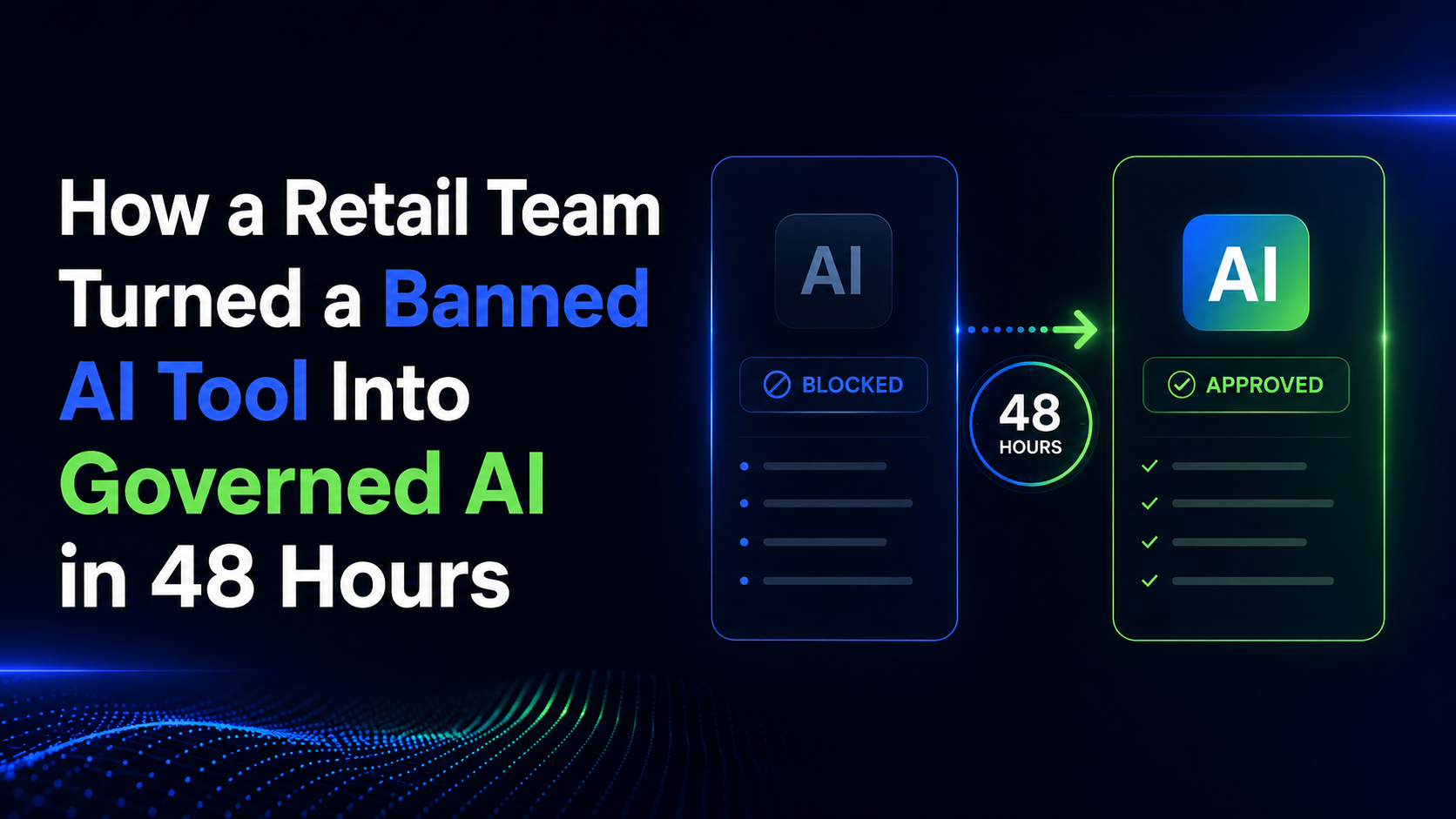
A retail organization blocked Brandify because security lacked evidence about what it could access, how it behaved, and how it could be governed after approval.
AIBound assessed Brandify and helped the organization move from permanent blocking to governed approval in 48 hours.
The approval enabled 210 marketing employees to use Brandify within defined marketing workflows.
AIBound’s assessment produced an A Trust Score and found no sensitive production-system exposure during the review.
Approval was not unrestricted. Brandify was scoped to approved marketing workflows under a least-privilege policy.
Sensitive categories remained restricted, including PII, regulated customer data, confidential business documents, proprietary files, and architectural assets.
The case study shows that the best AI security outcome is often governed approval, not permanent blocking.
Blocking useful AI tools indefinitely can increase Shadow AI pressure because employees may look for unsanctioned workarounds.
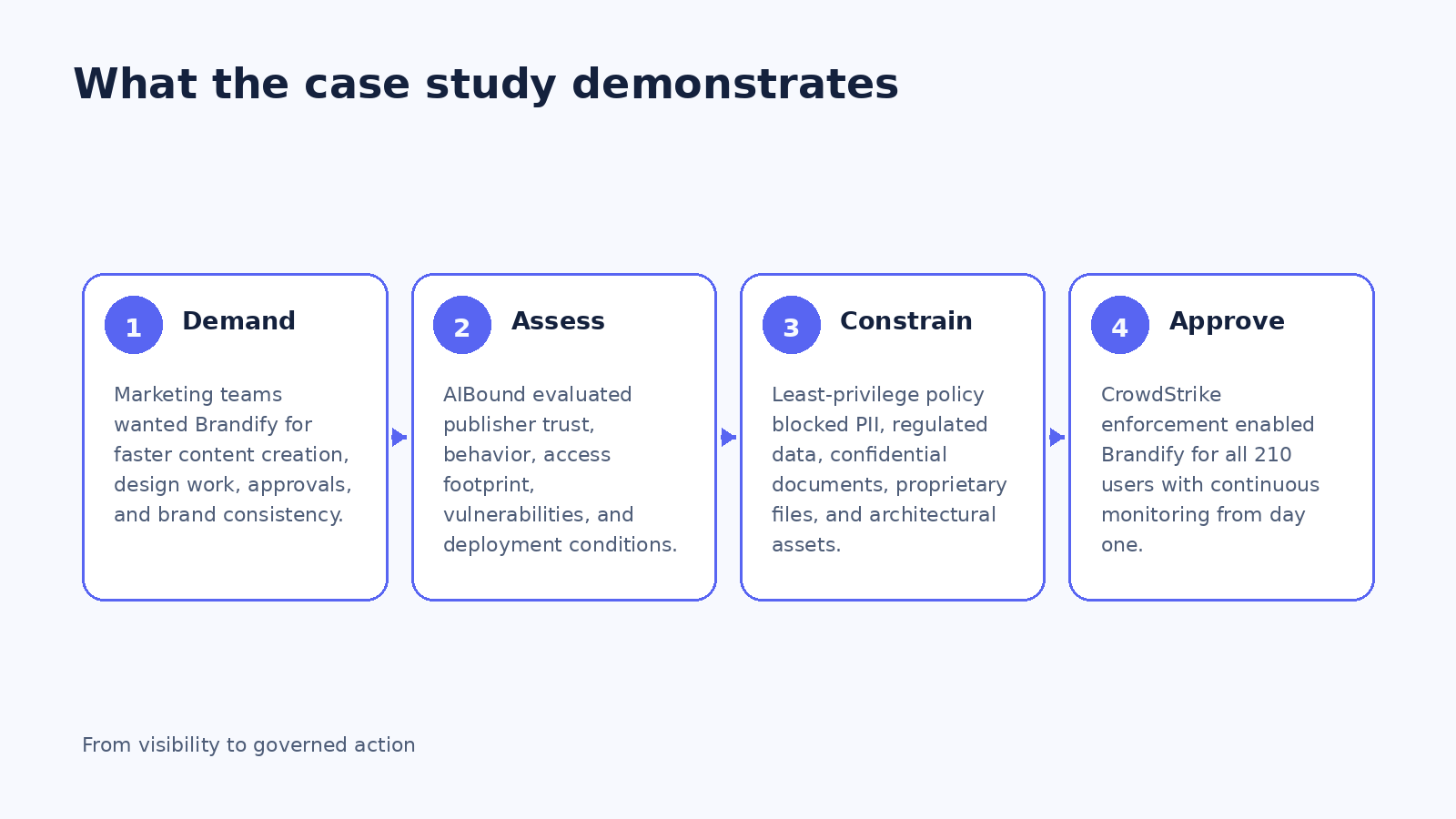
Evidence-based approval should evaluate publisher trust, product behavior, vulnerability history, identity requirements, permission scope, data proximity, and business value.
Continuous monitoring after approval is critical because AI tools can change through new features, integrations, connectors, permissions, or vendor updates.
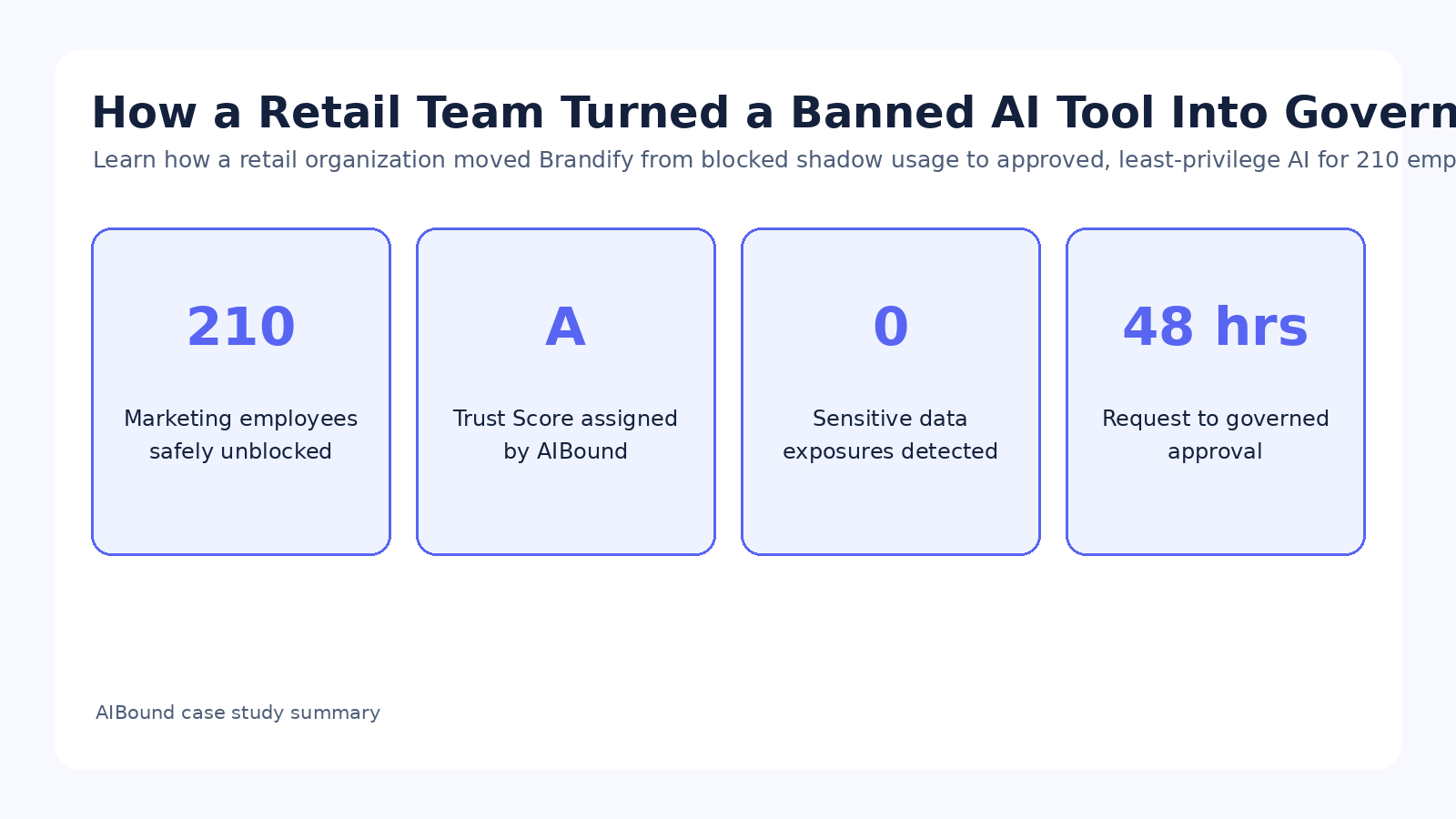
Case study overview. A retail organization had blocked Brandify because security could not prove what it could access or how to govern it after approval. AIBound assessed the tool, created least-privilege boundaries, and enabled 210 marketing employees to use it within 48 hours.
For additional context, see AIBound YouTube: 5 Steps to Discover, Score, and Prevent High-Risk AI, which outlines AIBound's five-stage approach to discovering, scoring, and preventing high-risk AI.
Direct Answer: The Best AI Security Outcome Is Often Governed Approval, Not Permanent Blocking
The Brandify case demonstrates an important shift in enterprise AI security. Security teams do not create value by blocking every unfamiliar AI tool indefinitely. They create value by making fast, evidence-based decisions that separate acceptable use from unacceptable exposure. In this retail organization, Brandify moved from blocked to approved and continuously governed in 48 hours, allowing 210 marketing employees to use the tool within defined boundaries.
AIBound's assessment produced an A Trust Score and found no sensitive production-system exposure during the analysis. Rather than treating the tool as safe everywhere, the organization applied a least-privilege policy so Brandify could operate within approved marketing workflows. At the same time, interaction with PII, regulated customer data, confidential business documents, proprietary files, and architectural assets remained restricted.
Why Marketing Demand Became a Shadow AI Risk
Retail marketing teams move quickly, and the case study explains why Brandify generated strong internal demand. Employees wanted faster campaign content, less repetitive design work, quicker approvals, and better brand consistency. Security and IT, however, lacked evidence about what Brandify could reach and how they would know if its behavior changed after approval.
The easiest decision was to block the application. That reduced immediate uncertainty, but it created a second problem. Productivity slowed while demand continued to grow. The more useful the tool appeared to employees, the greater the pressure for unsanctioned workarounds. A permanent block could therefore increase shadow AI pressure rather than eliminate it.
What Evidence-Based Approval Looks Like
A defensible approval decision starts with specific questions. Is the publisher transparent about data practices and security? Does the product behave within a narrow business purpose? Which systems and data categories can it reach? Does it have a meaningful vulnerability history? What controls can limit it after approval?
The Brandify assessment answered those questions across five dimensions. Publisher and community trust were strong. Behavior remained scoped to creative and brand workflows. Agentic reach was limited to marketing tooling and design processes. The case study reported no CVEs or vulnerability disclosures in the prior 90 days. The final deployment recommendation was approval within governed marketing workflows under least-privilege policy.
Least Privilege Turns Approval Into a Control Decision
Approving an AI tool should not mean granting broad access by default. The strongest part of this case is the use of boundaries. AIBound scoped Brandify to its intended function and explicitly blocked categories of information that were not needed for marketing work. This is more precise than either a blanket ban or unrestricted enterprise approval.
Least privilege is especially important because AI capabilities can expand after deployment. New integrations, features, connectors, and permissions can change the risk profile. Continuous governance gives security teams a way to keep the original approval valid only while the conditions supporting it remain true.
Why Continuous Monitoring Matters After the “Yes”
The case study emphasizes that approval is not a one-time event. CrowdStrike integration enabled continuous enforcement and behavioral drift detection. If Brandify later tried to access restricted information, or if its risk posture changed, policy controls could be enforced before exposure occurred.
This is a useful operating principle for every enterprise AI program: approvals should be conditional and observable. The security team should know what made the tool acceptable, which permissions were granted, which data categories remain off limits, who owns the business use, and which changes would trigger re-review.
A Practical Fast-Track AI Approval Workflow
Organizations can adapt the Brandify pattern into a repeatable approval process. First, discover organic adoption before the formal review begins. Knowing who is already using the tool and what it can reach gives the review real context. Second, evaluate publisher trust, product behavior, vulnerabilities, identity and permission requirements, data proximity, and expected business value.
Third, define the minimum access required for the approved use case. Fourth, document explicit restrictions for sensitive data and high-impact systems. Fifth, push controls through existing security infrastructure where possible. Finally, monitor for behavioral drift, permission changes, new integrations, and risk-intelligence updates.
How This Changes the Relationship Between Security and the Business
The most telling outcome in the case study is cultural as well as technical. The IT Director said marketing stopped treating security like the department of no. That happens when security can make decisions at business speed without sacrificing control.
A mature AI governance program should create multiple outcomes: approve, approve with conditions, restrict, pilot, quarantine, or block. When teams know a request can receive a fast, evidence-based answer, they have less incentive to route around governance.
Frequently Asked Questions
Was Brandify simply declared safe? No. It received an A Trust Score in the case study, but approval was limited to governed marketing workflows with least-privilege enforcement and continuous monitoring.
Why not keep the tool blocked permanently? The case study describes productivity and workflow impacts while employee demand kept increasing. Evidence-based approval resolved both the business need and the shadow AI pressure.
What data remained restricted? The case study specifically lists PII, regulated customer data, confidential business documents, proprietary files, and architectural assets.
How quickly did approval happen? The case study reports 48 hours from request to governed approval for 210 employees.
Conclusion
Brandify is a strong example of AI governance as enablement. The organization did not choose between innovation and security. It gathered evidence, established a narrow access model, enforced clear data boundaries, and kept monitoring after approval.
For security leaders, the lesson is simple: a fast, defensible 'yes with controls' can be safer than a slow 'no' that drives employees toward shadow use. Governance works best when it creates a secure path to adoption, not merely a list of prohibited tools.
Implementation Checklist for a Business-Friendly AI Review
Create a standard evidence package for every requested AI tool. It should include publisher and security posture, data handling, account model, identity and permission requirements, integrations, vulnerability history, expected business value, and proposed restrictions. Reviews become faster when every request is evaluated against the same evidence template.
Set service-level targets for low-, medium-, and high-risk reviews. A low-risk marketing or productivity tool should not wait behind a complex autonomous-agent assessment. Finally, make approvals conditional: define what would trigger re-review, such as new connectors, new data categories, expanded permissions, or a significant change in vendor risk.
What Security Teams Should Document Before Approving an AI Tool
A repeatable approval file should capture the tool's intended use, the business team requesting it, the publisher and security documentation, account model, data retention practices, integrations, identity requirements, permission scopes, information categories in reach, known vulnerabilities, and any agentic or autonomous features. The review should end with explicit conditions rather than a vague statement that the tool is 'approved.'
For Brandify, the important condition was scope. Marketing workflows were allowed while sensitive categories remained outside the permitted boundary. That distinction should be written into the approval record so a later feature expansion or integration can be compared with the original decision. If the facts change, the approval can be revisited without restarting the entire governance process from memory.
How to Prevent Fast Approval From Becoming Weak Approval
Speed is valuable only when the evidence is strong enough to support the decision. Fast-track review should not mean skipping identity mapping, data analysis, vulnerability review, or permission design. It means standardizing those steps so security can decide quickly. Automated evidence collection, pre-defined risk thresholds, and reusable least-privilege policies can reduce cycle time without reducing scrutiny.
Organizations should also track approval quality after go-live. Monitor whether tools remain inside their approved data boundaries, whether new integrations appear, whether employees shift to personal accounts, and whether the vendor introduces autonomous features. A rapid approval process is mature when it includes equally rapid detection of material change.
A 60-Day Governed AI Adoption Program
During the first 30 days, inventory the highest-demand blocked and shadow AI tools, identify the business teams requesting them, and create a standard evidence package. Prioritize use cases where business value is clear and required data access is narrow. Use these as pilot approvals to prove the workflow.
During days 31 through 60, publish approved tools and conditions, automate monitoring for data and permission drift, define re-review triggers, and measure adoption. The objective is to reduce both security exposure and employee incentive to use unapproved alternatives. A good program should make the governed path easier than the shadow path.
Key Takeaways for CISOs and Security Leaders
For CISOs, Brandify is a reminder that governance maturity should be measured partly by how quickly the organization can reach a defensible decision. A slow review process can become a risk factor when employees have strong business demand and easy access to alternatives. Security needs enough automation and evidence to move low- and moderate-risk tools through a predictable path while reserving deep manual analysis for the cases that truly require it.
The approval record should also be treated as a control contract. It states the business purpose, permitted users, allowed data, approved integrations, and conditions that would trigger re-review. Continuous monitoring then checks whether real-world use still matches that contract. This makes approval dynamic without making it arbitrary.
Final Strategic Note
Across all five case-study patterns, the common requirement is continuous context. Enterprises need to know not only which AI resources exist, but also who uses them, what identities and permissions they inherit, which data and systems they can reach, what risk signals are present, and what governance decision is currently in force. That context makes it possible to distinguish productive AI adoption from material exposure and to respond proportionately. The strongest programs therefore connect discovery, assessment, approval, enforcement, monitoring, and reporting in one operating loop. That loop gives employees a safer path to use AI, gives security teams a way to prioritize the most important risks, and gives leadership evidence that policy decisions are actually being applied in the environment.
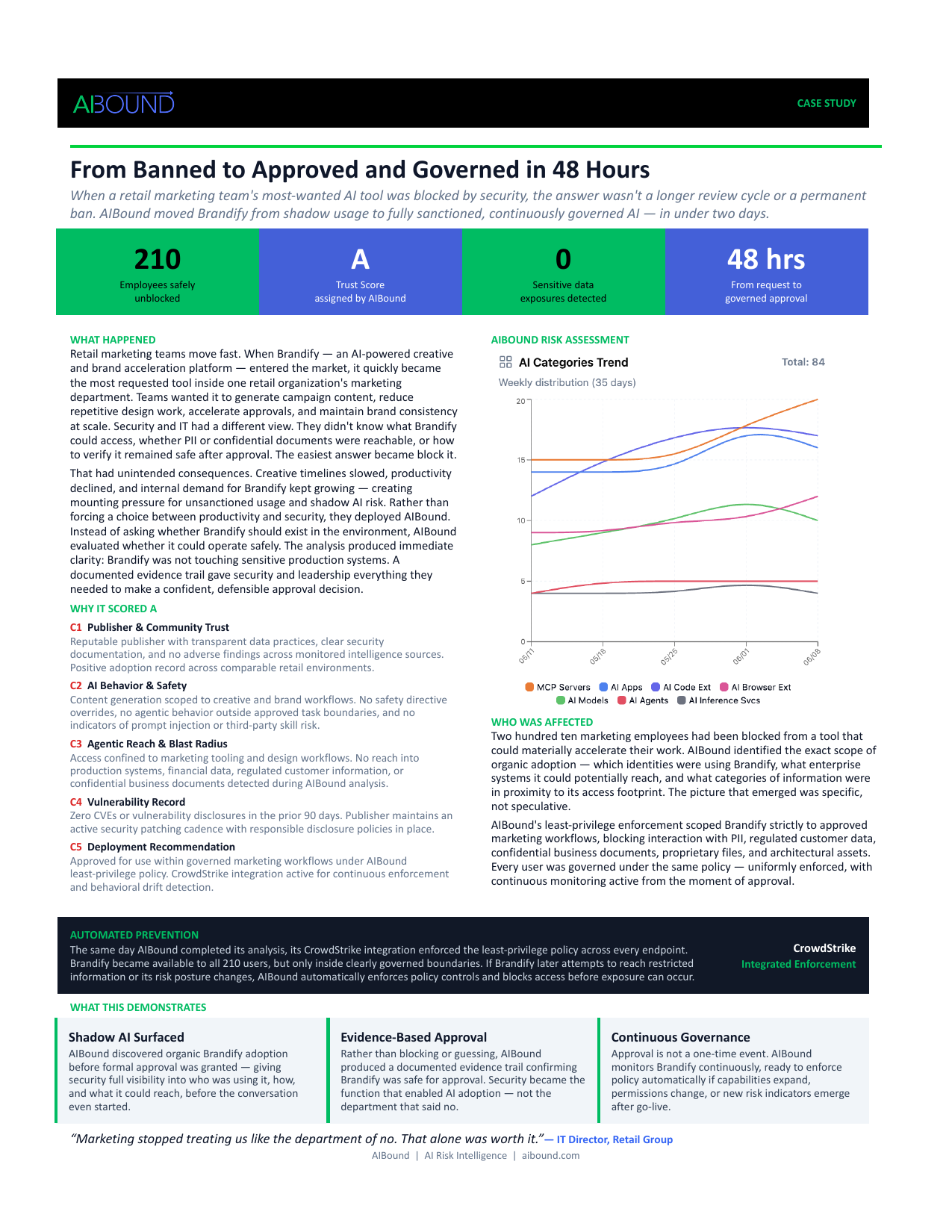
Original Case Study Snapshot
The source case study supplied for this article is shown below for reference. The blog preserves the case study metrics and outcomes while expanding the security and governance lessons into a long-form SEO article.
Recommended Internal AIBound Links
- Enterprise AI Governance Framework: https://www.aibound.com/blog-posts/ai-governance-enterprise-framework
- AI Governance Framework for CISOs: https://www.aibound.com/blog-posts/ai-governance-framework-for-cisos
- AIBound Case Studies: https://www.aibound.com/lovable-case-studies
- AIBound AI Control Plane: https://www.aibound.com/
External Resources
- AIBound YouTube: 5 Steps to Discover, Score, and Prevent High-Risk AI: https://www.youtube.com/watch?v=nYQ8kVQAkPc
- NIST AI Risk Management Framework: https://www.nist.gov/itl/ai-risk-management-framework
- OWASP Top 10 for Agentic Applications 2026: https://genai.owasp.org/resource/owasp-top-10-for-agentic-applications-for-2026/
- NIST Generative AI Profile: https://nvlpubs.nist.gov/nistpubs/ai/NIST.AI.600-1.pdf
Next Step
Organizations facing similar visibility, governance, or reporting challenges can explore AIBound to see how a live AI inventory and control plane can support secure AI adoption.
Leadership Review Questions
Use these questions to test whether the case-study lessons translate into a repeatable enterprise operating model:
- Can we identify every AI application, agent, model, extension, plugin, and MCP service currently in use?
- Does each material AI resource have a named business owner and documented purpose?
- Can security map the human or machine identity, effective permissions, sensitive data, and connected systems behind each resource?
- Are approval decisions conditional on least privilege, data boundaries, and ongoing monitoring?
- Do high-risk conditions trigger a defined response such as restrict, block, revoke, or require human approval?
- Can governance teams show when a resource was discovered, assessed, approved, changed, and remediated?
- Can the organization produce evidence for a board, auditor, regulator, or incident responder without a manual data-gathering project?
- Are adoption and risk trends improving together, or is AI usage expanding faster than the control program?
If several answers are uncertain, the priority is usually not another policy document. It is improving the live inventory, relationship context, ownership model, and enforcement path that make policy measurable and actionable.
Find every AI browser extension in your environment.
Full AI inventory within 24 hours, with permissions, identities, and risk scores for each extension. No new agents.

%401x.png)