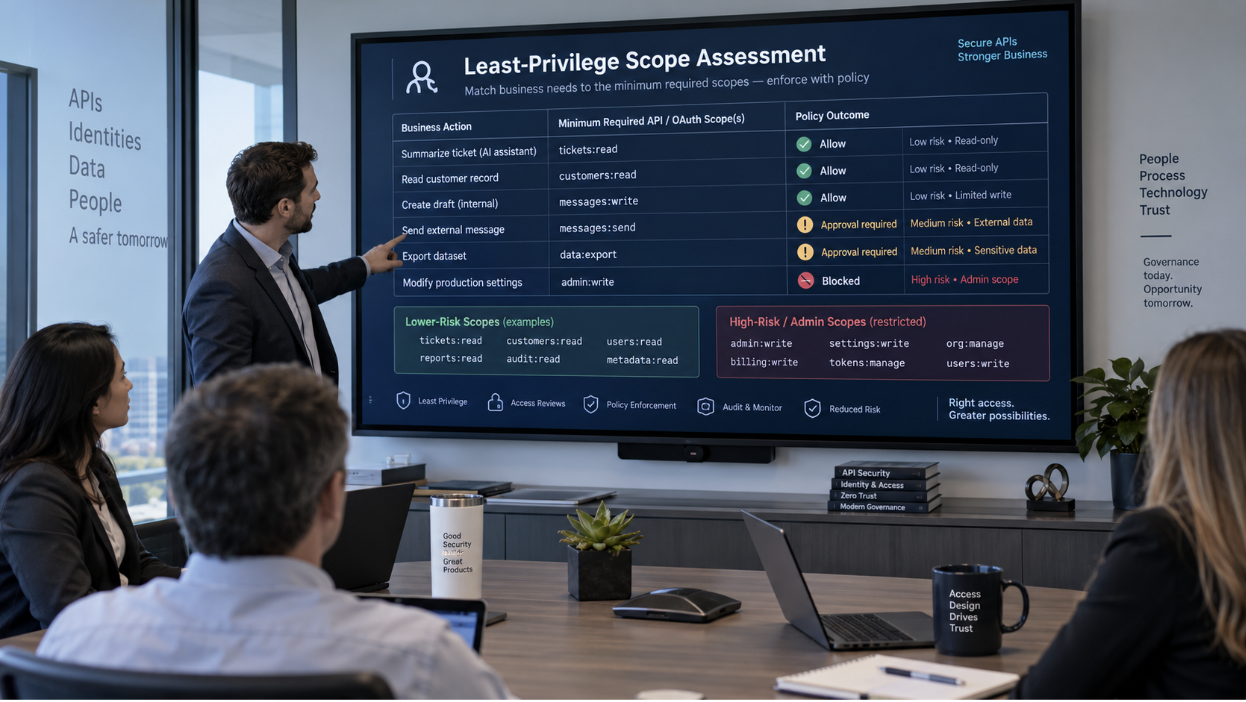
Enterprise AI rarely operates by itself. A copilot may connect to Microsoft 365, Salesforce, GitHub, a data warehouse, internal APIs, browser extensions, model providers, and third-party automation services. Each connection can make AI more useful, but each connection also expands the number of identities, permissions, data paths, and external dependencies that security teams must understand.
The risk is not that integrations are inherently unsafe. The risk is that AI integrations are often approved as individual features while their combined authority is never evaluated as one operational chain. A seemingly harmless assistant can become high risk when it inherits a privileged OAuth grant, reaches confidential data, and can send results to an external destination.
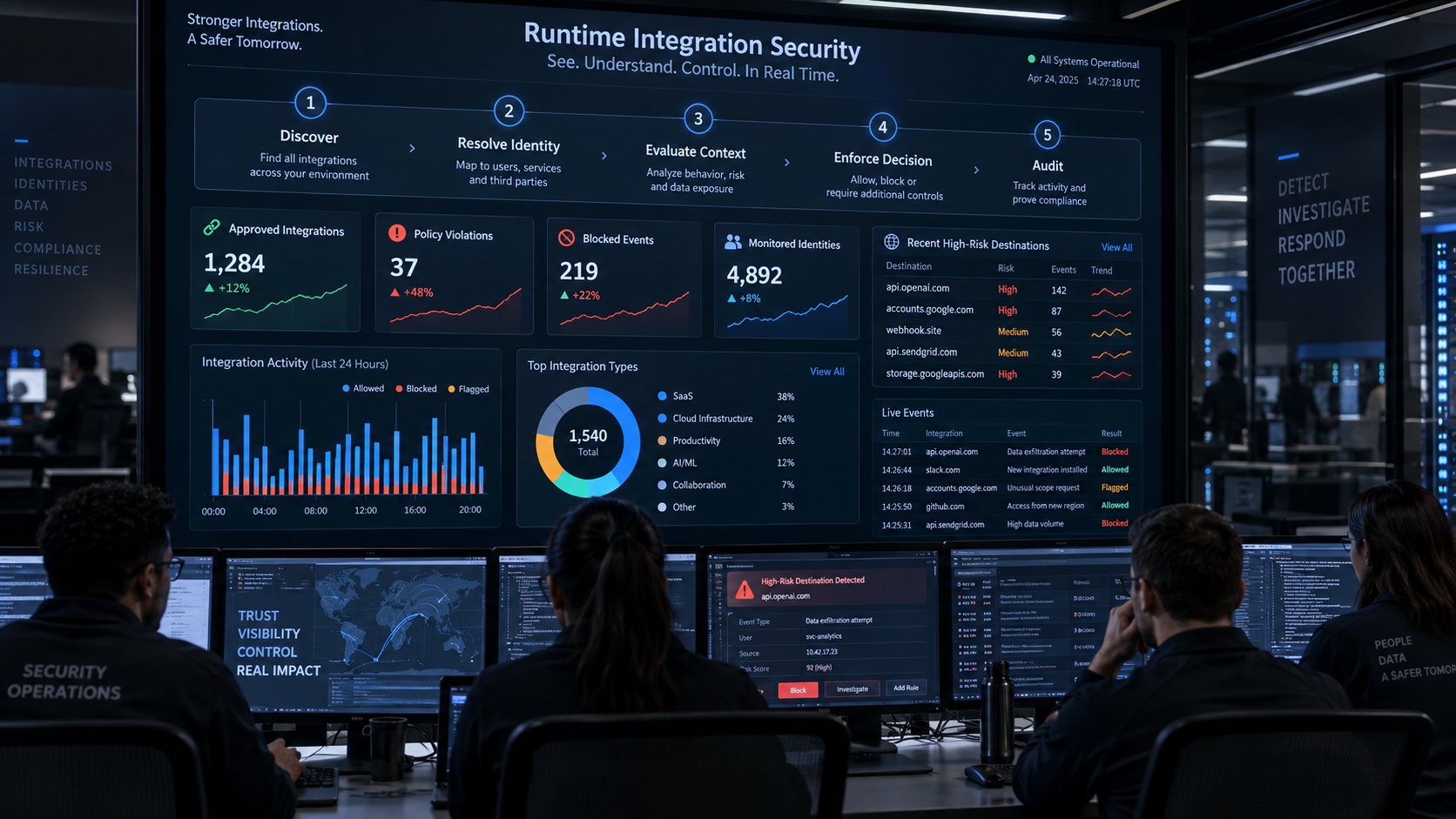
AIBound’s 5 Steps to Discover, Score, and Prevent High-Risk AI video provides a useful operating sequence for this problem: discover the AI resource, identify the identity behind it, map its connections and data reach, measure risk in context, and prevent the high-risk action.
A second useful reference is AIBound’s enterprise AI security walkthrough, which reinforces why discovery without identity and connection context is incomplete.
This article explains how security teams can apply that model specifically to SaaS, API, connector, and third-party AI integrations while still enabling useful business workflows.
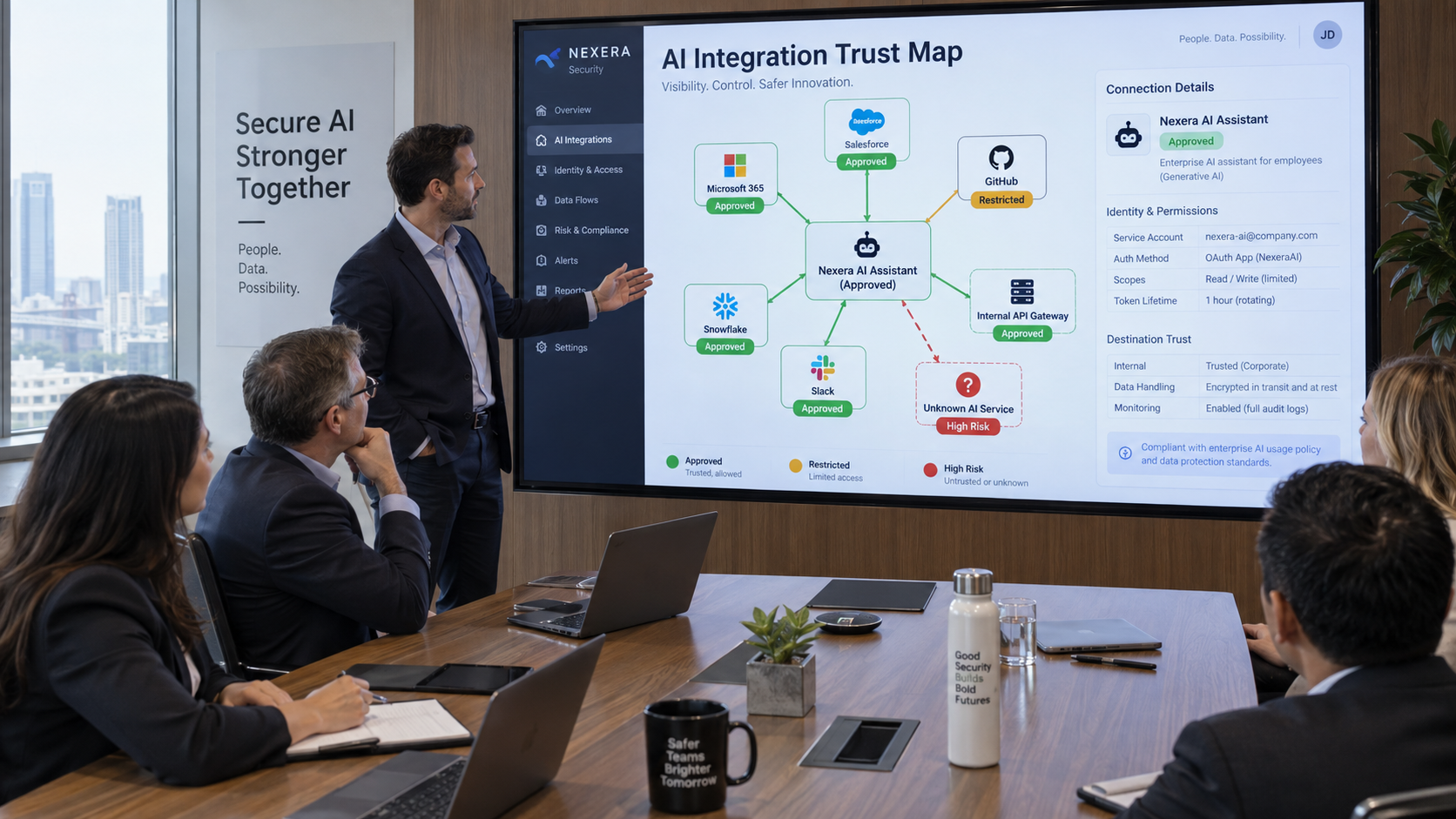
Direct Answer: Secure the Connection Chain, Not Just the AI Application
Enterprises should secure AI integrations by treating every connection as a chain of authority: AI resource -> identity -> permission -> data or system -> external destination -> action. Each link should have a named owner, a defined business purpose, a minimum required permission set, and a monitoring or enforcement point.
The objective is not to create a slow procurement gate for every API call. The objective is to make risky combinations visible and controllable. A low-risk read-only integration to public data may be approved quickly. A connector that can export customer records, modify production systems, or call an unknown external service should receive a very different review and enforcement path.
Why AI Integrations Create a Different Security Problem
Traditional integrations are usually invoked by deterministic application logic. AI agents and copilots introduce a runtime decision layer. The model may decide which tool to call, when to call it, what data to retrieve, and how to combine results. That means a connector can be technically approved while a particular use of the connector is still unsafe.
AIBound’s agent and MCP security guidance makes this distinction explicit: an agent's security consequence is defined by the tools it can call and the identity it calls them as. For integrations, this means security teams must evaluate both configuration-time permissions and runtime behavior.
1. Discover Every AI Integration, Including the Ones Nobody Registered
The first control is inventory. Security teams need to discover sanctioned and unsanctioned AI connections across browsers, endpoints, networks, cloud environments, SaaS products, development tools, automation platforms, model APIs, plugins, and MCP servers.
The inventory should include the AI resource, connector or integration name, vendor, owner, users, authentication method, OAuth scopes, API permissions, connected systems, accessible data categories, external domains, environment, approval status, and last observed activity.
Embedded AI features deserve special attention because they can appear in products approved before the AI capability existed. A SaaS application may add a copilot, agent, or external model integration without requiring a new purchase or deployment. Discovery therefore has to be continuous, not tied only to procurement.
2. Resolve the Identity Behind the Integration
Every AI integration acts through an identity. It may use a named employee account, a service account, an OAuth application, an API key, a workload identity, or a cloud role. That identity determines the AI workflow's real reach.
Security teams should ask whether the identity is shared, whether its credentials are long-lived, whether the owner is still valid, whether it has inherited permissions, and whether it can create or delegate new access. The same AI application can be low risk when connected through a read-only account and high risk when connected through a service identity with administrative privileges.
AIBound’s identity-security approach is useful because it maps each AI resource to the identity it runs as and then traces what that identity can reach. That relationship converts an abstract integration review into a concrete blast-radius analysis.
3. Review OAuth and API Scopes for Least Privilege
OAuth scopes and API permissions are one of the fastest ways for integration risk to expand quietly. Teams often accept broad vendor-requested scopes because the connector will not function otherwise during setup. Those scopes may remain long after the original use case changes.
The review should map every business action to the minimum permission required. If the AI only needs to search customer records, it should not also receive export or user-administration rights. If it only drafts a message, sending externally can remain behind an approval checkpoint.
Test least privilege in practice. Remove one scope at a time, confirm the workflow still succeeds, and document the final minimum set rather than relying on the vendor’s default permission bundle.
4. Classify the Data the Integration Can Reach
Integration security is inseparable from data security. A connector that touches public content is different from one that can retrieve customer PII, source code, financial records, employee data, credentials, or legal documents.
Map data classification to both read and write paths. An AI agent may be able to read a sensitive source and write the result to a different application. The risk therefore depends on the full path, not only the first system in the chain.
AIBound’s data-leakage prevention model emphasizes destination-aware policy. The same data can be acceptable when it remains inside an approved enterprise destination and unacceptable when it flows to a personal AI account, unknown API, or unreviewed MCP server.
5. Evaluate Third-Party Destination Trust
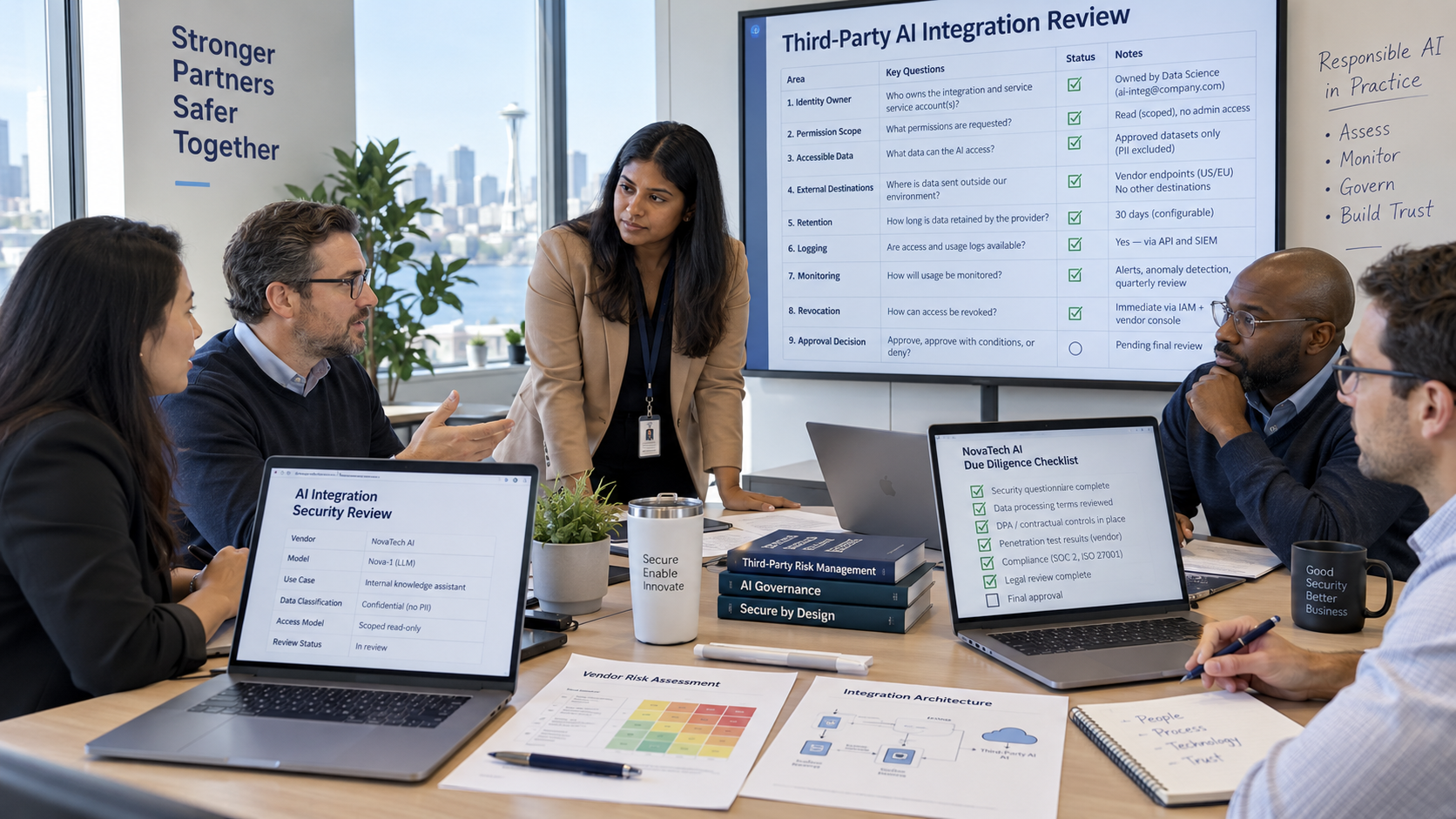
A connector may pass data through multiple external services. Security teams should understand which domains receive data, whether subprocessors are involved, where data is retained, whether content is used for model improvement, and whether the destination supports enterprise controls such as SSO, logging, retention configuration, and tenant isolation.
Destination trust should not be a one-time questionnaire. Vendor behavior, subprocessor lists, model providers, and product architecture change. The organization needs a way to reassess trust when those dependencies change.
For high-impact integrations, contracts should also define security responsibilities, incident notification expectations, data handling, deletion obligations, and the ability to revoke or terminate the connection.
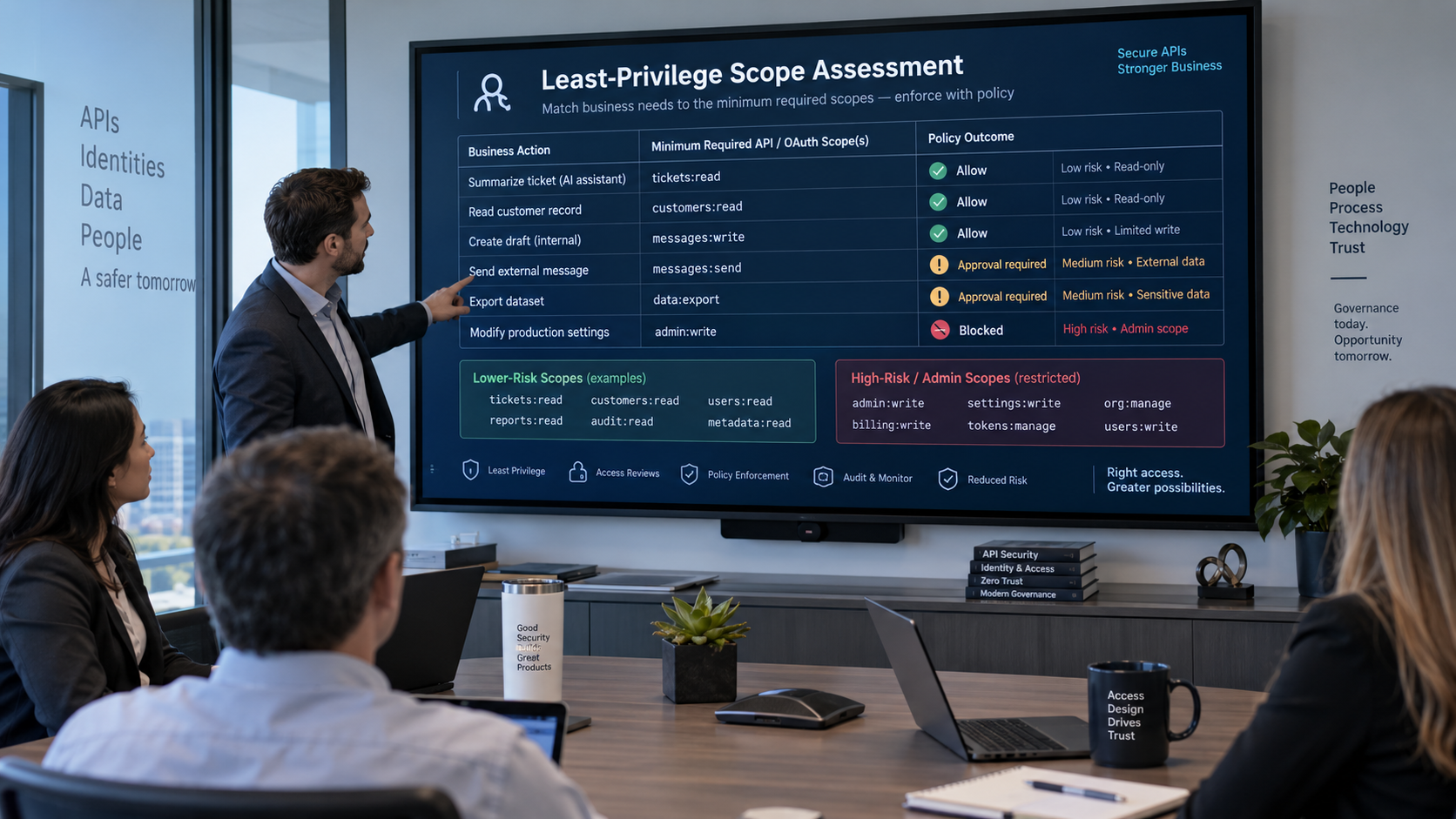
6. Separate Low-Risk Access From High-Impact Actions
A single integration can support both harmless and high-impact actions. Security teams should avoid one blanket decision for the whole connector. Read-only lookup, draft creation, external sending, bulk export, permission changes, and destructive actions should have separate policy treatments.
Low-impact actions can often run autonomously. Medium-impact actions may require monitoring, coaching, or confirmation. High-impact actions should require stronger approval, a narrower scope, or outright blocking, depending on context.
This action-level model preserves productivity because users keep the safe parts of the integration instead of losing the entire tool.
7. Monitor Runtime Tool Calls and Connection Changes
Configuration review is not enough because AI behavior changes at runtime. Teams should monitor new connectors, new OAuth grants, newly observed domains, unusual tool-call frequency, unexpected data retrieval, scope increases, identity changes, and actions that deviate from the approved business purpose.
AIBound’s policy-enforcement approach is relevant here because it connects risk context to actions such as alerting, coaching, routing for review, restricting access, or blocking. The key principle is that enforcement should be consistent and explainable, not improvised during an incident.
Continuous monitoring also catches integration drift: a previously acceptable connection can become high risk after a vendor update, permission expansion, new data source, or change in the AI agent’s autonomy.
8. Require Owners, Review Dates, and Revocation Paths
Every material AI integration should have a business owner and a technical owner. The business owner confirms that the use case still matters. The technical owner confirms that the identity, permissions, data access, and monitoring controls are still appropriate.
Review dates should be risk-based. A read-only integration to public data may need only periodic confirmation. An autonomous integration with sensitive data and external write access should be reviewed much more frequently and automatically reassessed when its configuration changes.
Test revocation before an incident. Teams should know how to turn off the connector, revoke OAuth tokens, rotate secrets, block destinations, remove scopes, suspend the service identity, and preserve logs without waiting for vendor support.
9. Use an Integration Risk Score That Explains Why
A useful AI integration risk score should include identity privilege, data sensitivity, permission breadth, external exposure, autonomy, vendor trust, business criticality, and blast radius. It should also show which factors are driving the score so the owner knows what to change.
For example, a connector may be high risk because it combines confidential data with export permissions and an unknown external destination. Removing export scope or approving the destination may materially reduce risk without turning off the integration.
10. Turn Policy Into Runtime Decisions
The final step is making the policy operational. The security program should define what happens when a risky integration condition appears. Possible actions include allowing, monitoring, coaching the user, requiring approval, restricting scope, quarantining, revoking a token, blocking a destination, opening a ticket, or turning off the connector.
The response should match the risk. New or unfamiliar does not automatically mean malicious. AIBound’s policy-enforcement model explicitly supports lighter responses before blocking, which is useful for organizations trying to govern AI without becoming the department of no.
A Practical 30-Day AI Integration Security Plan
- Inventory AI applications, connectors, plugins, APIs, MCP servers, and external model integrations already in use.
- Assign owners and resolve the identities, OAuth apps, API keys, and service accounts behind each connection.
- Prioritize integrations with confidential data, broad write permissions, external destinations, or autonomous actions.
- Review OAuth scopes and remove permissions that are not required for the approved use case.
- Classify connected data sources and define destination trust categories.
- Create response rules for new domains, scope increases, high-risk data movement, and unowned integrations.
- Test token revocation, connector disablement, and log preservation for high-impact integrations.
- Create a recurring access review and continuously monitor configuration drift.
Metrics CISOs Should Track
- Total AI integrations discovered versus formally registered.
- Percentage with named business and technical owners.
- Integrations using privileged, shared, or long-lived identities.
- Number of excessive OAuth scopes removed.
- Integrations that can reach confidential or regulated data.
- External destinations that are unknown or not yet approved.
- High-impact actions protected by human approval.
- Mean time to revoke or restrict a risky integration.
- Configuration or permission changes detected after approval.
- Percentage of integrations with complete audit trails.
Frequently Asked Questions
Are third-party AI integrations always high risk?
No. Risk depends on the identity, permission scope, data access, destination trust, autonomy, and business impact. A narrow read-only integration can be low risk, while the same vendor can become high risk under a privileged identity with broad external write access.
Should enterprises block unknown AI integrations automatically?
Not always. Enterprises should discover unknown integrations and route them for review. Immediate blocking is more appropriate when the integration combines clearly unacceptable conditions such as credential access, sensitive data exfiltration, destructive permissions, or an untrusted destination.
How often should OAuth scopes be reviewed?
Review frequency should match risk, but scopes should also be reassessed automatically when new permissions appear, owners change, connectors are upgraded, or business purpose changes.
Does integration security replace existing IAM or API security tools?
No. IAM, API security, DLP, endpoint, network, and cloud controls remain important. The AI-specific layer correlates their signals around the AI resource and its runtime behavior so the organization can understand the complete risk chain.
Conclusion
AI integration security is not a vendor-review exercise, and it is not solved by approving a list of applications. The real security boundary is the connection chain between the AI resource, the identity it uses, the permissions it receives, the data it can reach, the destination it can contact, and the actions it can perform.
Enterprises that continuously discover these connections, apply least privilege, evaluate destination trust, monitor runtime behavior, and enforce proportionate responses can support AI adoption without accepting invisible integration risk.
AIBound’s control-plane model is designed around this connected view: discover the AI, resolve identity, map data and connections, measure risk with context, and prevent high-risk actions before impact.
Recommended Internal AIBound Links
- AI Identity Security
- AI Agent and MCP Server Security
- AI Data Leakage Prevention
- Policy Enforcement and Automation
External Resources and Video References
Find the AI already running on your devices.
Install takes 15 minutes. A full AI inventory arrives within 24 hours of deployment.