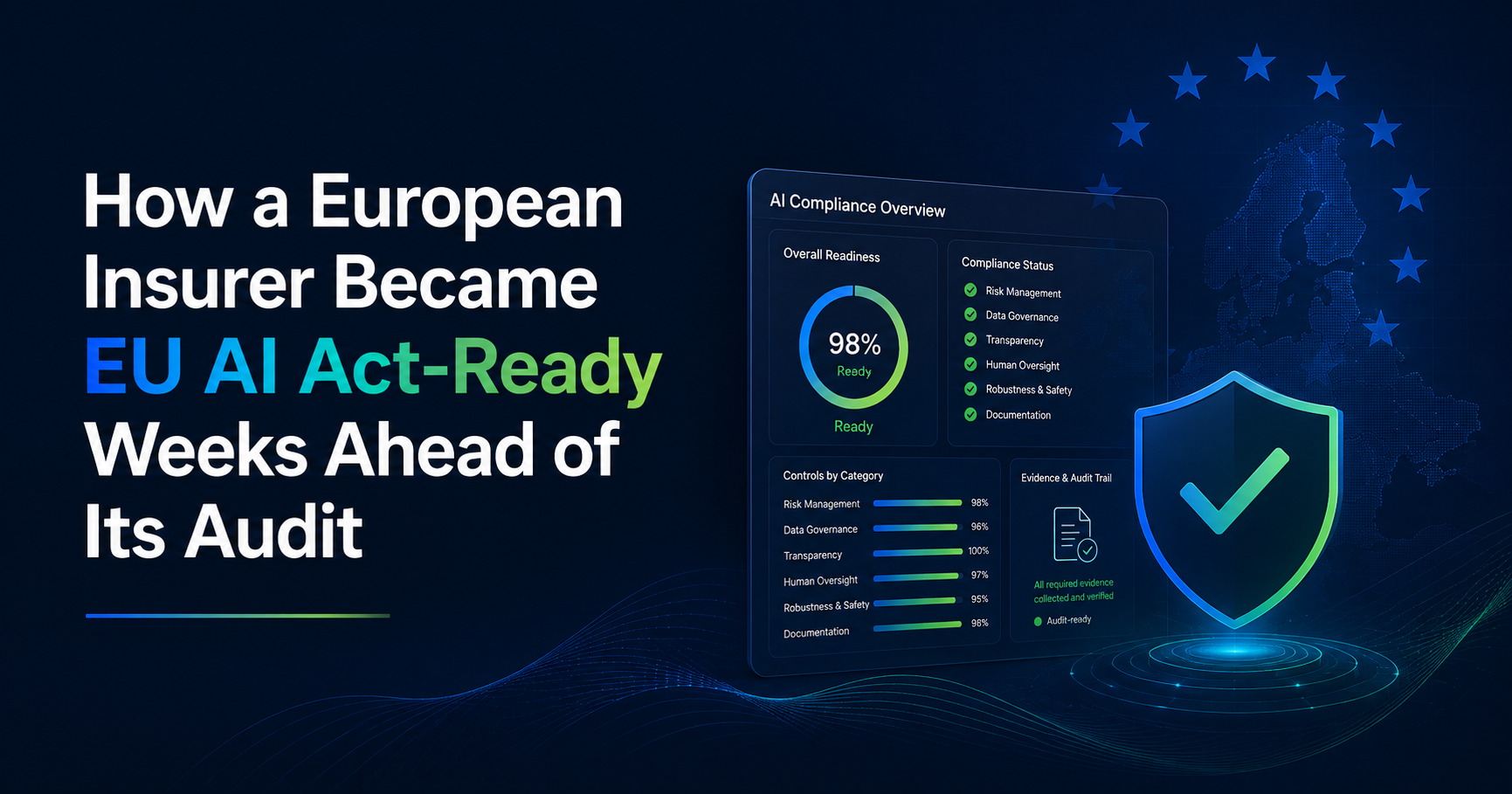
A European insurer preparing for EU AI Act review needed a defensible view of AI usage, high-risk systems, data exposure, identities, and governance decisions.
The organization had security point solutions and governance spreadsheets, but it lacked a complete enterprise AI inventory.
AIBound discovered more than 3,500 AI applications in 24 hours across AI agents, MCP servers, SaaS applications, browser extensions, and emerging services.
AIBound placed 93 AI resources under active EU AI Act governance, showing the difference between broad AI discovery and deeper high-risk governance review.
The case study shows that EU AI Act readiness starts with a live inventory and continuous evidence, not a point-in-time spreadsheet.
Identity attribution helped the insurer connect AI systems to the people, identities, access levels, business units, and usage patterns behind them.
Data exposure and blast radius were used to prioritize regulatory review based on potential impact, not just the number of AI applications discovered.
AIBound connected vulnerability intelligence, exposure indicators, and supply-chain risk to discovered AI systems so governance teams could make better review decisions.
The insurer became audit-ready weeks ahead of schedule because governance evidence was preserved continuously as AI systems were discovered, reviewed, approved, blocked, restricted, or remediated.
The main lesson is that regulated enterprises need AI governance evidence by design: inventory, ownership, data access, identity context, risk state, decisions, remediation, and monitoring history.
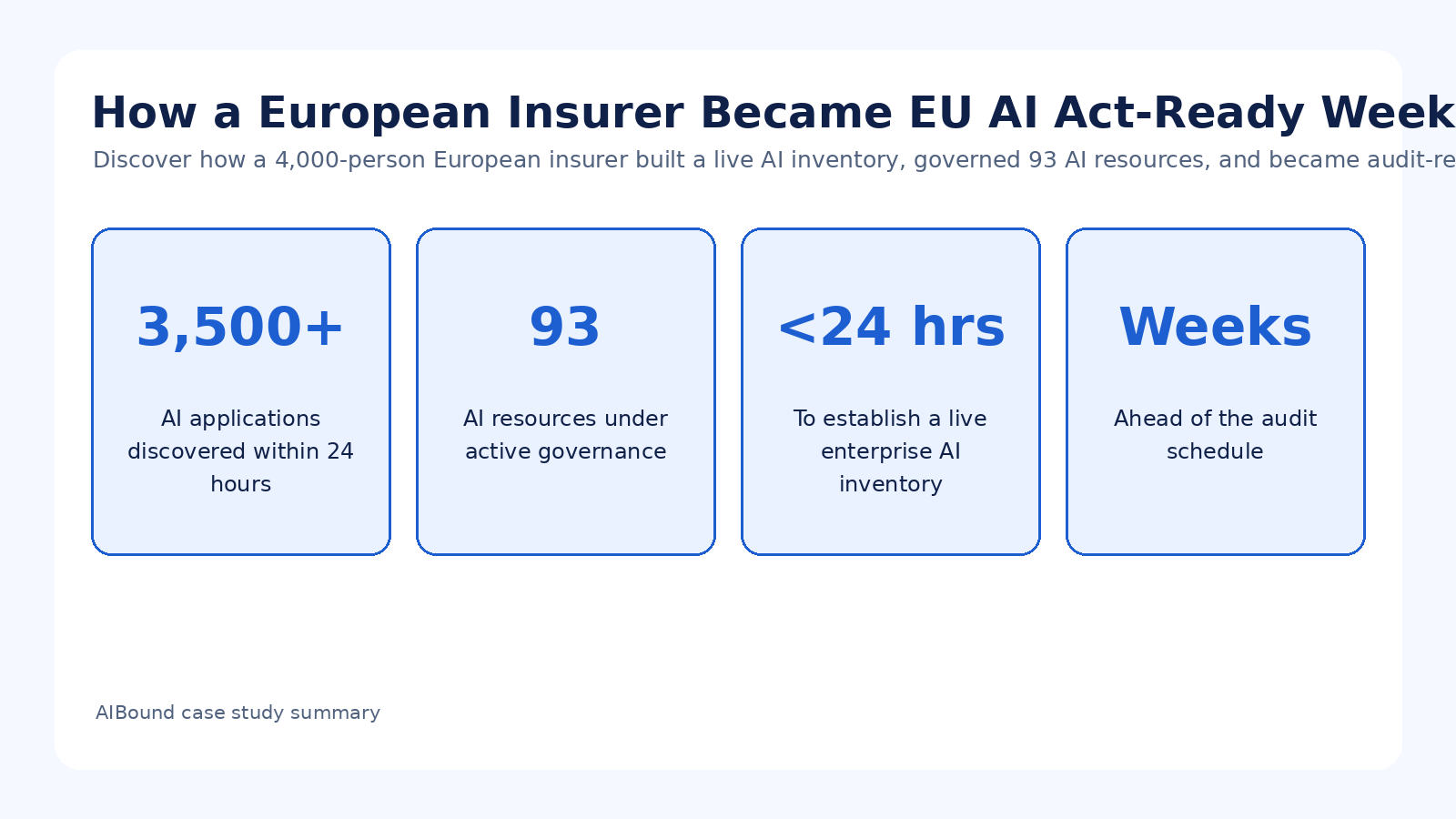
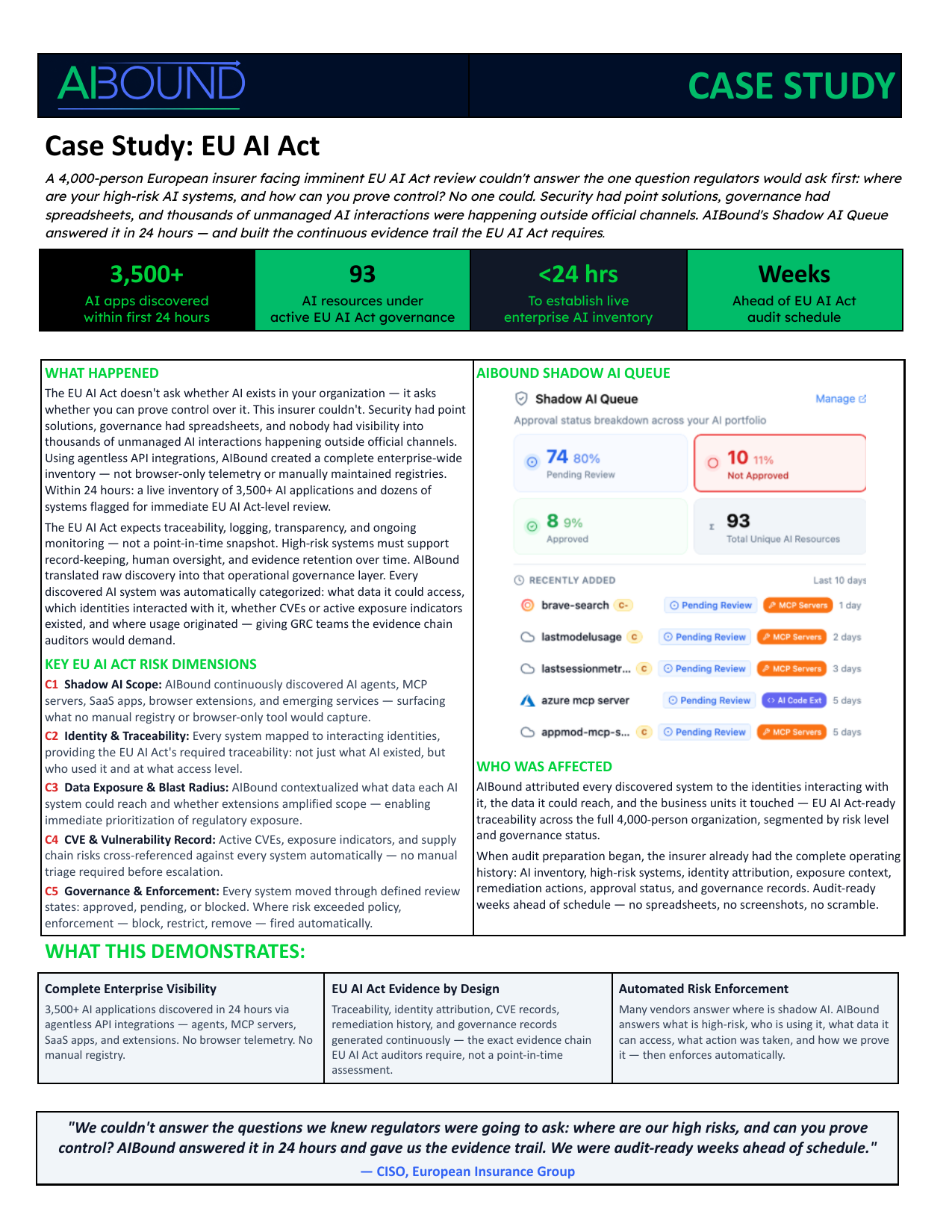
Case study overview. A 4,000-person European insurer preparing for EU AI Act review lacked a defensible enterprise AI inventory. AIBound discovered 3,500+ AI applications in 24 hours, placed 93 AI resources under active governance, and created a continuous evidence trail that made the organization audit-ready weeks early.
For additional context, see AIBound YouTube: 5 Steps to Discover, Score, and Prevent High-Risk AI, which outlines AIBound's five-stage approach to discovering, scoring, and preventing high-risk AI.
Direct Answer: EU AI Act Readiness Starts With a Live Inventory and Continuous Evidence
The European insurer's challenge was not a lack of policy documents. It was the inability to answer a regulator's first operational question: where are the organization's high-risk AI systems, and how can control be proven? AIBound created an enterprise-wide AI inventory in under 24 hours, discovering more than 3,500 AI applications and moving 93 resources into active governance.
The case study's most important lesson is that compliance evidence must be produced continuously. The EU AI Act emphasizes traceability, logging, transparency, monitoring, human oversight, and record-keeping for relevant systems. A point-in-time spreadsheet can describe a program, but it cannot provide the same living history of what existed, who used it, what it could access, what risk was identified, and what action was taken.
The Visibility Problem Behind the Compliance Problem
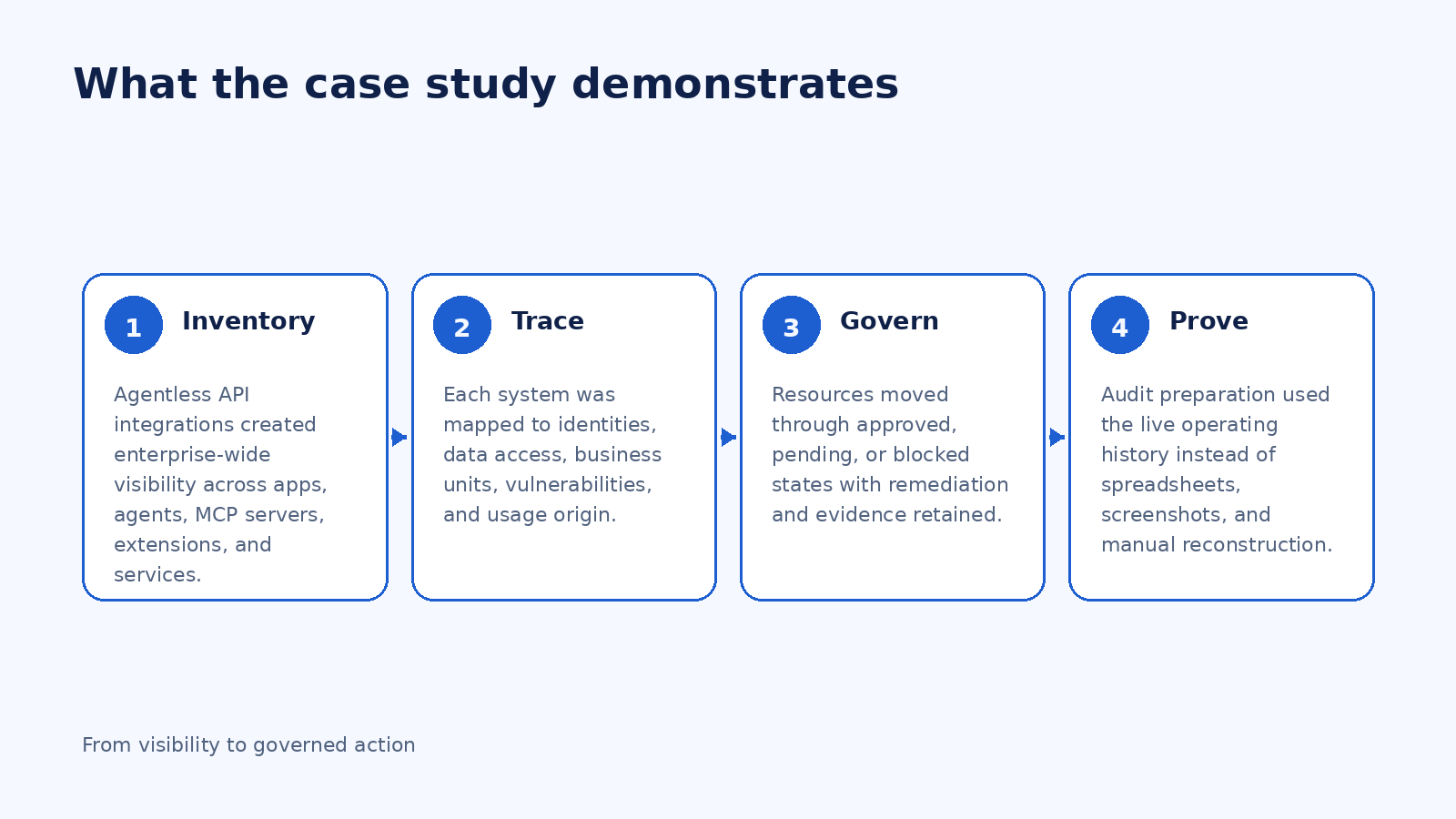
The insurer had security point solutions and governance spreadsheets, yet thousands of unmanaged AI interactions were occurring outside official channels. This is a common structural problem. Governance teams often know what has been approved, while security teams know what individual tools report, but neither view produces a complete enterprise AI inventory.
Using agentless API integrations, AIBound created visibility that extended beyond browser-only telemetry and manual registries. The case study says the inventory covered AI agents, MCP servers, SaaS applications, browser extensions, and emerging services. That breadth matters because regulatory accountability cannot stop at tools acquired through official procurement.
Identity and Traceability: Knowing Who Used What
A list of AI applications is not sufficient evidence. The insurer needed to connect systems to identities and access levels. AIBound attributed discovered systems to the people or identities interacting with them and connected that activity to data reach and business units.
This provides the traceability that lets governance teams investigate a specific high-risk resource without treating the entire organization as equally exposed. It also supports accountability because every system can be tied to usage, ownership, risk state, and remediation history.
Data Exposure and Blast Radius Must Be Part of Regulatory Prioritization
The case study explains that AIBound contextualized what data each AI system could reach and whether extensions amplified scope. This is essential because two AI systems with the same category label may present very different regulatory and operational risks.
A low-impact assistant used with public information may require basic governance. A system connected to confidential data, broad identities, vulnerable components, and autonomous actions can justify immediate review. Context gives GRC teams a way to prioritize their workload around potential impact, not inventory size alone.
From Vulnerability Data to Governance Decisions
The insurer's operating model also included vulnerability and exposure intelligence. Active CVEs, exposure indicators, and supply-chain risks were cross-referenced against discovered systems. This connects conventional security information with AI governance rather than treating them as separate programs.
Every system then moved through defined review states such as approved, pending, or blocked. Where risk exceeded policy, actions such as block, restrict, or remove could be enforced. This is the difference between a governance dashboard and a governance control system.
What “Audit-Ready Weeks Ahead of Schedule” Really Means
When the insurer began audit preparation, it already had the operating history it needed: AI inventory, high-risk systems, identity attribution, exposure context, remediation actions, approval status, and governance records. The case study says the organization was audit-ready weeks ahead of schedule, without the usual spreadsheet and screenshot scramble.
For regulated enterprises, that is the real value of evidence by design. Instead of assembling a story after the fact, the organization preserves the story as governance happens. Reviews become a retrieval problem, not a reconstruction project.
A Practical EU AI Act Readiness Workflow
Start by creating a continuous AI inventory across sanctioned and shadow usage. Enrich every record with ownership, identity, data access, deployment location, business purpose, vulnerabilities, and governance status. Next, define the criteria that move a system into higher scrutiny and document the evidence required for each review state.
Establish controls for human oversight, logging, access restriction, remediation, and evidence retention. Connect those controls to enforcement so policy decisions can be acted on consistently. Finally, design reporting around the questions auditors and executives are likely to ask: what exists, which systems are high risk, who uses them, what data can they reach, what decisions were made, and can the organization prove those decisions over time?
Frequently Asked Questions
Did AIBound classify all 3,500+ applications as high risk? No. The case study says 3,500+ AI applications were discovered and 93 AI resources were under active EU AI Act governance. Discovery and high-risk governance are distinct stages.
Why are spreadsheets insufficient? They can be useful documentation, but the case study emphasizes continuous traceability, logging, monitoring, remediation history, and governance records rather than a point-in-time snapshot.
What did the insurer gain in 24 hours? A live enterprise AI inventory plus dozens of systems flagged for immediate EU AI Act-level review.
What made the program audit-ready? The organization had continuous evidence tying inventory, identities, data exposure, vulnerabilities, decisions, and remediation together.
Conclusion
The insurer's success came from converting governance requirements into an operating system. Visibility was continuous, risk was contextual, review states were explicit, evidence was preserved, and enforcement was connected to policy.
That is a useful model for any enterprise preparing for AI regulation. The goal is not to produce more governance paperwork. The goal is to make trustworthy evidence a natural by-product of how AI is discovered, assessed, approved, monitored, and controlled every day.
Implementation Checklist for Continuous Regulatory Evidence
Treat evidence retention as part of the control design. For every governed resource, preserve the discovery date, owner, business purpose, risk rating, relevant data and identities, review decision, approver, restrictions, remediation actions, monitoring state, and subsequent changes. This turns each governance decision into an auditable record.
Create reporting views for security, GRC, legal, and executive audiences rather than forcing every stakeholder to use one dashboard. The underlying evidence should remain consistent while the presentation changes to match the question being asked.
What Regulators and Auditors Need to Be Able to Trace
A mature AI governance program should be able to move from a high-level inventory record to the underlying evidence. That means identifying the system, owner, purpose, users, identities, access level, relevant data categories, deployment environment, risk classification, vulnerability context, review history, human-oversight requirements, remediation actions, and current governance state. The precise legal obligations will depend on the system and role under the EU AI Act, but traceability becomes significantly easier when these facts are already maintained operationally.
The insurer case is useful because the evidence was not assembled only for the audit. It accumulated as part of normal governance. That reduces the risk of inconsistent spreadsheets, stale screenshots, and undocumented decisions when a regulator or internal auditor asks for proof.
How to Organize the AI Inventory for Regulatory Work
Do not create one flat list of thousands of AI applications and expect GRC teams to review it manually. Segment resources by business unit, use case, risk tier, governance status, data sensitivity, identity privilege, autonomy, and regulatory relevance. Higher-risk resources should have richer evidence requirements and tighter review intervals, while low-risk resources can move through lighter controls.
The inventory should also distinguish discovery from classification. Finding an application does not automatically make it a regulated high-risk system. Discovery provides the population; governance determines which resources require deeper legal, compliance, and technical assessment.
A 90-Day EU AI Governance Readiness Plan
In the first month, establish enterprise discovery and ownership. In the second month, map data, identities, permissions, vulnerabilities, and review states to the resources most likely to create regulatory exposure. Define the evidence each state requires and make approval or remediation decisions visible to legal and GRC teams.
In the third month, test evidence retrieval. Select several systems and simulate an audit request: show when the system was discovered, who uses it, what data it can access, what decision was made, which controls are active, and what changed over time. Any question that requires a manual hunt across multiple teams reveals a gap in the operating model.
Key Takeaways for CISOs and Security Leaders
For CISOs and GRC leaders, evaluate regulatory readiness as an evidence-retrieval problem. If the organization can answer key questions only by launching a cross-functional project, the governance system is too dependent on people remembering where information lives. A stronger program continuously connects system identity, ownership, use, data, risk, decisions, and remediation so evidence can be retrieved when needed.
The same operating model supports more than one regulation. A live AI inventory and traceable decision history can be reused across internal policy reviews, vendor governance, risk committees, audits, and emerging legal obligations. That does not remove the need for legal analysis, but it gives legal and compliance teams reliable technical facts instead of reconstructed assumptions.
Final Strategic Note
Across all five case-study patterns, the common requirement is continuous context. Enterprises need to know not only which AI resources exist, but also who uses them, what identities and permissions they inherit, which data and systems they can reach, what risk signals are present, and what governance decision is currently in force. That context makes it possible to distinguish productive AI adoption from material exposure and to respond proportionately. The strongest programs therefore connect discovery, assessment, approval, enforcement, monitoring, and reporting in one operating loop. That loop gives employees a safer path to use AI, gives security teams a way to prioritize the most important risks, and gives leadership evidence that policy decisions are actually being applied in the environment.
Original Case Study Snapshot
The source case study supplied for this article is shown below for reference. The blog preserves the case study metrics and outcomes while expanding the security and governance lessons into a long-form SEO article.
Recommended Internal AIBound Links
- AI Governance in Practice: From EU Law to Enterprise Control: https://www.aibound.com/news-events/ai-governance-in-practice-from-eu-law-to-enterprise-control
- Enterprise AI Governance Framework: https://www.aibound.com/blog-posts/ai-governance-enterprise-framework
- AI Governance Framework for CISOs: https://www.aibound.com/blog-posts/ai-governance-framework-for-cisos
- AIBound Case Studies: https://www.aibound.com/lovable-case-studies
External Resources
- EU Artificial Intelligence Act - Regulation (EU) 2024/1689: https://eur-lex.europa.eu/eli/reg/2024/1689/oj
- AIBound YouTube: 5 Steps to Discover, Score, and Prevent High-Risk AI: https://www.youtube.com/watch?v=nYQ8kVQAkPc
- NIST AI Risk Management Framework: https://www.nist.gov/itl/ai-risk-management-framework
- NIST Generative AI Profile: https://nvlpubs.nist.gov/nistpubs/ai/NIST.AI.600-1.pdf
Next Step
Organizations facing similar visibility, governance, or reporting challenges can explore AIBound to see how a live AI inventory and control plane can support secure AI adoption.
Leadership Review Questions
Use these questions to test whether the case-study lessons translate into a repeatable enterprise operating model:
- Can we identify every AI application, agent, model, extension, plugin, and MCP service currently in use?
- Does each material AI resource have a named business owner and documented purpose?
- Can security map the human or machine identity, effective permissions, sensitive data, and connected systems behind each resource?
- Are approval decisions conditional on least privilege, data boundaries, and ongoing monitoring?
- Do high-risk conditions trigger a defined response such as restrict, block, revoke, or require human approval?
- Can governance teams show when a resource was discovered, assessed, approved, changed, and remediated?
- Can the organization produce evidence for a board, auditor, regulator, or incident responder without a manual data-gathering project?
- Are adoption and risk trends improving together, or is AI usage expanding faster than the control program?
If several answers are uncertain, the priority is usually not another policy document. It is improving the live inventory, relationship context, ownership model, and enforcement path that make policy measurable and actionable.
Find every AI browser extension in your environment.
Full AI inventory within 24 hours, with permissions, identities, and risk scores for each extension. No new agents.

%401x.png)