Which AI Security Metrics Should CISOs Report to the Board?
Published:
September 14, 2026
Niall Browne
Summary
Board-level AI security reporting should help directors understand enterprise exposure, control effectiveness, risk trends, and accountability without overwhelming them with raw technical findings. This article explains which AI security metrics CISOs should report to the board, including AI inventory coverage, Shadow AI exposure, high-risk AI findings, privileged AI identities, sensitive-data exposure, remediation velocity, governance evidence, policy enforcement outcomes, exceptions, and AI security incident trends.
Key Takeaways
Boards need a compact AI security scorecard, not a long list of every AI tool, prompt, alert, or technical finding.
The most useful board metrics answer four questions: how much AI is operating, where material exposure exists, whether controls are reducing risk, and which risks remain unresolved or accepted.
AI inventory coverage should show how many material AI resources have been discovered, how many have owners, and how many have completed governance review.
Shadow AI reporting should separate broad discovery from material risk, especially AI touching sensitive data, privileged users, production systems, or high-value workflows.
Critical and high-risk AI exposures should be reported by trend, age, business function, and risk theme.
Privileged AI identities are a board-level concern because AI systems may act through OAuth grants, service accounts, API keys, delegated users, and other non-human credentials.
Sensitive-data exposure metrics should distinguish routine policy coaching from material events involving regulated data, source code, credentials, legal material, financial information, or confidential customer records.
Control effectiveness should show whether the AI security program is reducing exposure, not just reviewing tools or producing reports.
Remediation velocity matters because boards need to know how quickly critical AI risks are triaged, assigned, and mitigated.
Governance evidence coverage should show whether material AI resources have owners, business purpose, risk classification, identity mapping, data-access context, approval status, policy decisions, review dates, and audit history.
Accepted risk and exceptions should be reported when they are material, long-lived, repeatedly renewed, or dependent on executive sponsorship.
Boards increasingly ask whether artificial intelligence is creating material cyber, privacy, operational, or regulatory risk. The problem for many CISOs is not a lack of security telemetry. It is the opposite: hundreds of AI tools, thousands of events, multiple security platforms, identity systems, data controls, exception workflows, and governance records can produce more detail than an executive audience can use.
AIBound’s Governance and Compliance positioning focuses on turning live AI inventory and operational evidence into board-ready reporting rather than rebuilding evidence manually each quarter. Its Control Plane similarly emphasizes one connected record from discovery through identity, risk, policy, and governance evidence.
The reporting challenge also appears in AIBound’s YouTube overview, where the value of AI security comes from connecting discovery and risk to actions. For the board, that connection matters more than a long list of technical alerts. Directors need to know what changed, which exposures could create material impact, whether controls are working, what remains unresolved, and who is accountable.
Direct Answer: Report Risk, Trend, Control Effectiveness, and Accountability
CISOs should report a compact set of AI security metrics that answer four executive questions. First, how much AI is operating across the enterprise and how much of it is governed? Second, where are the material exposures involving privileged identities, sensitive data, external reach, or autonomous action? Third, are controls measurably reducing those exposures over time? Fourth, which risks remain accepted, overdue, or dependent on executive decisions?
The board does not need a dashboard full of every discovered AI application or every blocked prompt. It needs a defensible risk narrative supported by traceable evidence. The most useful metrics therefore combine inventory, context, treatment, trend, ownership, and business impact.
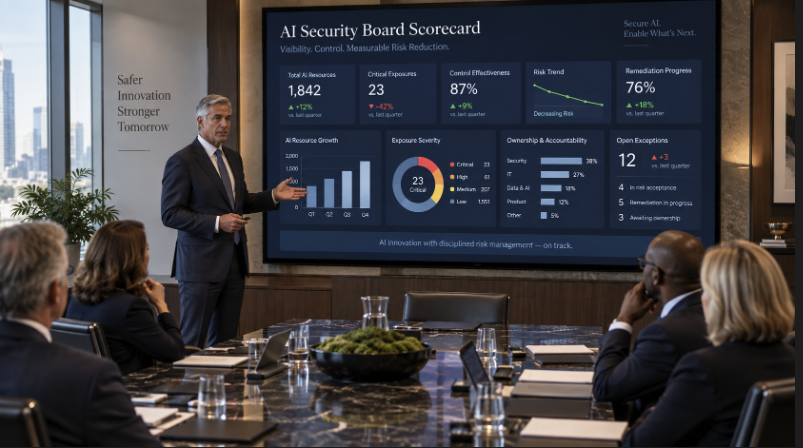
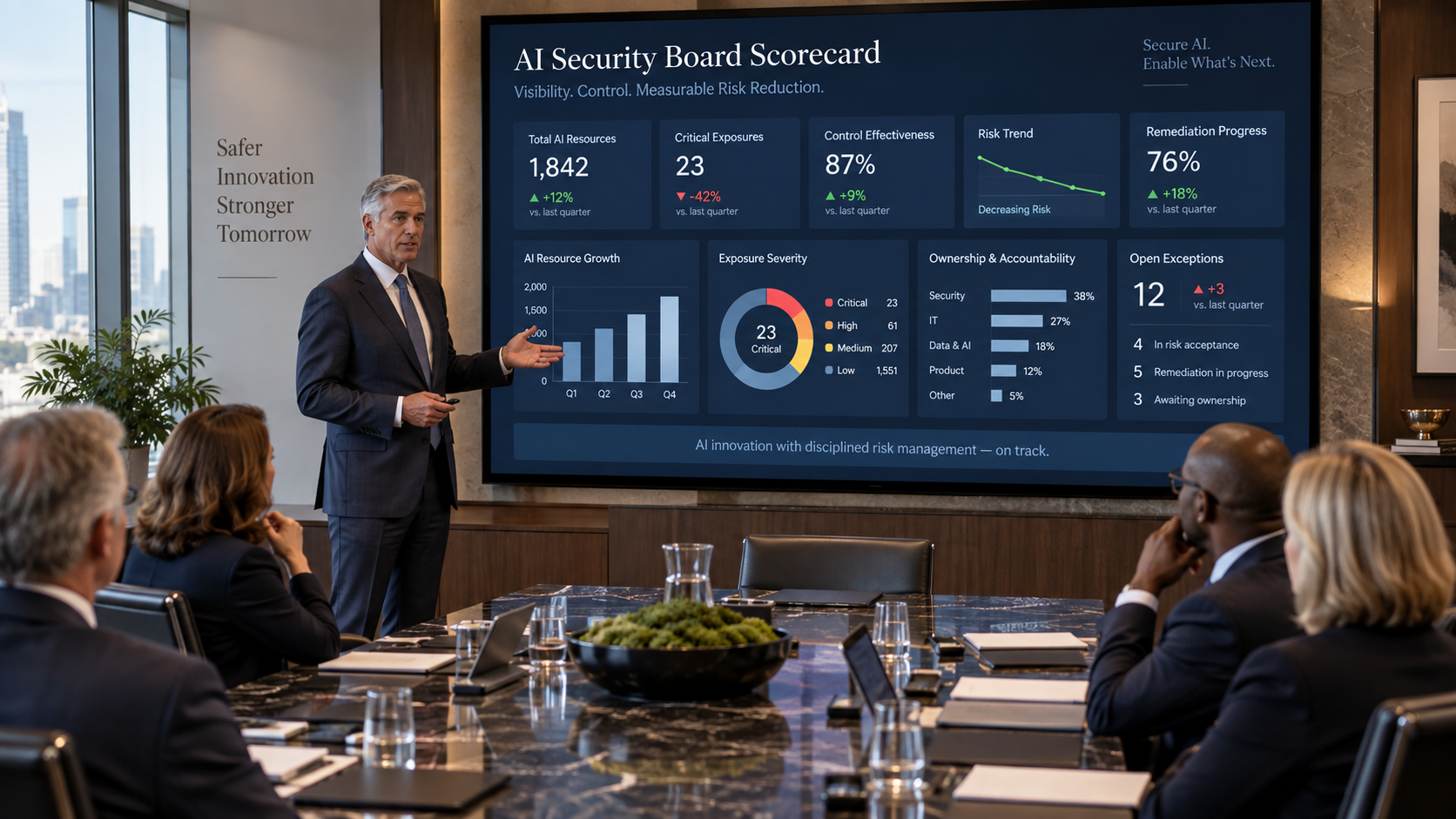
Figure 1. A board-ready AI security scorecard compresses technical telemetry into exposure, control effectiveness, trend, and accountability.
Why AI Security Reporting Is Different From Traditional Cyber Reporting
Traditional cyber dashboards often focus on vulnerabilities, incidents, patching, endpoint coverage, phishing, and identity risk. AI introduces additional dimensions: shadow adoption, AI-specific identities, prompt and data flows, model or agent autonomy, MCP and plugin connections, rapidly changing third-party tools, and the difference between approved and unapproved AI use.
A single AI resource can also cut across multiple control domains. An autonomous agent may be discovered by one tool, authenticate through a service account, access a sensitive database, invoke an external model, and trigger an action in a SaaS platform. Board reporting should reflect the combined exposure rather than presenting each technical finding in isolation.
The NIST AI Risk Management Framework provides a useful reporting lens because its Govern, Map, Measure, and Manage functions encourage organizations to connect governance with contextual understanding, measurement, and action. NIST’s Generative AI Profile adds generative-AI-specific risk considerations that can help security and risk teams define what to measure.
1. AI Inventory Coverage
The first board metric should answer a basic question: do we know what AI is operating in the enterprise? Report the number of material AI resources discovered, the percentage with an identified owner, and the percentage that have completed an approval or governance workflow.
The absolute count is less important than coverage and trend. A growing inventory can be healthy if visibility is improving. A low tool count can be misleading if discovery is incomplete. The board should see whether the organization is moving toward a continuously governed inventory, not whether the number of AI tools happens to be high or low.
Total material AI resources discovered.
Percentage with named business and technical owners.
Percentage classified as approved, restricted, under review, or blocked.
Percentage discovered across browser, endpoint, network, cloud, SaaS, developer, and agent surfaces.
New high-impact resources discovered since the previous reporting period.
2. Shadow AI Exposure
Boards should understand how much AI use sits outside approved channels. A useful metric is not merely the number of unsanctioned tools, but the subset with meaningful business exposure. Highlight shadow AI that touches sensitive data, privileged users, production systems, or high-value workflows.
The board-level story should distinguish discovery from risk. “We found 600 unapproved AI tools” can sound alarming without context. “We found 600; 92 percent were low-risk productivity tools, 31 required review, and 6 had access to sensitive systems and were restricted within 24 hours” is decision-useful.
3. Critical and High-Risk AI Exposures
The board needs the number and trend of AI exposures that could plausibly create material business impact. These should be contextual findings, not raw severity labels. High-risk exposures often combine multiple factors such as privileged identity, sensitive data, external connectivity, autonomous action, weak ownership, excessive permissions, or broad blast radius.
Report how many critical exposures exist, whether the number is rising or falling, how long they have been open, and which business functions they affect. Where appropriate, group exposures by risk theme such as data leakage, excessive agency, untrusted third-party integration, model or skill supply-chain risk, or weak governance evidence.
Figure 2. Effective board reporting shows the path from broad AI discovery to the smaller set of critical exposures and the portion already remediated.
4. Privileged AI Identities and Excessive Permissions
AI systems increasingly act through service accounts, OAuth grants, cloud roles, API keys, delegated user identities, and other non-human credentials. These identities determine how far a compromised or misbehaving AI resource can reach.
Useful board metrics include the number of privileged AI identities, the percentage operating under least privilege, the number with stale or excessive permissions, the number without a named owner, and the count of critical AI workflows that use shared or long-lived credentials. Trend matters more than raw volume: the board should see whether the organization is reducing unnecessary authority over time.
5. Sensitive Data Exposure Attempts
Boards need a high-level view of how often AI workflows encounter sensitive information and how effectively controls prevent inappropriate disclosure. Report blocked, redacted, coached, or escalated sensitive-data events by category and destination trust level.
Avoid presenting every prompt violation as a material incident. Separate ordinary policy coaching from high-impact events involving regulated data, source code, credentials, legal material, financial information, or confidential customer records. The board should understand whether risky data movement is increasing, decreasing, or shifting to new AI destinations.
6. Control Effectiveness
A risk program should demonstrate that controls change outcomes. Useful effectiveness metrics include the percentage of high-risk resources restricted or remediated, the number of risky actions blocked before execution, reductions in excessive permissions and unowned AI resources, policy coverage across critical AI workflows, and the percentage of sensitive AI interactions evaluated in real time.
This is the difference between reporting activity and reporting impact. “Security reviewed 400 AI tools” measures effort. “Critical exposure fell 35 percent while approved AI adoption increased” measures outcome.
7. Remediation Velocity
Time is one of the clearest board-level risk indicators. Report the median or average time from high-risk discovery to triage, from triage to owner assignment, and from confirmed critical exposure to mitigation. Aging buckets help make chronic risk visible: less than 7 days, 7–30 days, 31–90 days, and more than 90 days.
The most important metric is not whether every issue is closed instantly. It is whether critical risks have clear deadlines, owners, compensating controls, and executive visibility when deadlines slip.
8. Governance and Evidence Coverage
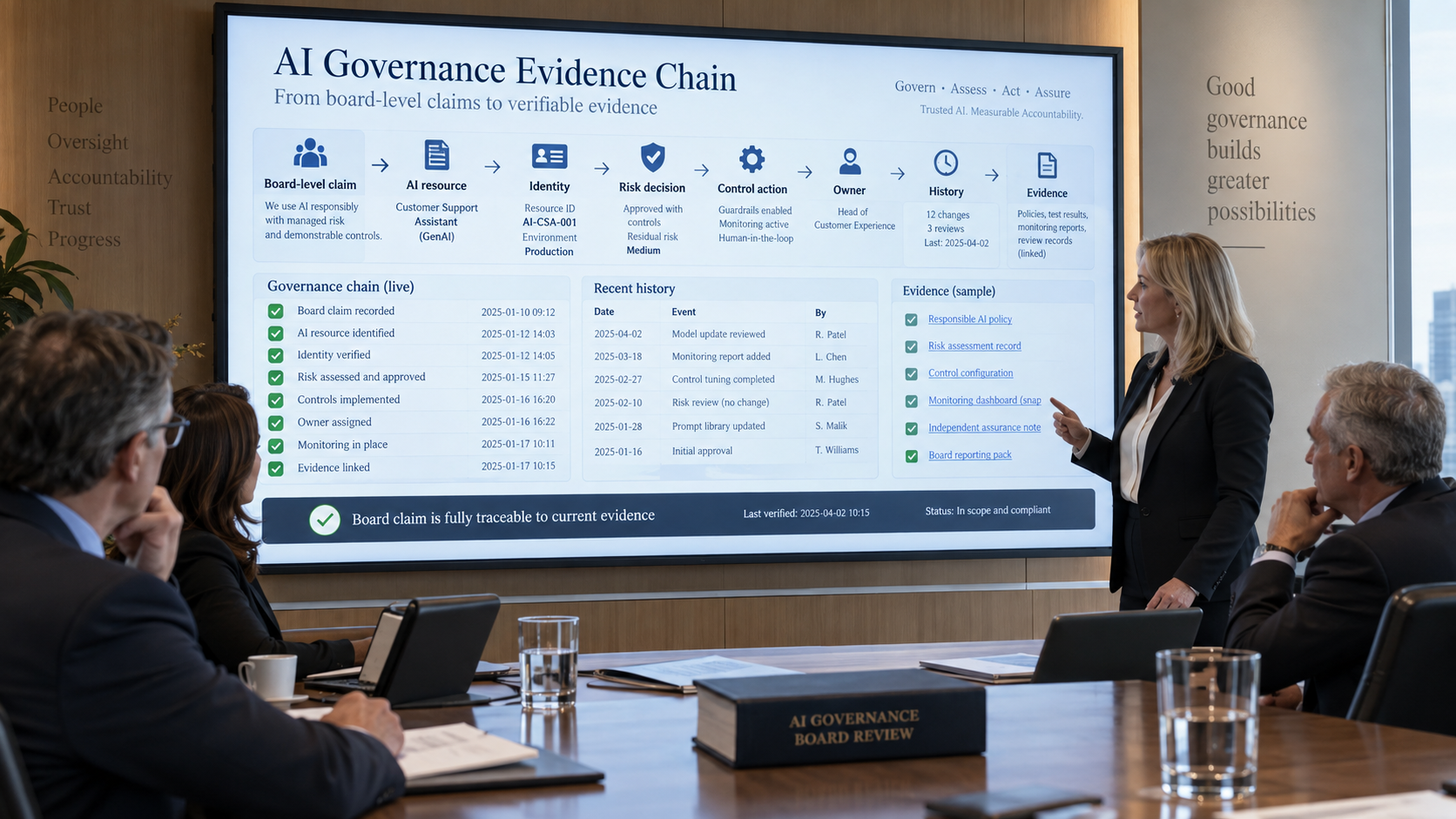
Boards and regulators need evidence that policy is more than a document. Report the percentage of material AI resources with a complete governance record: owner, business purpose, risk classification, identity mapping, data-access context, approval status, policy decision, review date, and audit history.
AIBound’s global bank case study illustrates the value of converting fragmented AI telemetry into a structured board-ready risk view. At the same time, its enterprise AI governance framework emphasizes reporting as a pillar of a mature governance program.
Figure 3. Board-level claims should be traceable to a live governance evidence chain from AI resource and identity through risk decision, control action, ownership, and history.
9. Policy Enforcement Outcomes
A board should know whether policy decisions are actually enforced. Summarize the number of allow, coach, restrict, quarantine, block, and exception decisions for material AI activity. Show the trend and explain major changes. A spike in blocks may indicate improved visibility, a new policy, a risky new tool, or deteriorating user behavior. Context determines the interpretation.
Where possible, connect enforcement to business enablement. An effective program should increase approved enterprise AI adoption while reducing unsafe use. That combination demonstrates that security is helping the business use AI safely rather than simply suppressing adoption.
10. Exceptions and Accepted Risk
Include accepted risk in board reporting when it is material, long-lived, or dependent on executive sponsorship. Report the number of open high-risk exceptions, their age, the business owner, compensating controls, and expiration date. Highlight exceptions that have been renewed repeatedly or lack a clear exit plan.
The board should be able to distinguish three categories: risk security is actively remediating, risk the business has formally accepted, and risk that remains unresolved because ownership or funding is unclear. Mixing these categories hides accountability.
11. AI Security Incident Trend
Report material AI-related incidents and near misses, not every policy event. Useful dimensions include incident count, severity, affected business processes, root cause, containment time, data impact, and recurrence. The objective is to show whether lessons are being converted into control improvements.
The MITRE ATLAS AI Incident Sharing initiative reflects the broader industry need for structured AI incident learning. Internally, the same principle applies: incident data should improve risk models, controls, testing priorities, and board understanding of the changing threat landscape.
12. Risk Trend, Not Just Point-in-Time Status
A single quarter-end score can hide direction. Boards should see whether enterprise AI risk is improving or deteriorating over time. A simple composite trend can combine critical exposure count, remediation speed, ownership coverage, excessive permission reduction, governance coverage, and policy enforcement outcomes.
The composite score should remain explainable. Do not create a mysterious number that nobody can reconstruct. Every movement in the score should be attributable to specific underlying changes.
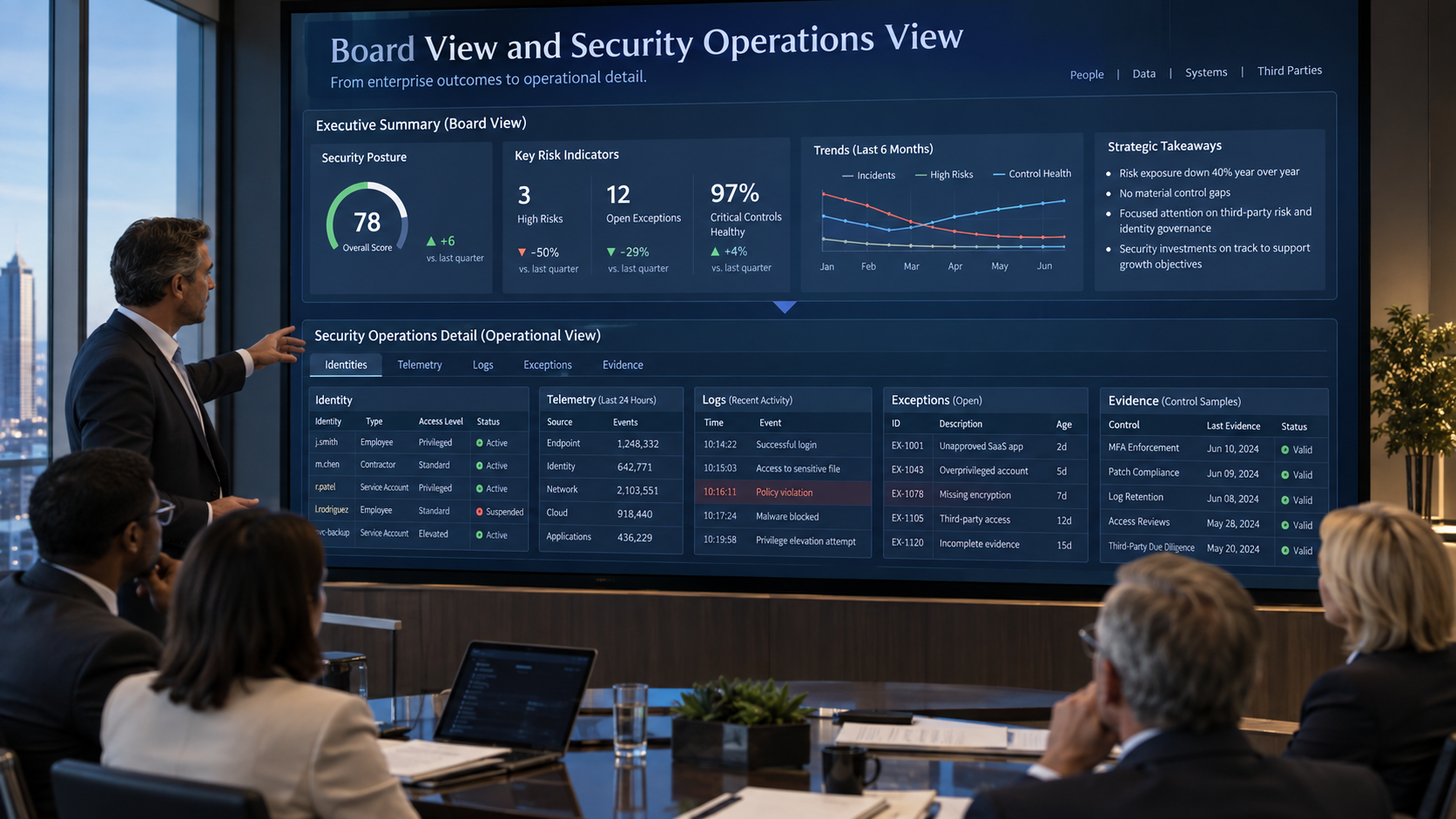
Figure 4. The board should get a compressed executive view, while security operations retains the detailed telemetry, identities, logs, exceptions, and evidence underneath it.
Metrics the Board Usually Does Not Need
Technical detail is necessary for the security team but can obscure the board discussion. Avoid filling board decks with raw prompt counts, total model API calls, every blocked domain, full vulnerability lists, per-event logs, extension IDs, or long tables of individual low-risk applications unless one of those details supports a material decision.
A useful test is simple: can a director understand why the metric matters, whether the trend is good or bad, and what decision or oversight action follows? If not, the metric probably belongs in the operational appendix rather than the main board view.
A Practical Board Dashboard: 10 Metrics
AI inventory coverage and percentage with named owners.
Approved versus shadow AI usage for material resources.
Critical and high-risk AI exposures, including aging.
Privileged AI identities and excessive-permission trend.
Control effectiveness: blocked, restricted, or remediated high-risk actions.
Median time to remediate critical AI exposure.
Governance evidence coverage for material AI resources.
Open material exceptions and accepted-risk aging.
Material AI security incidents and quarter-over-quarter risk trend.
How to Present the Metrics to the Board
Lead with the story, not the spreadsheet. Begin with what changed since the last meeting, why it changed, and whether the organization’s residual risk is moving in the right direction. Then show the top material exposures, the status of previously reported items, the effectiveness of the most important controls, and the decisions required from leadership.
Each metric should have an owner, a trend, a target or threshold, and a short interpretation. For example: “Privileged AI identities without least-privilege validation: 14, down from 29 last quarter; target below 10; five remaining identities belong to the finance automation program and are scheduled for scope reduction by October 15.”
A 90-Day Reporting Improvement Plan
Days 1-30: Define the Board Questions
Agree with the CISO, CIO, risk leader, and board committee on the questions the report must answer. Establish a common definition of material AI resource, critical AI exposure, privileged AI identity, sensitive-data event, accepted risk, and governance coverage.
Days 31-60: Connect the Evidence
Link AI inventory, identities, permissions, data context, risk decisions, enforcement actions, incidents, exceptions, and remediation records. Eliminate metrics that cannot be traced to current operational evidence.
Days 61-90: Establish Trend and Thresholds
Define targets, warning thresholds, and quarter-over-quarter trend logic. Build an executive page with no more than roughly ten primary metrics and keep detailed operational data in supporting material.
Frequently Asked Questions
How many AI security metrics should go on the board dashboard?
Usually a small set is more effective than a large catalog. Around eight to twelve primary metrics is often enough as long as each answers a specific risk or oversight question. Detailed supporting metrics can remain in an appendix or operational dashboard.
Should the board see the total number of AI tools?
Yes, but only with context. Total count is a visibility metric, not a risk metric. Pair it with ownership coverage, governance status, material-risk count, and trend so the board can understand whether discovery is improving or risk is increasing.
What is the most important AI security metric?
There is no single universal metric. For most organizations, the most useful top-level view is the trend in material AI exposure combined with evidence that critical risks are being remediated within defined timeframes. That connects posture to action.
How often should AI security be reported to the board?
The formal cadence depends on the organization and board committee, but the underlying data should be continuous. A quarterly board report built from live inventory and evidence is more defensible than a quarterly manual reconstruction.
Conclusion
Board-level AI security reporting should not be a catalog of tools or alerts. It should explain enterprise exposure, control effectiveness, direction of travel, accountability, and the decisions leadership needs to make. The most credible metrics can be traced from an executive statement back to the AI resource, identity, data connection, risk rationale, control action, owner, and dated evidence.
When CISOs report AI risk this way, the board can oversee AI adoption with greater confidence. Security teams also gain a clearer operating model because the same evidence that powers the board dashboard can drive prioritization, remediation, governance, and continuous improvement.
See Your AI Attack Surface
Discover every AI tool, agent, and model running in your enterprise — before attackers do.