How Should Security Teams Respond When an AI Agent Causes a Security Incident?
Published:
August 30, 2026
Niall Browne
Summary
AI agents can turn a security event into a chain of actions across identities, tools, APIs, data, connectors, and downstream systems. This article explains how security teams should adapt incident response for agentic AI by treating the agent, identity, credentials, tools, MCP servers, data paths, and completed actions as one coordinated incident that must be contained, investigated, recovered, and improved through stronger controls.
Key Takeaways
AI-agent incidents should not be investigated as only a model or application issue. Security teams need to examine the agent, identity, tools, credentials, data access, external destinations, and downstream actions together.
Agentic AI changes incident response because agents can interpret instructions, select tools, reuse context, call APIs, modify records, and execute multi-step workflows without approval at every step.
Security teams should prepare AI-specific incident playbooks before an event occurs, including emergency stops, credential revocation, connector blocking, MCP server isolation, evidence preservation, and business-owner escalation.
Triage should focus on business impact, not just unusual model behavior. A normal-looking AI output can be critical if it causes data export, production modification, access changes, or financial actions.
Containment should target the full capability chain, including the agent session, service account, OAuth grant, API key, connector, MCP server, permissions, and affected workflow.
AI forensics requires preserving the full instruction-to-impact evidence chain, including prompts, retrieved context, tool calls, model versions, skill versions, identity events, API requests, approvals, policy decisions, and downstream logs.
Security teams should scope blast radius before declaring containment complete because multiple agents may share the same identity, connector, skill, MCP server, or credential.
Root-cause remediation should fix the control failure that allowed the agent to create impact, such as excessive permissions, unsafe tools, weak approval thresholds, untrusted connectors, or missing data restrictions.
Recovery should not restore the exact pre-incident configuration if that setup enabled the failure. Teams should recover with reduced permissions, short-lived credentials, stronger approval gates, and higher monitoring.
Post-incident review should create concrete improvements across AI discovery, identity mapping, data-connection mapping, risk scoring, prevention, audit logging, and runtime control.
AI agents can turn a security event into a chain of actions faster than traditional incident processes were designed to handle. One manipulated instruction can cause an agent to call a tool, use a privileged identity, retrieve sensitive data, invoke an external API, and modify a downstream system before an analyst has opened a ticket.
AIBound’s 5 Steps to Discover, Score, and Prevent High-Risk AI walkthrough is useful for incident response because it emphasizes the context defenders need before acting: the AI resource, the identity behind it, the connected systems and data, the risk level, and the prevention path.
This article explains how security teams can adapt incident response to agentic AI by containing the complete capability chain, preserving AI-specific evidence, understanding blast radius, recovering safely, and feeding lessons back into identity, permission, and policy controls.
Direct Answer: Treat the Agent, Identity, Tools, and Downstream Actions as One Incident
When an AI agent causes or contributes to a security incident, the response should not focus only on the model or application. Security teams should immediately identify the agent session, the identity and credentials it is using, the skills and tools it can invoke, the data it can reach, the external destinations it can contact, and the downstream actions already completed.
The priority is to stop further impact while preserving evidence. That may require freezing the agent, revoking tokens, blocking connectors, narrowing service-account permissions, isolating a workflow, or applying an existing endpoint, network, identity, or SaaS control. The second priority is to reconstruct the full instruction-to-impact chain so the organization fixes the real control failure, not just the visible symptom.
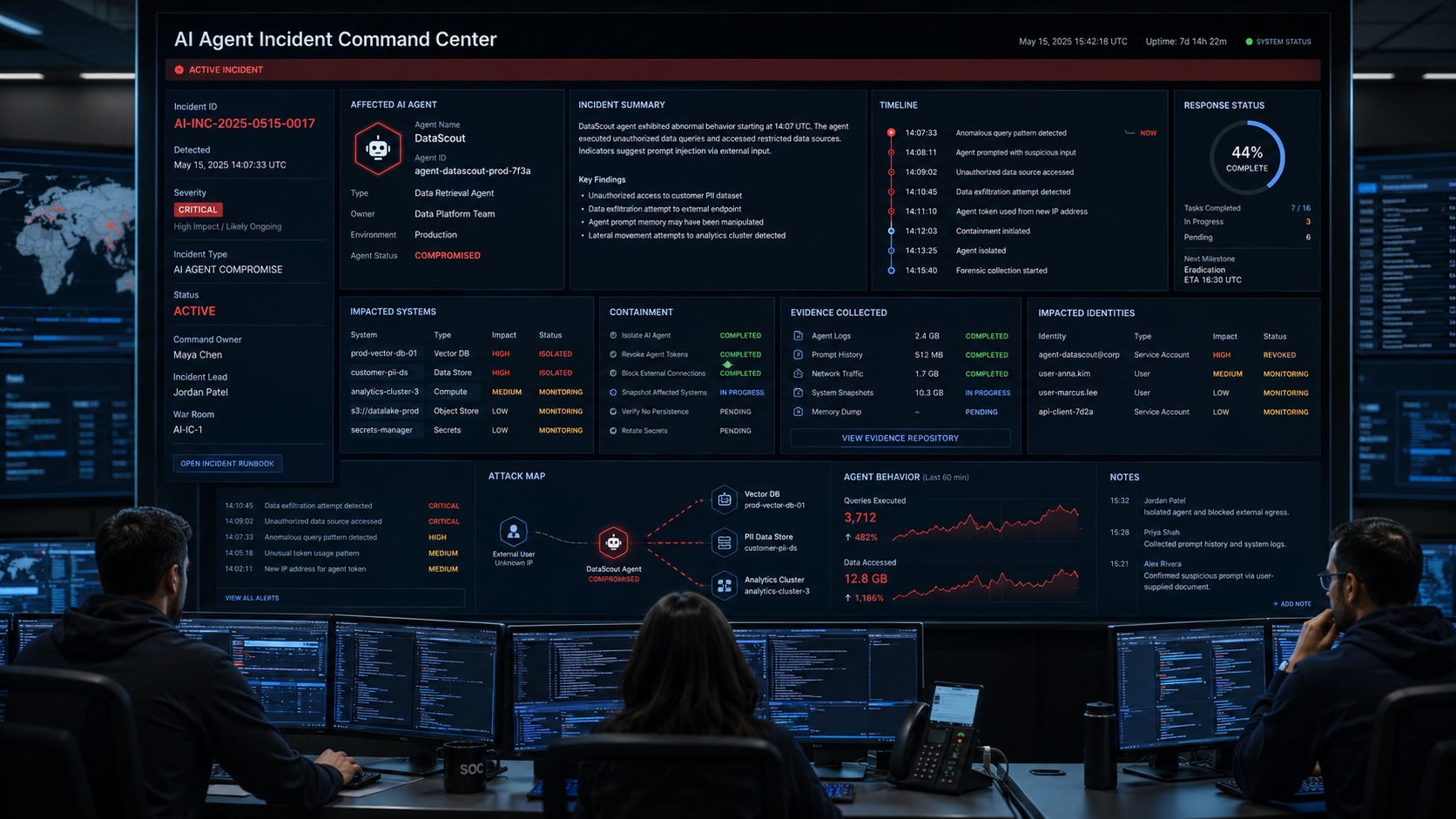
Figure 1. AI-agent incident response should contain the agent, credentials, connectors, data paths, and downstream systems as one coordinated incident.
Why AI Agent Incidents Are Different From Conventional Application Incidents
Traditional incidents often center on a compromised endpoint, account, application, or network path. Agentic AI can connect all of those domains inside one workflow. The agent may interpret ambiguous content, choose a tool dynamically, reuse previous model output as context, and execute several steps without a person approving each one.
The OWASP Excessive Agency guidance explains that excessive functionality, permissions, or autonomy can lead to damaging outcomes. This means an incident may not involve a conventional exploit. The agent may simply be acting within authority that should never have been granted.
AI incident response therefore needs stronger identity context, tool-call evidence, prompt and retrieved-content preservation, and a clear understanding of which actions were recommendations versus executions.
1. Prepare an AI-Specific Incident Playbook Before an Event Occurs
The worst time to decide how to disable an agent is after it has started acting unexpectedly. Preparation should define who can freeze an AI workflow, revoke a service-account token, block an MCP server, disable an OAuth grant, preserve prompt logs, and coordinate with the business owner.
The current NIST SP 800-61 Rev. 3 treats incident response as part of cybersecurity risk management across the full CSF 2.0 lifecycle rather than as an isolated technical activity. For AI, that means preparation should connect governance, asset inventory, identity ownership, monitoring, response authority, recovery, and lessons learned.
Named security incident owner and business owner for each high-risk agent.
Emergency method to stop or isolate the agent workflow.
Credential revocation and rotation procedures.
Connector and MCP blocking procedure.
Location of prompt, tool-call, policy, identity, and API logs.
Process for preserving volatile context such as agent memory and session state.
Criteria for legal, privacy, compliance, customer, and executive notification.
Safe fallback process if the business workflow must continue manually.
2. Detect and Triage the Event Using AI Context
Triage an AI incident by potential business impact, not simply by model behavior. A strange output may be harmless. A normal-looking output that causes an unauthorized payment, data export, access change, or production modification may be critical.
AIBound’s article on contextual AI risk prioritization highlights the importance of combining identity privilege, data sensitivity, external exposure, autonomy, business criticality, and blast radius. The same dimensions are useful during incident triage.
What agent, model, skill, plugin, MCP server, or browser extension was involved?
Which human or machine identity authorized the actions?
What data was accessed, generated, exported, or modified?
Which tools and external destinations were involved?
Did the agent act autonomously or after human approval?
Were production, customer-facing, financial, identity, or security systems affected?
Is the risky behavior still active or repeatable?
Could other agents use the same credential or connector?
3. Contain the Complete Capability Chain
Containment should stop the ability to continue harmful actions. Disabling only the front-end assistant may be insufficient if the same service account, API key, connector, or MCP server remains usable elsewhere.
AIBound’s Policy Enforcement platform illustrates a graduated-response model in which high-risk AI can trigger blocks, alerts, tickets, or workflow actions through the existing security stack. During an incident, defenders should use the fastest reliable control point available.
Freeze or turn off the affected agent session.
Revoke active tokens, API keys, and OAuth grants when credential misuse is possible.
Block the connector, MCP server, extension, or external domain involved in the event.
Temporarily reduce the service identity to read-only or minimum access.
Disable autonomous execution for high-impact actions.
Protect unaffected workflows from using the same risky component.
Preserve logs and context before deleting, reimaging, or rebuilding anything.
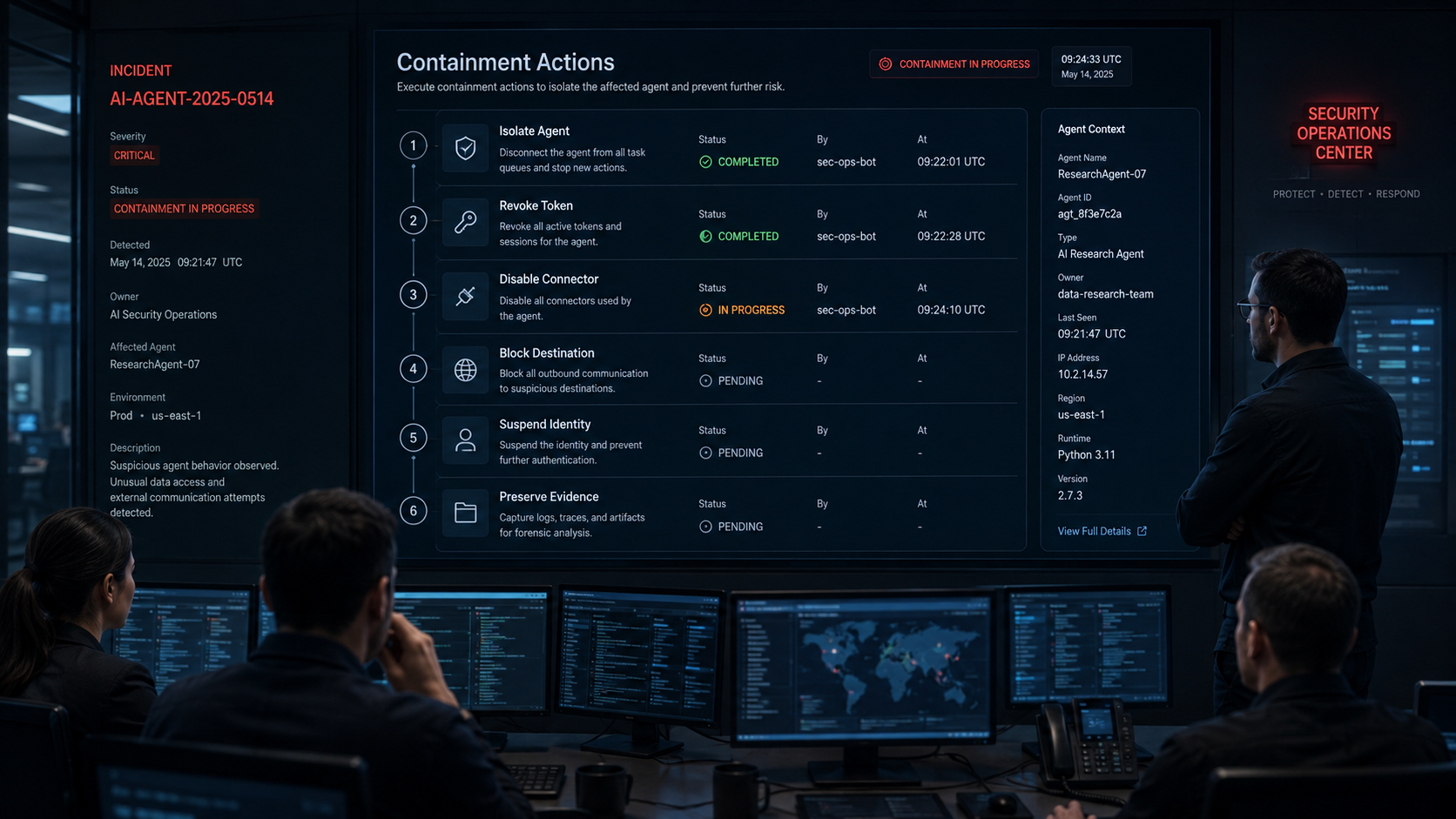
Figure 2. Effective containment targets the capability chain: agent execution, credentials, connectors, permissions, evidence, and business coordination.
4. Preserve the Full Instruction-to-Impact Evidence Chain
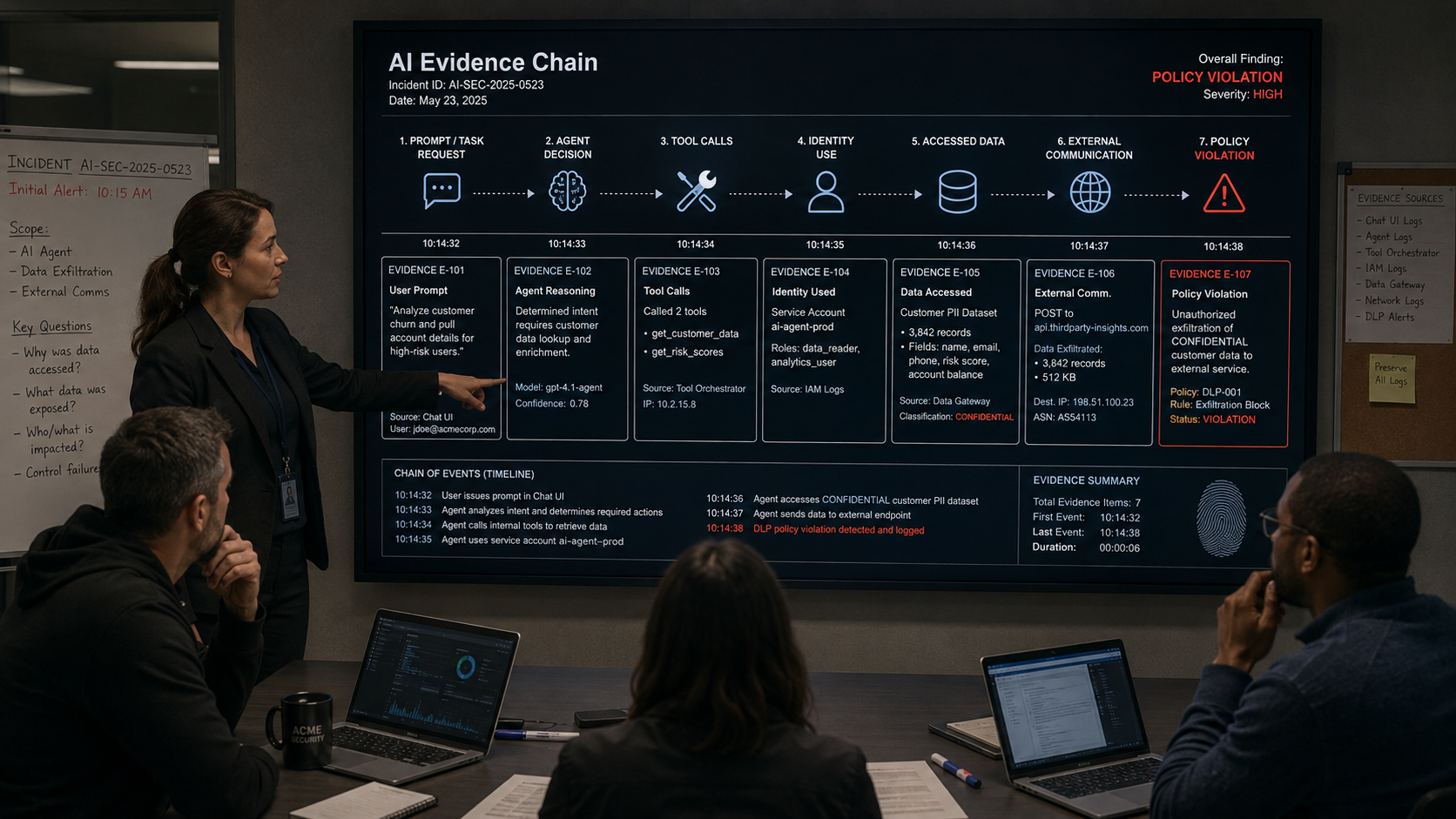
AI forensics requires more than application logs. Investigators need enough evidence to explain how an instruction became an action. That chain may begin with a user prompt, a retrieved document, a malicious web page, a compromised skill, an altered tool description, or a peer-agent message.
Preserve the prompt and retrieved context, model and tool versions, agent memory (if available), selected skills, tool arguments, identity events, API requests and responses, policy decisions, approvals, downstream application logs, timestamps, and the final business effect. If the organization cannot reconstruct this chain, it may fix the wrong control and leave the root cause available for reuse.
The MITRE ATLAS knowledge base provides a useful adversary-oriented reference for AI threats across tactics such as credential access, collection, exfiltration, persistence, privilege escalation, and impact. Mapping incident evidence to known attack techniques can improve investigation consistency and help red teams reproduce the failure path.
Figure 3. Preserve evidence across prompt, model, skill, identity, API, downstream system, and business impact so investigators can reconstruct the complete chain.
5. Scope the Blast Radius Before Declaring Containment Complete
An agent incident may extend beyond the first visible event. Several agents can use a shared identity. A compromised skill can be installed across multiple teams. An MCP server may expose several tools. Retrieved sensitive data may have been copied into model context, logs, external services, or downstream records.
Other agents using the same identity or token.
Other users who installed the same skill, extension, or connector.
Additional datasets reachable through inherited permissions.
External services that received prompts, files, or generated output.
Downstream records modified by the agent.
Repeated actions triggered by scheduled or autonomous workflows.
Credentials or secrets that may have been exposed to the agent context.
Customer, employee, financial, legal, or production systems in the same path.
6. Eradicate the Root Cause, Not Only the Visible Symptom
If a malicious instruction caused the incident, deleting that instruction is not enough when the agent still has excessive permissions. If a token was stolen, rotating it is not enough when the same connector can request another overbroad token. If a model hallucinated an unsafe action, changing the prompt is not enough when downstream systems accept high-impact actions without independent authorization.
Root-cause remediation should address the control layer that allowed unsafe behavior to become real impact. That can include least-privilege changes, narrower tool functionality, per-action authorization, stronger connector review, human approval, data restrictions, egress controls, safer retrieval boundaries, or improved policy enforcement.
AIBound’s article on malicious AI skill detection reinforces this point by tracing skill risk through intent, identity, permissions, data destinations, and monitoring rather than treating a skill as safe or unsafe based only on its name.
7. Recover With a Reduced-Risk Configuration
Recovery should not restore the exact pre-incident configuration if that configuration enabled the failure. Bring the workflow back in a constrained state, verify each identity and connector, test the corrected controls, and gradually restore capability.
Issue new short-lived credentials rather than reusing the old token.
Restore only the minimum approved permissions.
Keep high-impact actions behind human approval until confidence is re-established.
Run replay tests using the original malicious or ambiguous input where safe.
Verify that downstream systems independently enforce authorization and limits.
Monitor the recovered workflow at a higher level for a defined period.
Require the business owner to sign off on restored production use.
8. Convert the Incident Into Better AI Controls
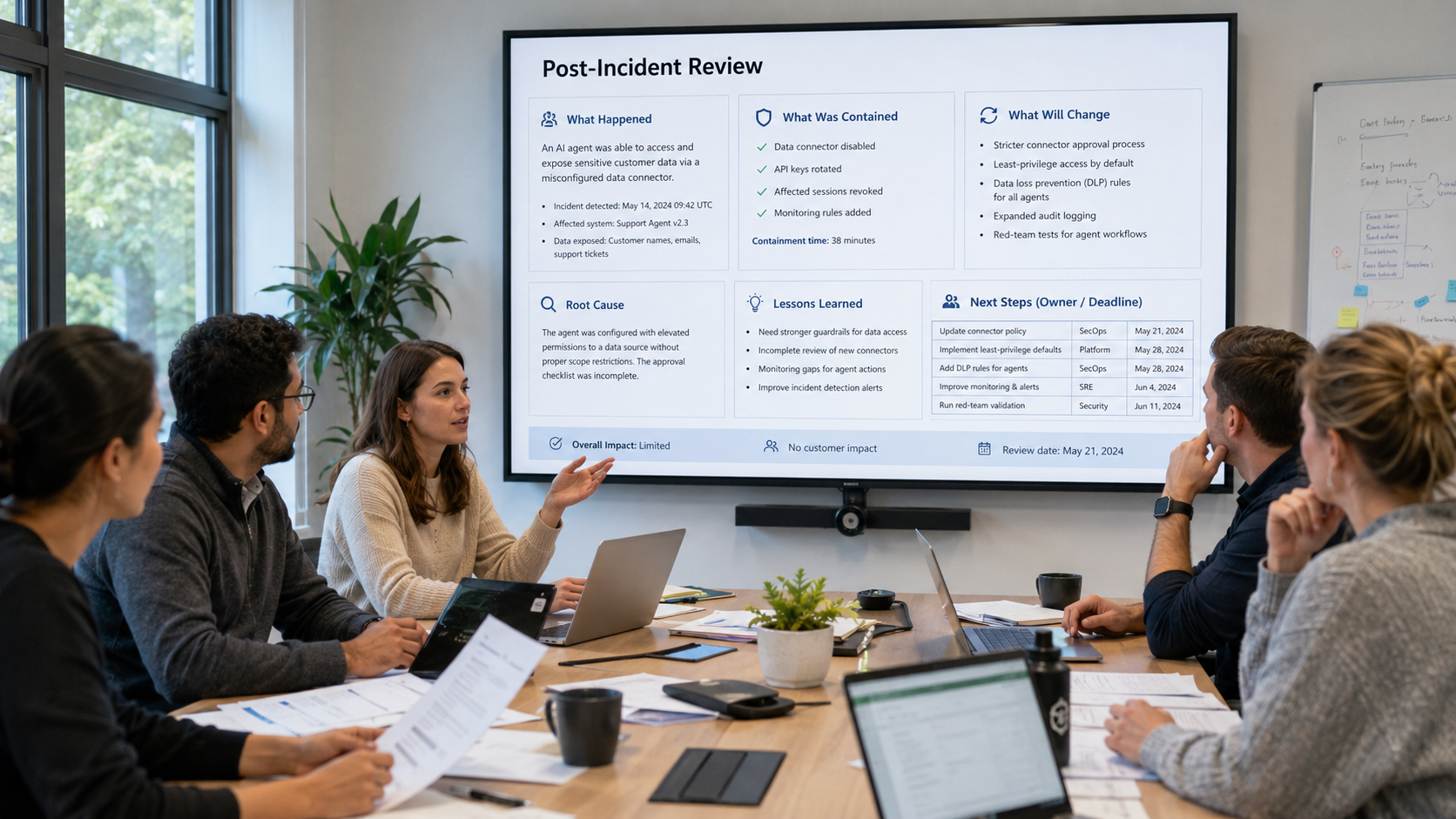
Post-incident review should produce concrete control changes, not only a narrative timeline. Ask which signals were missing, which response took too long, which permissions were broader than necessary, which evidence was unavailable, and whether another agent could follow the same path.
The AIBound Control Plane for High-Risk AI describes a five-step operating model: discover AI, expose identities, map data connections, measure risk, and prevent high-risk AI. An effective post-incident review should strengthen one or more of those stages so the organization becomes harder to surprise the next time.
Figure 4. Post-incident review should connect root cause to control gaps, specific fixes, verification evidence, and measurable response improvements.
A 30-Minute AI Agent Incident Response Checklist
Confirm the affected AI resource and open an incident record with a named incident commander.
Identify the identity, token, service account, OAuth grant, or cloud role authorizing the agent.
Freeze the agent or stop the affected workflow if harmful actions are still possible.
Revoke or restrict credentials that could be reused for additional actions.
Block suspicious connectors, MCP servers, extensions, or external destinations.
Preserve prompts, retrieved context, tool calls, identity events, API logs, policy decisions, and downstream changes.
Map the accessible systems and determine whether the same component is used elsewhere.
Notify the business owner and any privacy, legal, compliance, or executive stakeholders required by impact.
Create a reduced-risk recovery configuration and verify controls before restoring production use.
Document root cause, control gaps, lessons learned, and owners for follow-up actions.
Metrics Security Leaders Should Track
Mean time to detect AI-agent incidents.
Mean time to contain agent execution and revoke risky credentials.
Percentage of high-risk agents with tested emergency stop procedures.
Percentage of incidents with complete prompt-to-impact evidence.
Number of downstream systems affected per AI incident.
Repeat incidents involving the same skill, connector, identity, or policy gap.
Time required to restore a reduced-risk production workflow.
Post-incident control actions completed by due date.
Percentage of high-impact agent actions protected by independent approval or authorization.
Frequently Asked Questions
Should security teams shut down every AI system during an incident?
No. Containment should be proportionate to the affected capability chain. If the incident is isolated to one agent, credential, connector, or workflow, broad shutdowns can create unnecessary business disruption. Use the narrowest control that reliably stops further harm.
What evidence is most important in an AI-agent incident?
The most important evidence connects instruction to action: prompt or retrieved content, model and skill versions, tool selection, tool arguments, identity and credential events, API calls, policy decisions, approvals, downstream system logs, and timestamps.
When should token revocation happen?
Immediately when there is credible evidence that a credential is compromised, overprivileged, being misused, or could be reused to continue harmful actions. Preserve relevant identity logs first when possible, but do not delay containment if impact is ongoing.
Is prompt injection always the root cause?
No. Prompt injection can be a trigger, but material impact usually requires additional conditions such as excessive permissions, unsafe tools, insufficient authorization, sensitive data access, or excessive autonomy. Incident response should identify the full combination.
How can teams test their AI incident response plan?
Run tabletop exercises and controlled simulations that trace a complete path from malicious or ambiguous input to model decision, skill or tool selection, identity use, API call, downstream action, containment, evidence preservation, and recovery.
Conclusion
AI agents change incident response because the security team is no longer dealing only with software that waits for a person to act. An agent can interpret, choose, call, modify, and repeat. The response program must therefore understand the authority behind the agent and the chain of systems that convert generated decisions into business impact.
A strong AI-agent incident process prepares emergency controls in advance, triages using identity and data context, contains credentials and connectors, preserves the full evidence chain, scopes the blast radius, fixes the underlying control gap, and recovers with reduced risk. Organizations that build this discipline now can respond faster to AI incidents without giving up the operational benefits of agentic automation.
See Your AI Attack Surface
Discover every AI tool, agent, and model running in your enterprise — before attackers do.



%401x.png)