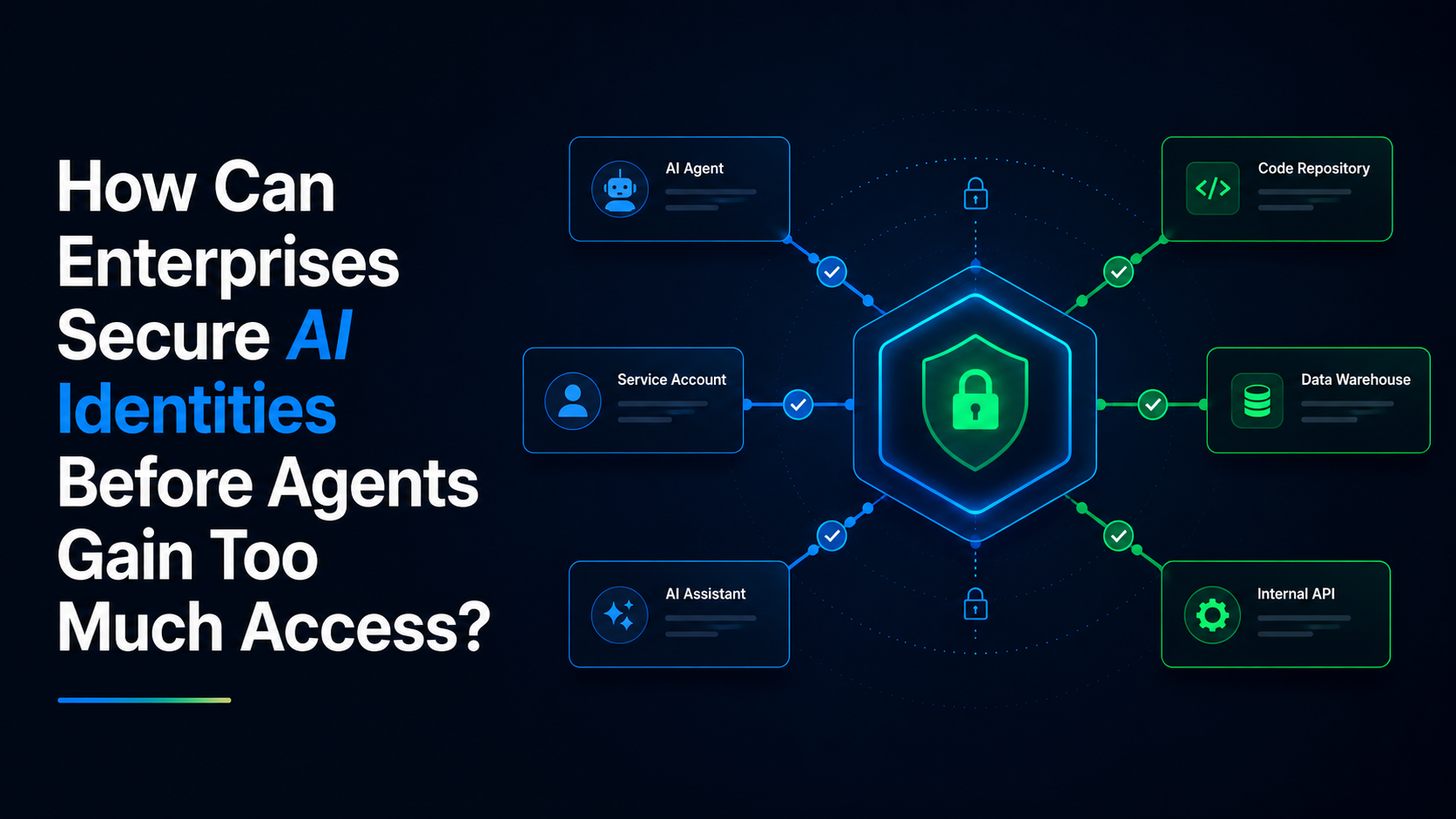
AI agents are no longer just passive tools; they can authenticate, access systems, and act on behalf of users or business processes.
Enterprise AI risk depends on what an AI identity can access, not just which model or app is being used.
Security teams should map user accounts, service accounts, roles, tokens, and machine identities connected to AI systems.
Reducing unnecessary permissions and monitoring access changes are key controls for AI identity security.
AIBound helps enterprises discover AI identities, evaluate access risk, and prevent high-risk AI before it spreads.
Artificial intelligence is no longer operating only as a tool that waits for a person to type a prompt. Across modern enterprises, AI assistants and agents are beginning to authenticate to applications, access internal information, call APIs, use plugins, and complete tasks on behalf of employees and business systems.
That shift makes identity one of the most important control points in enterprise AI security. An AI system may appear harmless when viewed only as an application name. Its real risk becomes visible when security teams identify the user, service account, role, token, or machine identity under which it operates and then examine what that identity is permitted to do.
A writing assistant with access only to public content presents a very different exposure from an autonomous agent using a privileged account across production repositories. The model may be similar, but the authority behind it is not.
AIBound’s YouTube video 5 Steps to Discover, Score, and Prevent High-Risk AI places “Expose AI Identities” immediately after discovery. That order matters. Finding an AI resource tells security teams that it exists. Mapping its identity begins to reveal what it can actually reach and change.
Enterprises that want to adopt AI safely therefore need a structured program for discovering AI identities, reducing unnecessary permissions, monitoring access changes, and preserving human approval for high-impact actions.
What Is an AI Identity?
An AI identity is any human or non-human identity through which an AI application, model, assistant, agent, extension, or automated workflow accesses enterprise resources. Sometimes the AI acts directly through a dedicated service account. In other cases, it inherits the permissions of an employee, an OAuth application, a cloud role, an API key, or a shared integration account.
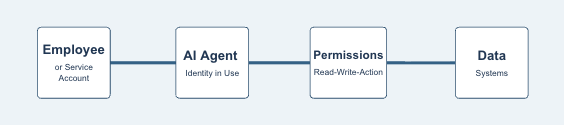
The identity may be obvious in a cloud console, or it may be hidden several layers deep. An employee signs into a SaaS platform. The platform activates an AI assistant. The assistant calls a plugin. The plugin uses a service account to query a database. The visible user is only one part of the chain.
Security teams should therefore document both the top-level identity and the downstream identities involved in the workflow. A useful inventory distinguishes between:
- Individual employee accounts used by AI-enabled applications
- Shared accounts used by teams or departments
- Service accounts created for agents and automations
- OAuth applications and delegated authorization grants
- Cloud roles and workload identities
- API keys, access tokens, and integration secrets
- Local machine identities used by developer tools
- Agent-to-agent identities in multi-agent workflows
This inventory is the foundation for answering a more meaningful question than “Who launched the tool?” The more important question is “Whose authority is the tool using at every step?”
Security teams can explore additional AIBound AI security resources covering Shadow AI, governance, agents, and emerging attack-surface risks.
Why AI Identity Risk Is Different From Ordinary Access Risk
Traditional identity and access management assumes that a person or workload requests access to a defined resource for a relatively predictable purpose. AI agents introduce more uncertainty because they may interpret natural-language instructions, select tools dynamically, chain multiple actions, and act on outputs generated during the workflow.
An identity that was acceptable for a fixed automation may become too powerful when attached to an adaptive agent. The agent may be able to choose among many functions, repeat actions, combine information from different systems, or respond to content that contains malicious instructions.
OWASP describes “Excessive Agency” as the risk created when an LLM-based system has excessive functionality, permissions, or autonomy. In practical terms, an agent does not need to exploit a software vulnerability if the organization has already given it more authority than the task requires.
This is why the permission review cannot stop at the model or application. Security teams must examine the complete chain:
- What functions can the agent invoke?
- Which identity authorizes each function?
- Can the agent read, create, modify, delete, publish, or transfer data?
- Can it access credentials or generate new tokens?
- Can it trigger financial, operational, or customer-facing actions?
- Does a person review the action before execution?
- Can downstream systems independently verify authorization?
A companion AIBound video walkthrough is available at AIBound enterprise AI security walkthrough. It can be linked beside this article to help readers explore the wider enterprise AI security context.
The Four Identity Patterns That Create the Most Risk
1. Agents That Inherit Broad Employee Permissions
An assistant operating through an employee session may gain access to everything that person can reach in email, cloud storage, collaboration platforms, customer systems, and internal dashboards. The employee may understand the sensitivity of those systems, but the agent may process instructions or external content without the same judgment.
2. Shared Service Accounts With No Clear Owner
Shared accounts are difficult to govern because activity cannot be attributed cleanly to one person or one use case. When several automations and agents use the same credentials, security teams may not know which workflow performed an action or whether removing access will break another process.
3. Long-Lived Tokens and API Keys
Long-lived credentials can remain valid after a pilot ends, a developer changes roles, or an integration is no longer needed. If an agent stores those credentials locally or passes them through plugins, the potential exposure grows.
4. Privileged Machine Identities
Agents connected to administrative roles, production repositories, deployment systems, HR databases, or financial platforms can create a large blast radius. A single incorrect or manipulated action may affect many records, users, or systems before a person notices.
A Seven-Step Framework for Securing AI Identities
Step 1: Discover the AI Resource and Its Identity
Begin by identifying AI applications, agents, extensions, models, MCP servers, and embedded AI features across browsers, endpoints, networks, code environments, and cloud services. For every resource, record the human and machine identities involved.
Step 2: Map the Complete Permission Path
Document the systems, datasets, tools, and actions accessible through each identity. Include inherited permissions, delegated OAuth scopes, plugin permissions, cloud roles, and any credentials stored by the agent or workflow.
Step 3: Assign an Owner and Business Purpose
Every material AI identity should have a named owner who can explain why it exists, what task it supports, what data it handles, and how long the access is needed. Unowned identities should be treated as higher risk until ownership is established.
Step 4: Apply Least Privilege
Reduce permissions to the minimum required for the specific task. Prefer read-only access where possible, restrict access to selected repositories or datasets, separate testing from production, and avoid broad administrative roles.
Step 5: Limit Credential Lifetime
Use short-lived tokens, managed workload identities, and automated credential rotation. Remove access when a pilot ends or an agent is retired. Avoid embedding reusable secrets in prompts, local files, extensions, or agent memory.
The NIST AI Risk Management Framework also provides a practical structure for governing, mapping, measuring, and managing AI risk as identities and permissions change.
Step 6: Require Human Approval for High-Impact Actions
Human review is especially important when an AI system can send payments, deploy code, delete records, change permissions, communicate externally, or act on regulated information. The reviewer should see the proposed action, the target system, the data involved, and the identity that will execute it.
Step 7: Monitor Identity and Permission Changes Continuously
AI workflows evolve quickly. New plugins are installed, scopes expand, service accounts are reused, models change, and agents gain new functions. A quarterly access review is unlikely to capture the pace of change. Security teams need continuous monitoring for new identities, new grants, dormant credentials, unusual access, and changes in the blast radius.
How AIBound Connects Identity to Risk
AIBound positions AI identity as part of a five-stage control process: discover Shadow AI, expose the identities it uses, map the data connections available to those identities, measure the resulting risk, and prevent high-risk activity. The platform states that it combines telemetry from browser, endpoint, network, cloud, and existing security tools rather than relying on a separate view of each layer.
The value of this approach is correlation. A browser event may show that an employee opened an AI tool. Identity telemetry may show the user’s role. Cloud and data-security information may show that the role can access sensitive records. When these signals are connected, security teams can distinguish routine use from a dangerous combination.
AIBound's AI governance framework for CISOs explains how identity controls fit into a broader enterprise governance program.
A Practical AI Identity Policy
A useful policy should be specific enough to guide technical decisions without preventing legitimate experimentation. It can establish the following rules:
- Every production AI agent must use a dedicated, identifiable account.
- Shared credentials are prohibited for high-impact AI workflows.
- AI identities must have a documented owner and expiration or review date.
- Administrative access requires written justification and additional monitoring.
- Agents should receive read-only access unless write access is essential.
- High-impact actions require human confirmation or an independently enforced approval step.
- Credentials must be stored in approved secret-management systems.
- Unused tokens, OAuth grants, and service accounts must be revoked promptly.
- New plugins, skills, tools, and MCP connections require permission review.
- Identity and access events must be retained for investigation and audit.
The policy should also define a fast path for low-risk use cases. An employee using an approved assistant with public information should not face the same review process as a developer connecting an autonomous agent to production infrastructure.
Metrics That Show Whether Identity Controls Are Working
Security leaders can track the number of AI identities discovered, the percentage with named owners, privileged AI identities, shared accounts used by agents, long-lived credentials, identities with access to sensitive data, agents operating without human approval, average time to revoke unused access, permission reductions completed, and high-risk identity combinations prevented.
These measurements help leadership understand whether the organization is reducing exposure while AI adoption grows. The goal is not to produce fewer AI identities. It is to make every identity visible, owned, appropriately scoped, and continuously monitored.
Frequently Asked Questions
Should every AI agent have a separate identity?
Production agents and high-impact automations should generally use dedicated identities so permissions, ownership, and activity can be traced. Low-risk features embedded inside an approved application may continue to operate through user sessions, provided the inherited access is understood and controlled.
Is multifactor authentication enough to protect AI identities?
Multifactor authentication protects the login process, but it does not reduce excessive permissions, limit autonomy, or prevent an authenticated agent from taking an unsafe action. It should be combined with least privilege, short-lived credentials, approval controls, and monitoring.
What identity should be investigated first?
Prioritize identities that combine administrative privileges, sensitive data access, broad system reach, long-lived credentials, weak ownership, and autonomous action. These characteristics create the largest potential blast radius.
Can existing IAM tools manage AI identity risk?
Identity platforms provide essential data and enforcement, but they may not know which accounts belong to AI resources or how an agent, model, plugin, and data connection combine into one risk. An AI-specific control layer can add that context while using existing IAM tools for enforcement.
Conclusion
The enterprise AI security problem is not only about which models employees use. It is also about the authority those models and agents receive. Identity determines what AI can access, which actions it can take, and how far an error or attack can spread.
By discovering AI identities, mapping permission paths, applying least privilege, limiting credential lifetimes, preserving human approval, and monitoring changes continuously, organizations can support ambitious AI adoption without giving autonomous systems unchecked authority.
The safest AI identity is not necessarily the one with the fewest permissions. It is the one whose purpose, owner, access, behavior, and risk are clearly understood.
To identify unmanaged agents, exposed identities, and risky permission paths, request an AIBound Shadow AI Risk Report.
Find the AI already running on your devices.
Install takes 15 minutes. A full AI inventory arrives within 24 hours of deployment.


