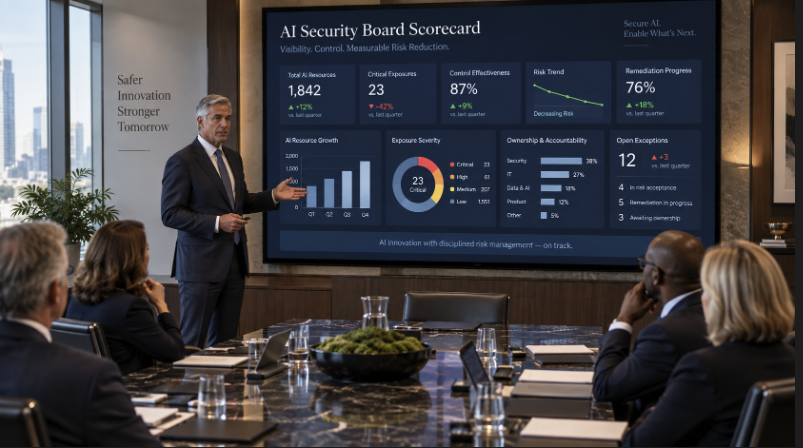
The organization started with an AI policy, a governance committee, and a list of approved AI applications, but that formal program did not reflect what was actually running across the enterprise.
AIBound discovered more than 180 AI systems across SaaS tools, browser extensions, developer copilots, local agents, autonomous workflows, internal models, and emerging AI tools.
The case study found that 92% of enterprise AI was Shadow AI at intake, showing why governance programs cannot rely only on approved-tool catalogs.
AIBound helped connect the NIST AI RMF functions of Govern, Map, Measure, and Manage to continuous discovery, contextual risk analysis, approvals, enforcement, and audit records.
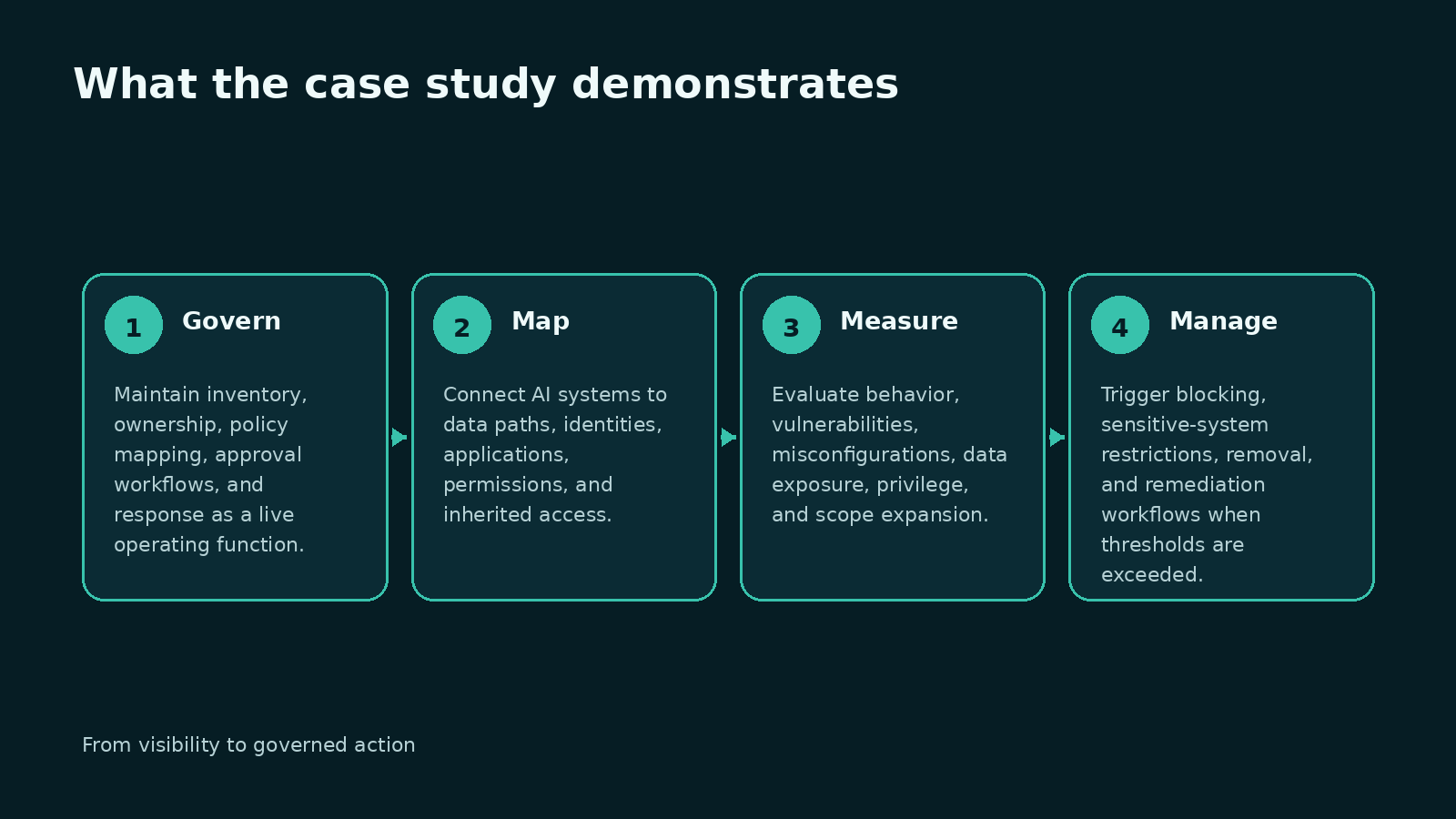
Govern shifted from committee meetings and policy documents into a live operating function with inventory, ownership, policy mapping, approvals, and automated response.
Map became a living view of AI systems, data access paths, identity interactions, connected applications, vendors, permissions, and inherited access.
Measure became a continuous evaluation of behavior, vulnerabilities, misconfigurations, data exposure, identity privilege, scope expansion, and AI deployment context.
Manage connected risk thresholds to action, including blocking high-risk AI, preventing interaction with sensitive systems, removing unauthorized tools, and triggering remediation workflows.
The organization moved away from quarterly attestations and static spreadsheets toward living inventories, approval histories, data-access evidence, governance decisions, and response records.
The core lesson is that the NIST AI RMF becomes operational only when framework functions are connected to live security data, enforceable workflows, and repeatable evidence.
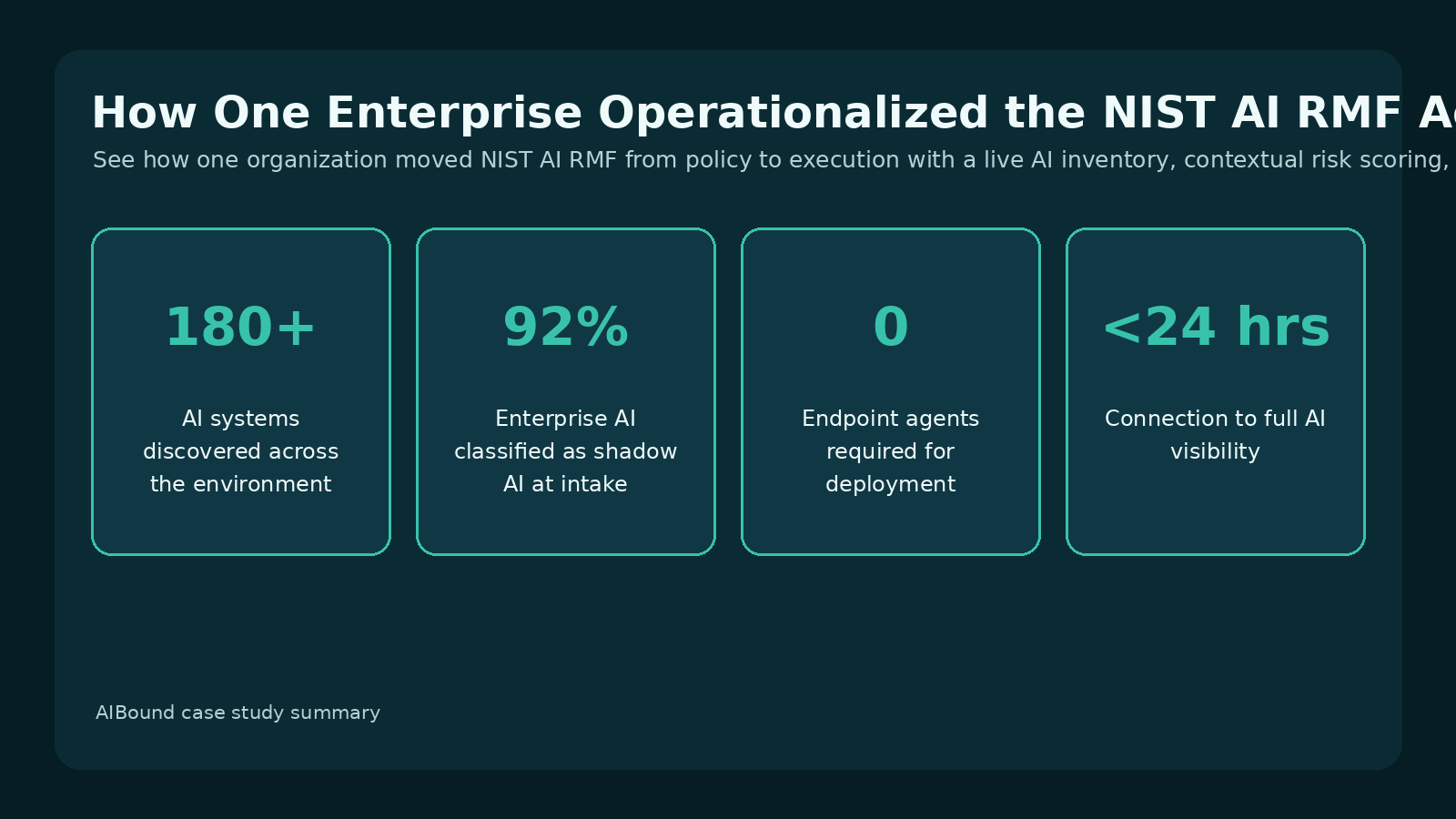
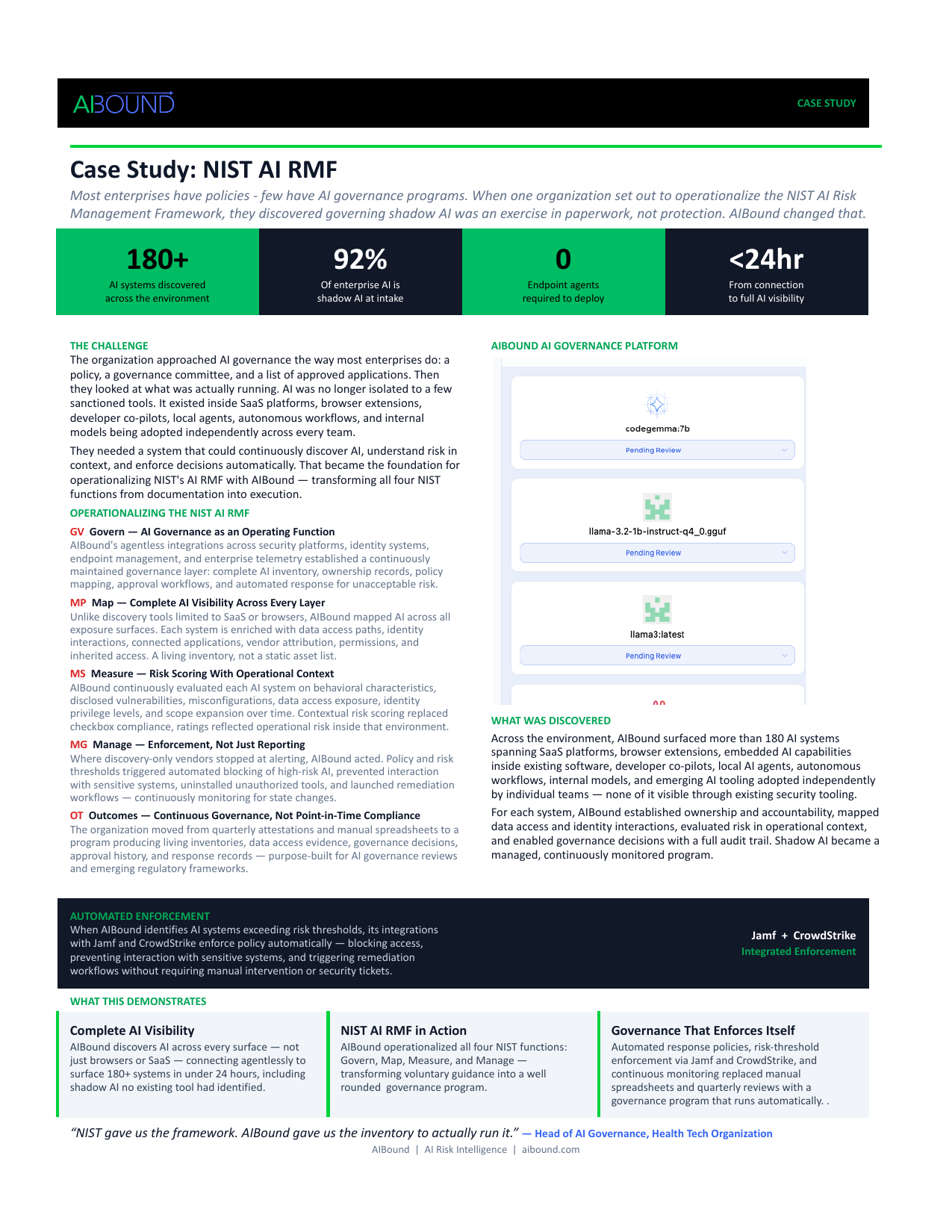
Case study overview. An enterprise trying to operationalize the NIST AI Risk Management Framework discovered that its formal governance program covered only a fraction of actual AI usage. AIBound surfaced 180+ systems and helped convert Govern, Map, Measure, and Manage from documentation into continuous operations.
For additional context, see AIBound YouTube: 5 Steps to Discover, Score, and Prevent High-Risk AI, which outlines AIBound's five-stage approach to discovering, scoring, and preventing high-risk AI.
Direct Answer: Frameworks Become Useful When Their Functions Are Connected to Live Security Operations
The organization in this case study had the same starting point as many enterprises: an AI policy, a governance committee, and a list of approved applications. The difficulty appeared when the team compared that formal program with what was actually running. AIBound discovered more than 180 AI systems across SaaS, browser extensions, developer copilots, local agents, autonomous workflows, internal models, and emerging tools. The case study reports that 92% of enterprise AI was shadow AI at intake.
The organization's objective was to operationalize the NIST AI Risk Management Framework. AIBound became the operating layer that connected the framework's Govern, Map, Measure, and Manage functions to continuous discovery, contextual risk analysis, approvals, enforcement, and audit records.
Govern: Move From a Committee to an Operating Function
Governance is often treated as a meeting cadence and a set of documents. In this case, Govern became a continuously maintained layer containing AI inventory, ownership records, policy mapping, approval workflows, and automated response for unacceptable risk.
That shift matters because AI changes too quickly for quarterly reviews to be the primary control. New SaaS features, browser extensions, models, agents, and developer tools can appear between governance meetings. A live operating model keeps accountability and policy attached to current reality.
Map: Build a Living View of the Entire AI Ecosystem
The Map function requires more than a software list. The case study says AIBound mapped data access paths, identity interactions, connected applications, vendor attribution, permissions, and inherited access for each system.
This relationship context is essential. A coding assistant with read access to one test repository is not equivalent to an autonomous agent with administrative access across production systems. Mapping makes these differences visible and gives risk teams a factual basis for prioritization.
Measure: Score Operational Risk, Not Checkbox Completion
The Measure function became a continuous evaluation of behavior, disclosed vulnerabilities, misconfigurations, data exposure, identity privilege, and scope expansion over time. This replaced generic ratings with risk scores tied to how AI was actually deployed inside the organization.
That distinction is important because the same AI product can have multiple risk profiles. Deployment context, account type, data sensitivity, connected systems, and autonomy can change the potential impact. Contextual scoring therefore produces a more useful security queue than a static vendor grade.
Manage: Connect Thresholds to Action
The case study clearly distinguishes between reporting and control. Where risk thresholds were exceeded, AIBound integrations with Jamf and CrowdStrike could block high-risk AI, prevent interaction with sensitive systems, remove unauthorized tools, and trigger remediation workflows.
This is where a framework becomes operational. Manage is not just having a remediation policy; it is the ability to apply a response reliably when the defined condition is met and preserve evidence that the action occurred.
Outcomes: Continuous Governance Instead of Point-in-Time Compliance
The organization moved away from quarterly attestations and manually maintained spreadsheets toward living inventories, data-access evidence, approval histories, governance decisions, and response records. That operating history supported both internal governance and emerging regulatory expectations.
The case study's quote captures the distinction well: NIST provided the framework, while AIBound provided the inventory needed to run it. The inventory is not the whole program, but without it the remaining governance functions depend on incomplete inputs.
A Practical NIST AI RMF Implementation Model
Security leaders can adapt this case into a phased program. Under Govern, define ownership, risk tolerance, review states, approval authority, and enforcement responsibilities. Under Map, discover AI continuously and connect each resource to users, identities, permissions, data, systems, vendors, and business purpose.
Under Measure, evaluate behavior, vulnerability intelligence, exposure, autonomy, privilege, and blast radius with explainable scoring. Under Manage, translate risk tiers into actions such as allow, monitor, restrict, require approval, revoke access, or block. Then measure outcomes over time so the governance program can demonstrate improved visibility, reduced high-risk exposure, faster remediation, and stronger evidence quality.
Metrics That Show Whether NIST AI RMF Is Actually Running
Useful program metrics include the percentage of AI resources with owners, the percentage assessed within target time, high-risk resources with completed remediation, sanctioned versus shadow AI, privileged agents, sensitive-data connections, mean time to governance decision, mean time to remediation, and the number of policy decisions enforced automatically.
The 180+ discovered systems and 92% shadow AI intake rate in this case show why visibility metrics matter. A governance program cannot accurately report maturity if most of the environment is outside its inventory.
Frequently Asked Questions
Does NIST require a specific commercial platform? No. The NIST AI RMF is voluntary and technology-neutral. This case study shows one organization's implementation approach using AIBound.
What did AIBound add beyond inventory? The case study describes ownership and policy mapping, identity and data relationships, contextual risk measurement, approval workflows, enforcement, and audit history.
How quickly was visibility established? The case study reports under 24 hours from connection to full AI visibility and zero endpoint agents required for deployment.
Why was shadow AI important to the NIST implementation? Because the organization discovered that 92% of enterprise AI was shadow AI at intake. Governance needed to encompass what was actually running, not only what had been formally approved.
Conclusion
The NIST AI RMF gives organizations a strong structure for AI risk management. Still, structure alone does not discover a new browser extension, map a service identity, detect permission growth, or block a high-risk tool. Those outcomes require operational systems and repeatable workflows.
This case study demonstrates a practical bridge from framework to execution: Govern the program continuously, Map the real environment, Measure risk in context, and Manage through enforceable actions. When those functions share the same live inventory and evidence trail, AI governance becomes a daily operating capability rather than a periodic compliance exercise.
Implementation Checklist for Moving From Framework to Operations
Map each NIST function to named owners and concrete technical workflows. Govern should have accountable policy and approval owners. Map should have inventory and relationship data sources. Measure should have defined risk factors and thresholds. Manage should have response playbooks and enforcement paths. If a function exists only in a policy document, it is not yet operational.
Review the program monthly for coverage gaps and quarterly for maturity. The question should not only be whether controls exist, but whether they are seeing the environment, producing decisions within target time, and reducing exposure.
Common Failure Modes When Organizations “Implement” the NIST AI RMF
A frequent failure mode is treating the framework as a policy-mapping exercise. Teams document which control or committee corresponds to Govern, Map, Measure, and Manage, but the mappings are not connected to live enterprise data. Another failure is maintaining only the approved AI catalog, which means the governance program measures the portion of AI it already knows about rather than the whole environment.
A third failure is separating measurement from response. Risk scores may exist, but high-risk findings still require manual tickets and unclear ownership. The case study illustrates a more operational approach: the same living inventory supports ownership, context, scoring, approval, enforcement, and evidence.
How to Assign Ownership Across the Four NIST Functions
Govern typically requires executive sponsorship plus clear security, risk, legal, and business ownership. Map needs technical owners for discovery sources and business owners who can explain use cases. Measure needs a documented methodology for data sensitivity, privilege, vulnerability, autonomy, exposure, and business impact. Manage needs incident-response and platform owners who can enforce the resulting decision.
The responsibilities can span teams, but the workflow should not disappear between them. Every high-risk resource needs a traceable path from discovery to owner, assessment, decision, enforcement, and re-review. That path is operational evidence that the framework is being used, not merely referenced.
A 90-Day NIST AI RMF Operating Roadmap
During month one, focus on Govern and Map: define the program, connect discovery sources, build the living inventory, and establish ownership. During month two, mature Measure: define explainable risk dimensions, enrich resources with identity and data context, and validate thresholds against real examples.
During month three, mature Manage: connect tiers to response playbooks, integrate enforcement with existing controls, and create dashboards that show whether risk is decreasing. The organization should then repeat the cycle because new AI resources and new capabilities continuously change the mapped environment.
Key Takeaways for CISOs and Security Leaders
For CISOs, the key test of a framework implementation is whether it changes day-to-day decisions. Can a newly discovered AI resource be assigned an owner? Can its identity and data reach be mapped? Can risk be measured consistently? Can the resulting decision be enforced? Can the organization show what happened later? If those answers depend on disconnected spreadsheets and manual follow-up, the framework has not yet become an operating capability.
The case also shows the value of using one evidence model across the four functions. Govern sets the rules, Map supplies the context, Measure determines significance, and Manage applies action. When those functions share live data, teams spend less time reconciling conflicting inventories and more time reducing actual exposure.
Final Strategic Note
Across all five case-study patterns, the common requirement is continuous context. Enterprises need to know not only which AI resources exist, but also who uses them, what identities and permissions they inherit, which data and systems they can reach, what risk signals are present, and what governance decision is currently in force. That context makes it possible to distinguish productive AI adoption from material exposure and to respond proportionately. The strongest programs therefore connect discovery, assessment, approval, enforcement, monitoring, and reporting in one operating loop. That loop gives employees a safer path to use AI, gives security teams a way to prioritize the most important risks, and gives leadership evidence that policy decisions are actually being applied in the environment.
Original Case Study Snapshot
The source case study supplied for this article is shown below for reference. The blog preserves the case study metrics and outcomes while expanding the security and governance lessons into a long-form SEO article.
Recommended Internal AIBound Links
- Enterprise AI Governance Framework: https://www.aibound.com/blog-posts/ai-governance-enterprise-framework
- AI Governance Framework for CISOs: https://www.aibound.com/blog-posts/ai-governance-framework-for-cisos
- How to Detect Shadow AI: https://www.aibound.com/blog-posts/how-to-detect-shadow-ai
- AIBound Case Studies: https://www.aibound.com/lovable-case-studies
External Resources
- NIST AI Risk Management Framework: https://www.nist.gov/itl/ai-risk-management-framework
- NIST Generative AI Profile: https://nvlpubs.nist.gov/nistpubs/ai/NIST.AI.600-1.pdf
- AIBound YouTube: 5 Steps to Discover, Score, and Prevent High-Risk AI: https://www.youtube.com/watch?v=nYQ8kVQAkPc
- OWASP Top 10 for Agentic Applications 2026: https://genai.owasp.org/resource/owasp-top-10-for-agentic-applications-for-2026/
Next Step
Organizations facing similar visibility, governance, or reporting challenges can explore AIBound to see how a live AI inventory and control plane can support secure AI adoption.
Leadership Review Questions
Use these questions to test whether the case-study lessons translate into a repeatable enterprise operating model:
- Can we identify every AI application, agent, model, extension, plugin, and MCP service currently in use?
- Does each material AI resource have a named business owner and documented purpose?
- Can security map the human or machine identity, effective permissions, sensitive data, and connected systems behind each resource?
- Are approval decisions conditional on least privilege, data boundaries, and ongoing monitoring?
- Do high-risk conditions trigger a defined response such as restrict, block, revoke, or require human approval?
- Can governance teams show when a resource was discovered, assessed, approved, changed, and remediated?
- Can the organization produce evidence for a board, auditor, regulator, or incident responder without a manual data-gathering project?
- Are adoption and risk trends improving together, or is AI usage expanding faster than the control program?
If several answers are uncertain, the priority is usually not another policy document. It is improving the live inventory, relationship context, ownership model, and enforcement path that make policy measurable and actionable.
Find every AI browser extension in your environment.
Full AI inventory within 24 hours, with permissions, identities, and risk scores for each extension. No new agents.

%401x.png)