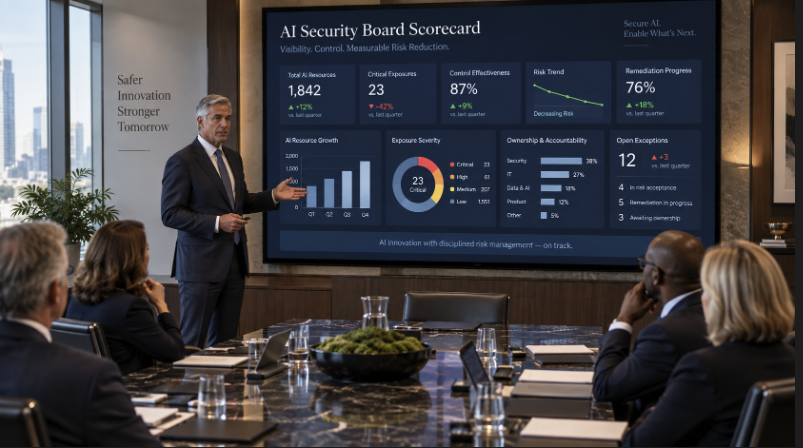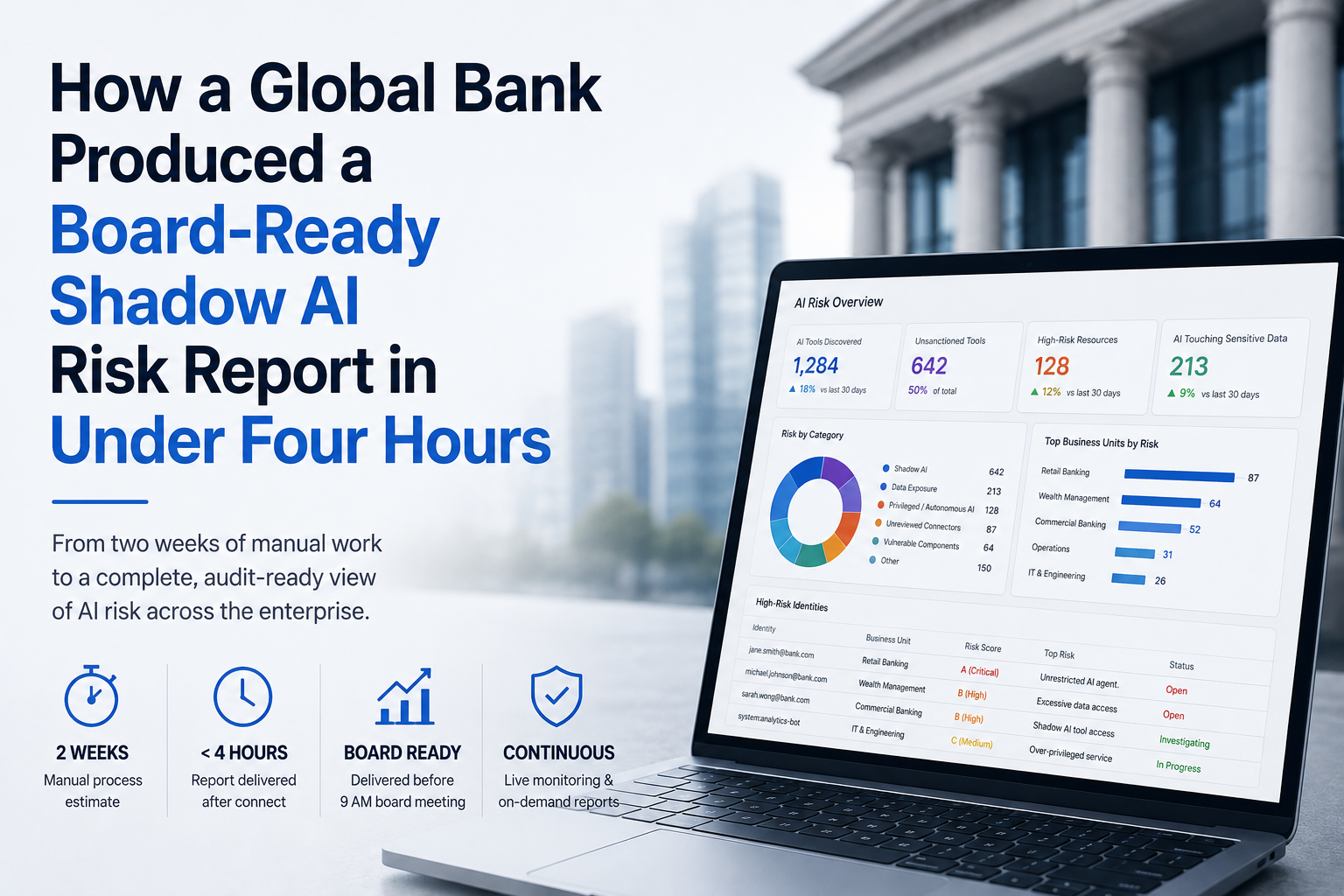
A global bank needed a comprehensive view of AI usage, access points, data exposure, and identities interacting with high-risk AI systems.
The bank’s existing security controls produced telemetry, but they could not correlate AI-specific usage, identity context, data exposure, and risk into one board-ready view.
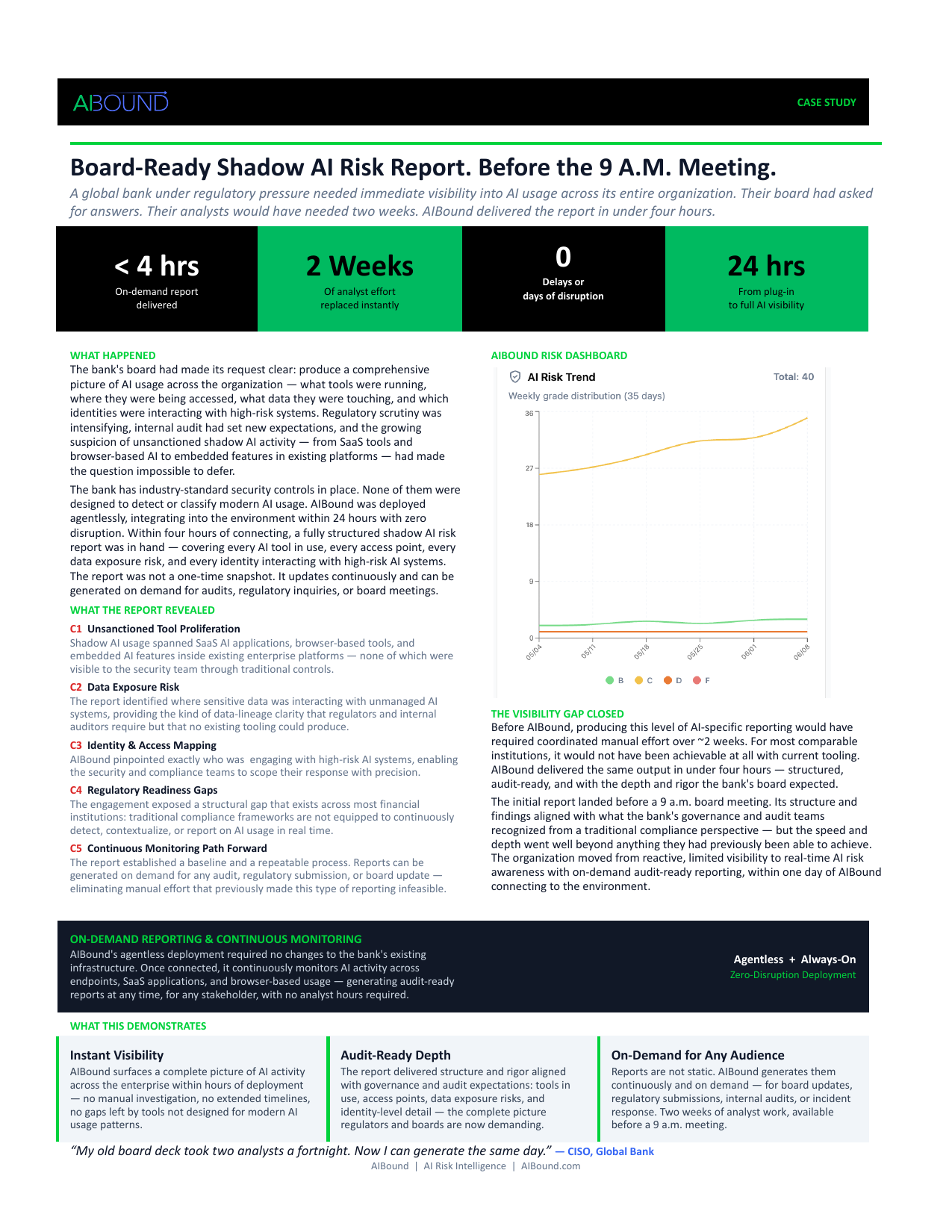
The manual process was expected to take roughly two weeks, but AIBound delivered a structured Shadow AI risk report in under four hours.
The report was delivered before a 9 a.m. board meeting and created a repeatable reporting model rather than a one-time slide deck.
AIBound helped the bank identify unsanctioned AI tool usage, sensitive data exposure, identity-level risk, regulatory-readiness gaps, and continuous monitoring needs.
Board-level AI reporting should be built from live risk data, not manually assembled spreadsheets, screenshots, or quarterly slide decks.
Identity-level detail makes executive reporting more useful by showing which users, business units, and high-risk identities are connected to material AI exposure.
Audit-ready AI reporting should include tools in use, access points, data exposure risks, identity-level detail, ownership, remediation status, and trend data.
A repeatable AI risk reporting process allows security teams to support board meetings, internal audits, regulatory inquiries, and incident response from the same underlying evidence.
The strongest board-ready AI risk report is concise enough for executive decisions but traceable enough to support follow-up questions, audits, and remediation workflows.
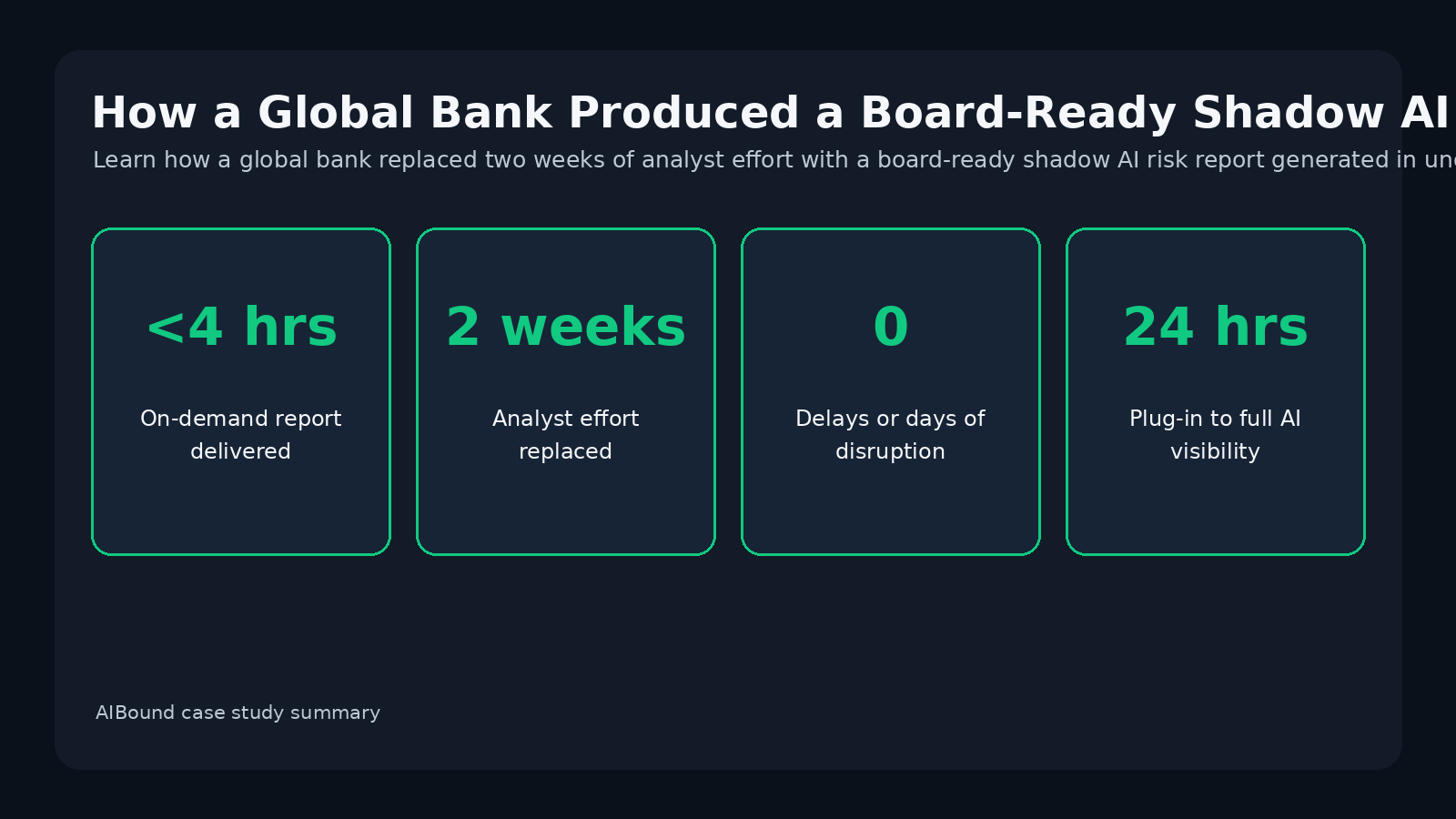
Case study overview. A global bank under regulatory and board pressure needed a comprehensive view of AI usage, data exposure, and high-risk identities. The manual process was expected to take two weeks. AIBound delivered a board-ready report in under four hours and established continuously refreshable reporting.
For additional context, see AIBound YouTube: 5 Steps to Discover, Score, and Prevent High-Risk AI, which outlines AIBound's five-stage approach to discovering, scoring, and preventing high-risk AI.
Direct Answer: Board-Level AI Reporting Must Be Built From Live Risk Data, Not Manual Slides
The global bank faced an urgent executive request: produce a comprehensive view of AI usage across the organization, including tools in use, access points, data exposure, and identities interacting with high-risk systems. Analysts estimated that assembling the answer manually would take roughly two weeks. AIBound produced a structured shadow AI risk report in under four hours after connecting to the environment.
The report arrived before a 9 a.m. board meeting. More importantly, it was not a one-time document. The underlying visibility and monitoring continued, allowing updated reports to be generated on demand for boards, internal audit, regulatory requests, and incident response.
Why Existing Security Controls Could Not Answer the Board’s Question
The bank already had industry-standard security controls. The gap was not a total lack of telemetry; it was the absence of AI-specific correlation and classification. Shadow AI usage spanned SaaS applications, browser-based tools, and embedded AI features inside enterprise platforms, none of which were visible as one coherent AI risk picture.
Board and regulatory questions are inherently cross-functional. They ask what is being used, where it is accessed, what data it touches, who is using it, how risky it is, and what the organization is doing about it. Producing that answer manually requires security, identity, data, governance, and application teams to reconcile multiple sources.
What the Report Revealed
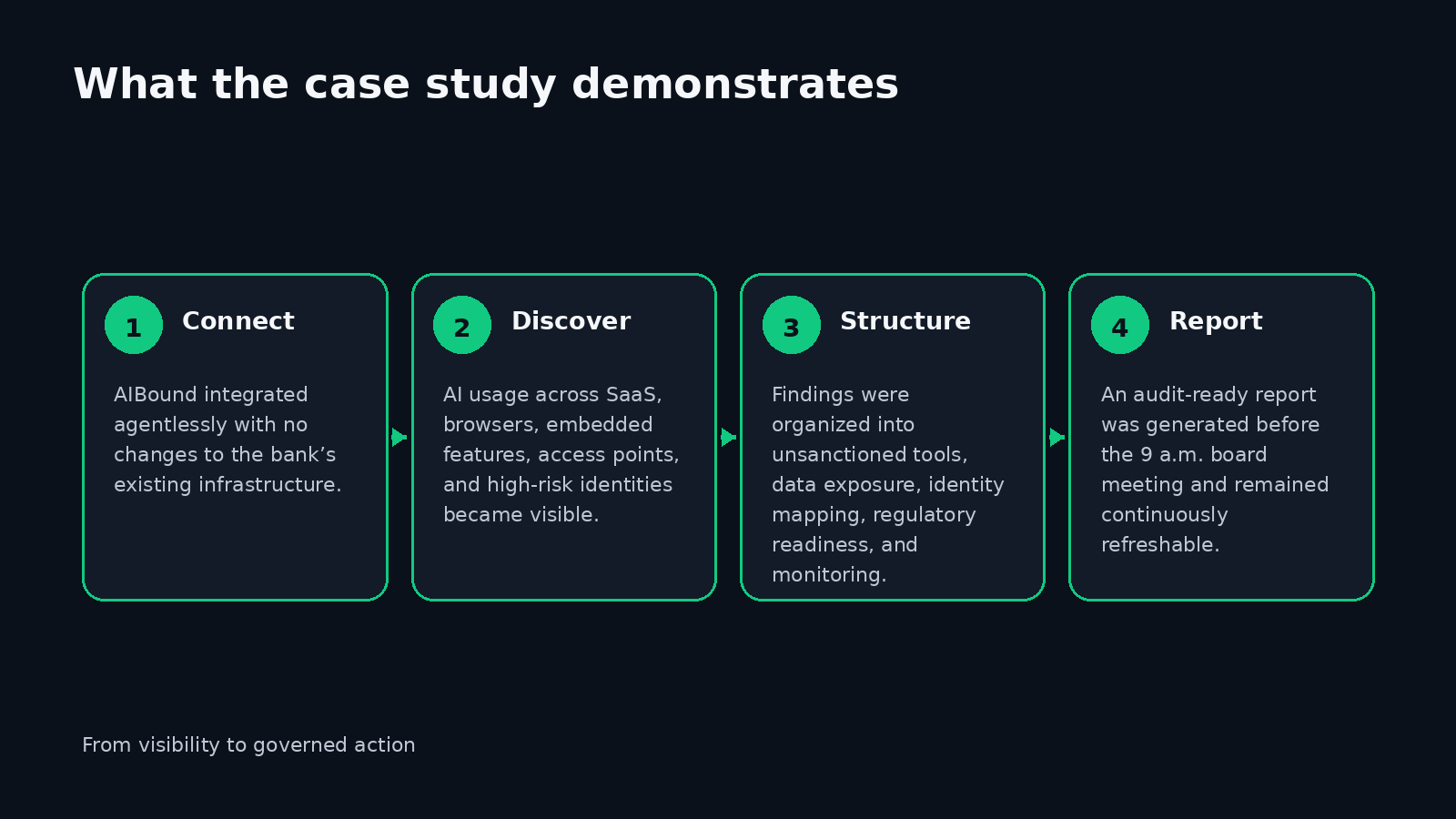
The case study organizes the findings into five areas. First, unsanctioned tool proliferation showed that shadow AI existed across multiple technology surfaces. Second, it identified data exposure risk where sensitive information interacted with unmanaged AI. Third, identity and access mapping showed exactly which users were engaging with high-risk systems.
Fourth, the work exposed regulatory-readiness gaps caused by traditional frameworks and tools that were not built to report on AI usage continuously. Fifth, continuous monitoring established a repeatable process so the same reporting depth could be produced again without another two-week investigation.
Why Identity-Level Detail Changes Executive Reporting
A board does not need a list of every prompt, but it does need confidence that material risk is understood. Identity context helps turn broad statements such as 'employees are using unsanctioned AI' into a measurable control question: which identities are using high-risk AI, what access do they carry, which business units are affected, and what remediation is underway?
This gives executives a clearer connection between technology adoption and enterprise impact. It also lets security teams scope action narrowly rather than recommending a blanket enterprise ban when the underlying exposure is unclear.
Audit-Ready Depth Requires More Than a Dashboard Screenshot
The report was valuable because its structure matched governance and audit expectations. It covered tools in use, access points, data exposure risks, and identity-level detail. The case study describes the output as structured and audit-ready, with depth that the bank's board expected.
Audit-ready reporting should also be repeatable. A screenshot proves what a dashboard displayed at one moment. A continuous control plane can preserve the inventory, risk state, decisions, and supporting context that produced the report, making future reporting faster and more defensible.
A Practical Board-Ready AI Risk Reporting Model
A useful executive report should begin with scope: how much AI exists, where it is used, and what proportion is governed. Next, it should summarize material risks rather than every finding. Categories can include shadow AI, sensitive-data exposure, privileged or autonomous agents, unreviewed connectors, vulnerable components, and regulatory gaps.
The report should then show ownership and response: which business units or identities are connected to the top risks, what controls are in place, what remediation is planned, and whether risk is improving. Finally, include trend information so leaders can see whether AI adoption and control maturity are moving in the same direction.
How to Replace Manual Reporting With an On-Demand Process
The bank's result depended on agentless integration and continuous monitoring. Organizations can replicate the principle by connecting the telemetry they already own, normalizing AI-specific activity into a living inventory, enriching it with identity and data context, and applying a consistent risk model.
Once that data model exists, board reporting becomes a query over current governance data instead of a bespoke investigation. The security team can generate a report for a board meeting, an auditor can request a different slice, and incident responders can use the same underlying evidence without rebuilding the picture each time.
Metrics Boards and Regulators Can Actually Use
High-level metrics should answer whether exposure is known and controlled. Examples include total AI resources discovered, percentage sanctioned, percentage with owners, high-risk resources, AI touching sensitive data, privileged-agent count, pending governance reviews, policy violations, mean time to remediation, and high-risk exposure trend.
The case study also demonstrates an operational efficiency metric: analyst effort avoided. A report that previously required approximately two analyst-weeks was generated in under four hours, changing reporting from a periodic burden into an on-demand capability.
Frequently Asked Questions
Did the bank replace its existing security stack? No. The case study says AIBound deployed agentlessly and required no changes to the bank's existing infrastructure.
Was the report static? No. It updated continuously and could be generated on demand for audits, regulatory inquiries, board meetings, or incident response.
What information did the report include? The case study lists AI tools in use, access points, data exposure risks, and identities interacting with high-risk systems.
How quickly did the bank gain full visibility? The case study reports 24 hours from plug-in to full AI visibility, with the specific board report delivered in under four hours after connecting.
Conclusion
The global bank case shows that AI governance reporting does not need to be a recurring manual project. When inventory, identity, data exposure, and risk context are maintained continuously, executive reporting becomes faster and more reliable.
The strongest board report is not the one with the most slides. It is the one backed by current evidence, clear risk prioritization, and a repeatable process that can answer the same questions tomorrow. In this case, that operating model turned two weeks of analyst effort into a report available before the morning board meeting.
Implementation Checklist for a Board-Ready AI Risk Brief
Standardize the board report so it can be generated repeatedly. Use a consistent executive summary, AI inventory and adoption trend, top material risks, data exposure, privileged or autonomous AI, governance status, remediation progress, regulatory considerations, and decisions required from leadership.
Keep the report concise but make every metric traceable to underlying evidence. Security teams should be able to move from a board-level number to the affected resources, identities, systems, and remediation actions without a separate investigation.
What a Board-Ready AI Risk Report Should Avoid
Executive reporting can fail in two opposite ways. One report overwhelms leaders with technical findings and tool names. Another is so high-level that it provides no evidence of control. A board-ready report should sit between those extremes: concise enough to support decisions, but grounded in measurable exposure, ownership, response, and trend data.
Avoid reporting only the number of AI tools. Tool count shows adoption, not material risk. Pair inventory metrics with sensitive-data exposure, privileged identity use, high-risk resources, unresolved governance decisions, remediation status, and changes since the previous reporting period.
How Security Teams Can Make AI Reporting Repeatable
Define a standard reporting data model before building the slide deck. Every AI resource should have consistent fields for type, owner, business unit, risk, governance status, data reach, identity privilege, external exposure, and remediation. The board report should be generated from those fields rather than from a manually assembled narrative each quarter.
Create audience-specific views from the same underlying evidence. The board may need a small number of top risks and trends. Internal audit may need approval history and evidence retention. Regulators may ask for a specific system's traceability. Incident responders may need technical relationships. One live data model can support all of those outputs.
A Monthly Executive Reporting Cadence
At the beginning of the month, refresh the inventory and identify changes in high-risk exposure. Mid-month, validate ownership and remediation status for the most material findings. Before the executive meeting, generate the report and review exceptions that require leadership decisions, such as risk acceptance, investment, or changes to business use.
After the meeting, record decisions back into the governance system. This closes the loop so executive reporting becomes part of control, not a presentation exercise that sits outside the operating process.
Key Takeaways for CISOs and Security Leaders
For CISOs, board reporting should be designed backward from the decisions leadership may need to make. A useful report should show whether AI adoption is known, whether the highest risks have accountable owners, whether sensitive data and privileged identities are controlled, whether remediation is progressing, and whether the risk trend is improving. The underlying system should preserve enough detail that executives can ask a follow-up question without starting a new investigation.
This also improves credibility with auditors and regulators. When the same live evidence can support a board summary, an audit request, and an incident investigation, the organization avoids maintaining multiple inconsistent versions of AI risk. Reporting becomes an output of governance rather than a parallel manual process.
Final Strategic Note
Across all five case-study patterns, the common requirement is continuous context. Enterprises need to know not only which AI resources exist, but also who uses them, what identities and permissions they inherit, which data and systems they can reach, what risk signals are present, and what governance decision is currently in force. That context makes it possible to distinguish productive AI adoption from material exposure and to respond proportionately. The strongest programs therefore connect discovery, assessment, approval, enforcement, monitoring, and reporting in one operating loop. That loop gives employees a safer path to use AI, gives security teams a way to prioritize the most important risks, and gives leadership evidence that policy decisions are actually being applied in the environment.
Original Case Study Snapshot
The source case study supplied for this article is shown below for reference. The blog preserves the case study metrics and outcomes while expanding the security and governance lessons into a long-form SEO article.
Recommended Internal AIBound Links
- Enterprise AI Governance Framework: https://www.aibound.com/blog-posts/ai-governance-enterprise-framework
- AI Governance Framework for CISOs: https://www.aibound.com/blog-posts/ai-governance-framework-for-cisos
- How to Detect Shadow AI: https://www.aibound.com/blog-posts/how-to-detect-shadow-ai
- AIBound Case Studies: https://www.aibound.com/lovable-case-studies
External Resources
- AIBound YouTube: 5 Steps to Discover, Score, and Prevent High-Risk AI: https://www.youtube.com/watch?v=nYQ8kVQAkPc
- NIST AI Risk Management Framework: https://www.nist.gov/itl/ai-risk-management-framework
- NIST Generative AI Profile: https://nvlpubs.nist.gov/nistpubs/ai/NIST.AI.600-1.pdf
- EU Artificial Intelligence Act - Regulation (EU) 2024/1689: https://eur-lex.europa.eu/eli/reg/2024/1689/oj
Next Step
Organizations facing similar visibility, governance, or reporting challenges can explore AIBound to see how a live AI inventory and control plane can support secure AI adoption.
Leadership Review Questions
Use these questions to test whether the case-study lessons translate into a repeatable enterprise operating model:
- Can we identify every AI application, agent, model, extension, plugin, and MCP service currently in use?
- Does each material AI resource have a named business owner and documented purpose?
- Can security map the human or machine identity, effective permissions, sensitive data, and connected systems behind each resource?
- Are approval decisions conditional on least privilege, data boundaries, and ongoing monitoring?
- Do high-risk conditions trigger a defined response such as restrict, block, revoke, or require human approval?
- Can governance teams show when a resource was discovered, assessed, approved, changed, and remediated?
- Can the organization produce evidence for a board, auditor, regulator, or incident responder without a manual data-gathering project?
- Are adoption and risk trends improving together, or is AI usage expanding faster than the control program?
If several answers are uncertain, the priority is usually not another policy document. It is improving the live inventory, relationship context, ownership model, and enforcement path that make policy measurable and actionable.
Find every AI browser extension in your environment.
Full AI inventory within 24 hours, with permissions, identities, and risk scores for each extension. No new agents.

%401x.png)