How Should Enterprises Set Safe Autonomy Boundaries for AI Agents?
Published:
August 26, 2026
Niall Browne
Summary
AI agents need autonomy boundaries based on the risk of each action, not one blanket rule for the entire agent. This article explains how enterprises can classify agent actions, map identities and permissions, evaluate data sensitivity, define human approval thresholds, monitor runtime behavior, and prevent high-risk AI agents from creating unnecessary business impact.
Key Takeaways
Low-impact, reversible AI-agent actions can often run autonomously, while high-impact or irreversible actions should require human approval, dual approval, or complete restriction.
Enterprises should classify the action an agent can perform, not just the agent itself. A single agent may be safe for summarizing information but unsafe for refunds, production changes, or permission updates.
AI-agent risk depends heavily on the identity behind the agent, including tokens, OAuth grants, service accounts, API keys, inherited permissions, and connected systems.
Data sensitivity should directly influence autonomy boundaries. Agents touching regulated, confidential, customer, financial, source code, or production data need stronger controls.
Human-in-the-loop policies should be explicit. Teams should define which actions need no approval, post-action review, single-person approval, dual approval, security approval, or prohibition.
Tool scope matters. Agents should only receive the tools, functions, data sources, and permissions required for their approved business purpose.
Runtime monitoring is essential because an agent that was safe at onboarding can become risky when its permissions, tools, connectors, model behavior, or data access changes.
Every production AI agent should have an autonomy review that documents its business purpose, allowed actions, identity, permissions, data access, irreversible actions, owner, and revocation path.
AI agents are moving from recommendation engines to operational workers. They can search internal knowledge, update records, open tickets, modify code, call APIs, and coordinate multi-step workflows. That makes the central governance question less about whether agents should exist and more about how much authority each agent should receive.
AIBound’s recent article on agentic AI governance frames the challenge as balancing useful autonomy with meaningful guardrails. Too little autonomy removes the productivity benefit. Too much autonomy creates a path for errors, manipulated instructions, or compromised identities to become real business impact.
A useful companion is AIBound’s YouTube walkthrough, 5 Steps to Discover, Score, and Prevent High-Risk AI. The sequence matters because autonomy decisions should not be made in isolation. Security first needs to know which AI resource is acting, which identity it uses, which systems and data it can reach, how risky that combination is, and which action should be allowed or prevented.
This article explains how enterprises can set safe autonomy boundaries for AI agents without reducing every workflow to manual approval.
Direct Answer: Use Risk-Based Autonomy, Not One Global Rule
Enterprises should set AI-agent autonomy based on the potential consequences of the action, the identity's privileges, the sensitivity of the data, the action's reversibility, the workflow's exposure, and the availability of independent controls.
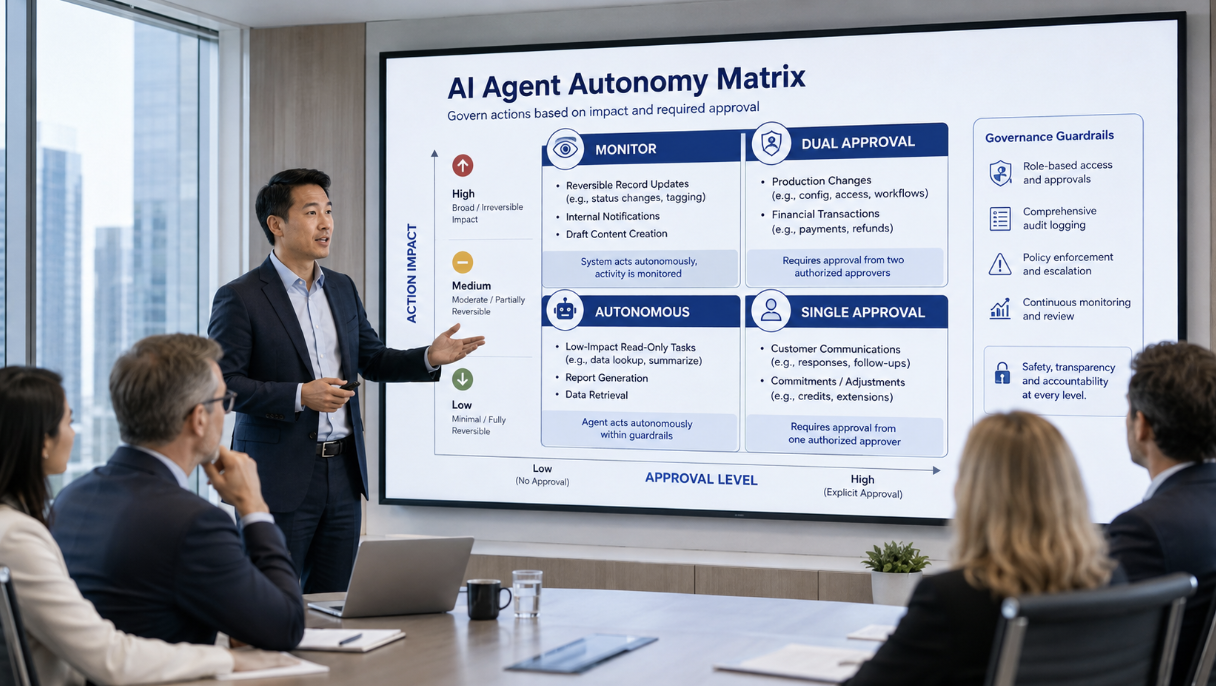
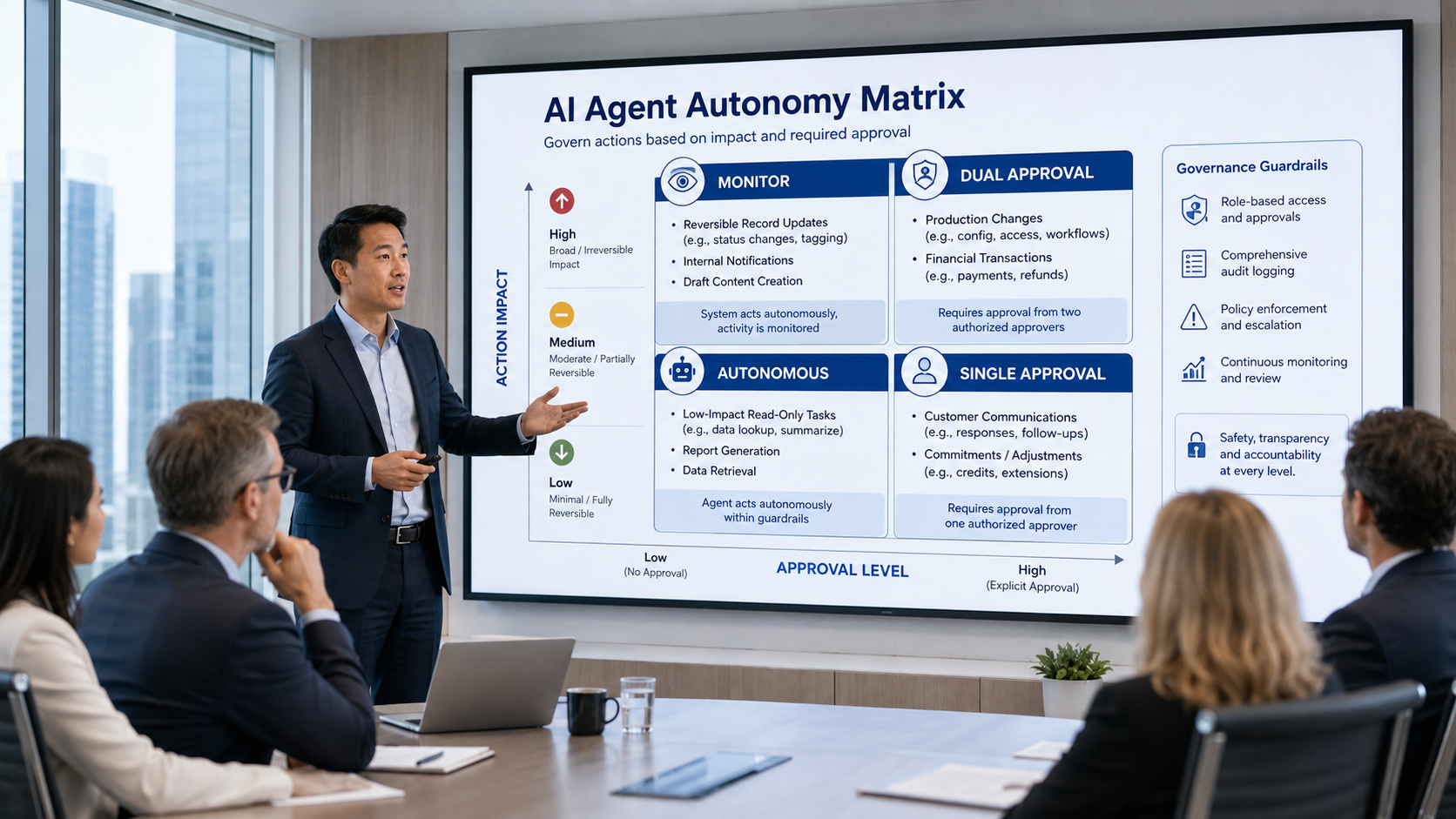
Low-impact, reversible actions can often run autonomously. Medium-impact actions may require monitoring or single-person approval. High-impact or irreversible actions should require explicit human confirmation, dual approval, or complete restriction.
This is not simply a governance preference. It is an engineering model for limiting blast radius.
Figure 1. A practical matrix for deciding which AI-agent actions may run autonomously and which require approval.
Why Agent Autonomy Is Different From Traditional Automation
Traditional automation usually follows a defined path. A script may receive an input, perform a known transformation, and call a specific API. The security team can inspect the code and predict most of the behavior.
Agentic AI is more adaptive. An agent can interpret a goal, select among tools, decide which step to perform next, use generated intermediate outputs, and change its approach based on context. That flexibility is exactly what makes agents valuable, but it also makes fixed assumptions about behavior less reliable.
The OWASP Top 10 for Agentic Applications 2026 identifies security risks that are specific to autonomous and multi-step systems. The practical lesson for enterprises is clear: agents require controls around authority, tool use, identity, memory, and action execution, not only around the model itself.
AIBound’s identity security solution makes the same point from an enterprise-security perspective. The risk of an AI system depends heavily on the identity it operates as and the permissions attached to that identity.
1. Start by Classifying the Action, Not the Agent
A common mistake is assigning one autonomy level to an entire agent.
A customer-service agent may be safe to summarize support tickets autonomously but not safe to refund a payment without confirmation. A developer agent may be safe to create a draft pull request but not safe to deploy code directly to production. An HR agent may be safe to answer policy questions but not safe to alter payroll or employee status.
Security teams should therefore classify actions such as:
Read-only information retrieval.
Drafting and recommendation.
Reversible record updates.
External communication.
Production modification.
Identity or permission changes.
Financial transactions.
Destructive or irreversible operations.
Each action category should have its own autonomy rule. This creates more useful control than a blanket statement such as “agents are allowed” or “agents require approval.”
2. Map the Identity and Permission Path Behind Every Agent
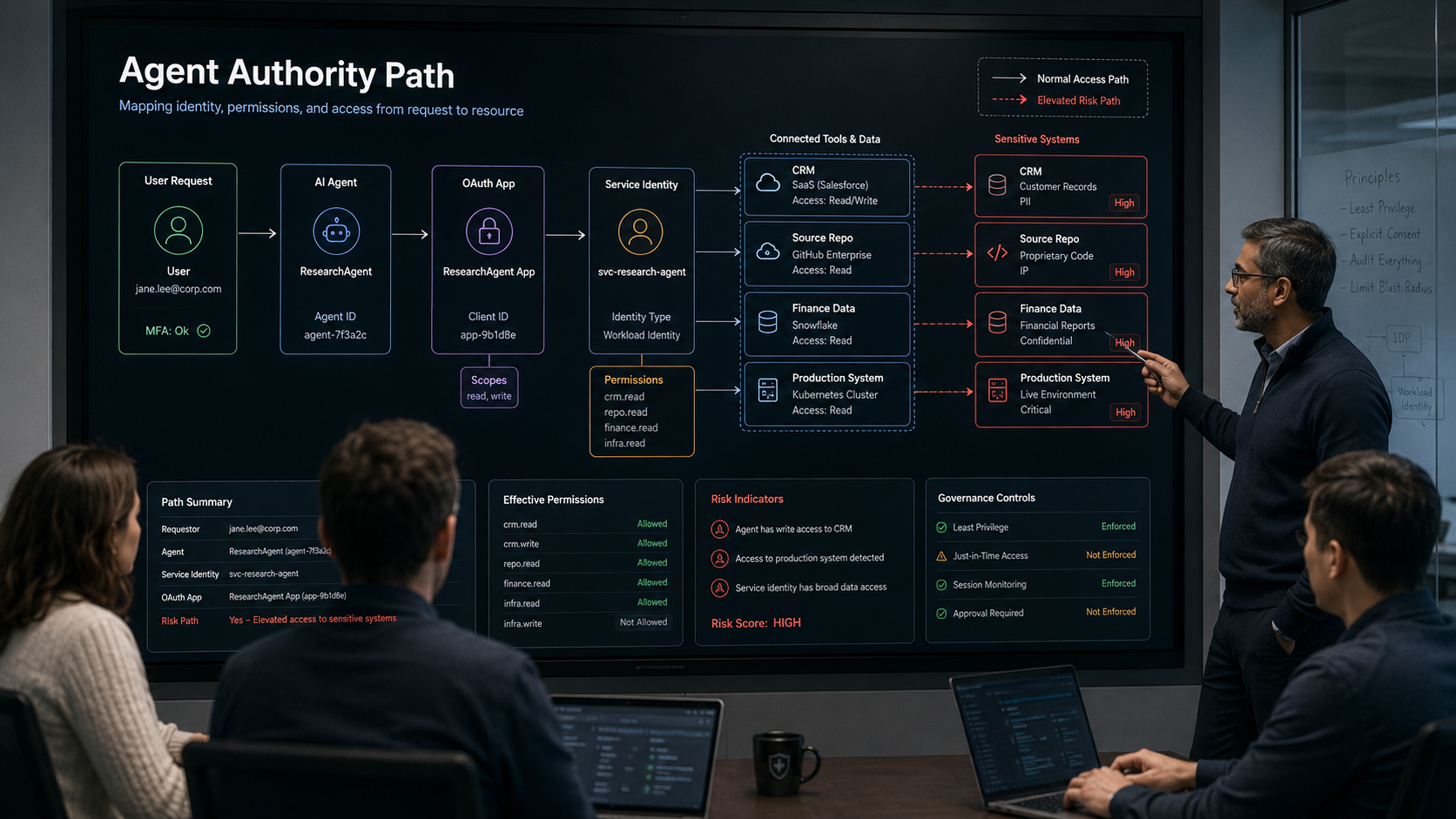
The apparent agent is only the visible layer. Its real authority comes from the identity, token, API key, OAuth grant, service account, or cloud role used behind the scenes.
AIBound’s identities and connections platform maps AI resources to the human and non-human identities behind them and shows the systems, datasets, and other resources those identities can reach.
That relationship is central to autonomy decisions. An agent running with a read-only support account has a very different risk profile from the same agent running under an engineering administrator.
Security teams should document:
The identity used by the agent.
The owner of that identity.
The effective permissions, including inherited and delegated access.
Credential lifetime and rotation.
Connected SaaS applications, APIs, databases, repositories, and MCP servers.
Whether the identity can create new credentials or elevate access.
Whether multiple agents use a shared identity.
The more privilege an agent receives, the narrower its permitted autonomous actions should become.
Figure 2. The effective authority path from user request to agent, identity, tools, and sensitive systems.
3. Use Data Sensitivity as a Boundary Condition
Autonomy should also depend on the data involved.
An agent summarizing public documentation can usually operate with fewer restrictions than one processing health information, source code, customer financial records, merger documents, or production credentials.
A practical data-aware policy can define different thresholds for public, internal, confidential, regulated, and highly restricted information.
For example, an agent may be allowed to classify public support requests automatically. At the same time, any workflow involving regulated customer information requires an approved enterprise model, a dedicated identity, full audit logging, and human review before external transmission.
The NIST AI Risk Management Framework encourages organizations to manage AI risk in context rather than as a one-time technical assessment. Data sensitivity is one of the most important contextual factors because it determines the possible consequences of a bad decision or compromised workflow.
4. Separate Recommendation From Execution
One of the simplest ways to gain value from agentic AI without accepting unnecessary risk is to separate “decide” from “do.”
An agent can collect evidence, summarize a problem, recommend a response, prepare a change, or draft a transaction while a human retains final execution authority.
This pattern works well for:
Production changes.
Customer refunds.
Access approvals.
Legal or compliance decisions.
Deletion of records.
Financial transfers.
Customer-facing commitments.
Changes to security configuration.
The organization still benefits from automated reasoning and preparation, but the final high-impact action remains controlled.
AIBound’s broader Control Plane for High-Risk AI positions prevention as the final stage after discovery, identity mapping, connection mapping, and risk measurement. That sequence supports action-level enforcement because the control decision is informed by context rather than a generic blocklist.
5. Define Human-in-the-Loop Thresholds Explicitly
“Human oversight” is too vague unless the organization defines exactly where it occurs.
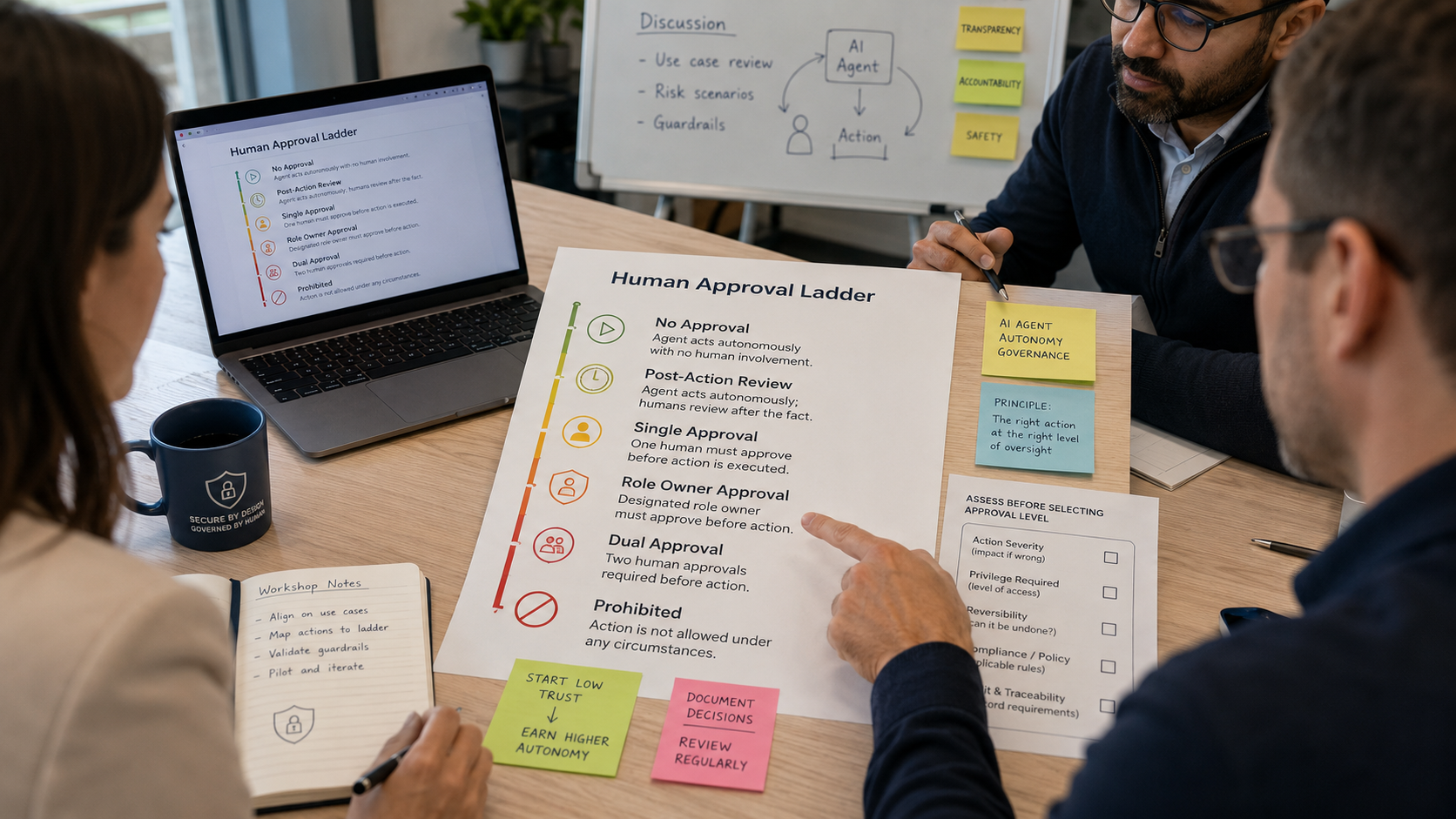
A mature policy should specify which actions need:
No approval.
Post-action review.
Single-person pre-approval.
Approval from a role owner.
Dual approval.
Security approval.
Complete prohibition.
The threshold should increase with business impact, privilege, data sensitivity, and irreversibility.
Figure 3. Human oversight should increase with action severity, privilege, and irreversibility.
For example, generating an internal summary may require no approval. Sending an external email on behalf of a sales representative may require a quick confirmation. Changing a production access policy may require dual approval from a system owner and security.
The point is not to put people into every agent loop. It is to keep people in the loops where mistakes would be expensive, difficult to reverse, or legally significant.
6. Use Reversibility as a Practical Risk Signal
Reversibility is one of the most useful and underused autonomy criteria.
If an autonomous action can be undone easily, the organization can often tolerate a higher level of automation. If the action is irreversible or creates downstream consequences, the approval requirement should increase.
A reversible action might include tagging a ticket, creating a draft record, moving a file to a review queue, or opening a non-production pull request.
An irreversible or difficult-to-reverse action might include sending money, deleting data, publishing externally, changing an identity policy, deploying to production, or sending a binding customer communication.
Reversibility should be visible in risk scoring and approval logic, not left to informal judgment.
7. Limit Tool Choice and Scope
An agent with five narrowly scoped tools is easier to govern than an agent with fifty powerful tools.
Tool restrictions can limit what an agent can do even when the model behaves unexpectedly. Security teams should avoid giving agents broad “all actions” connectors when the business process only requires a small number of operations.
Where possible:
Expose only required tool functions.
Use read-only endpoints by default.
Separate production and non-production tools.
Require parameter validation.
Apply transaction limits.
Restrict external destinations.
Use allowlisted data sources.
Prevent agents from dynamically adding unreviewed tools.
This is a practical application of least privilege at the tool layer.
8. Monitor Runtime Behavior, Not Just Design Intent
An agent may be safe at onboarding and become unsafe later because its permissions change, its tools expand, its model behavior changes, or the content it processes introduces manipulated instructions.
That is why runtime monitoring is essential.
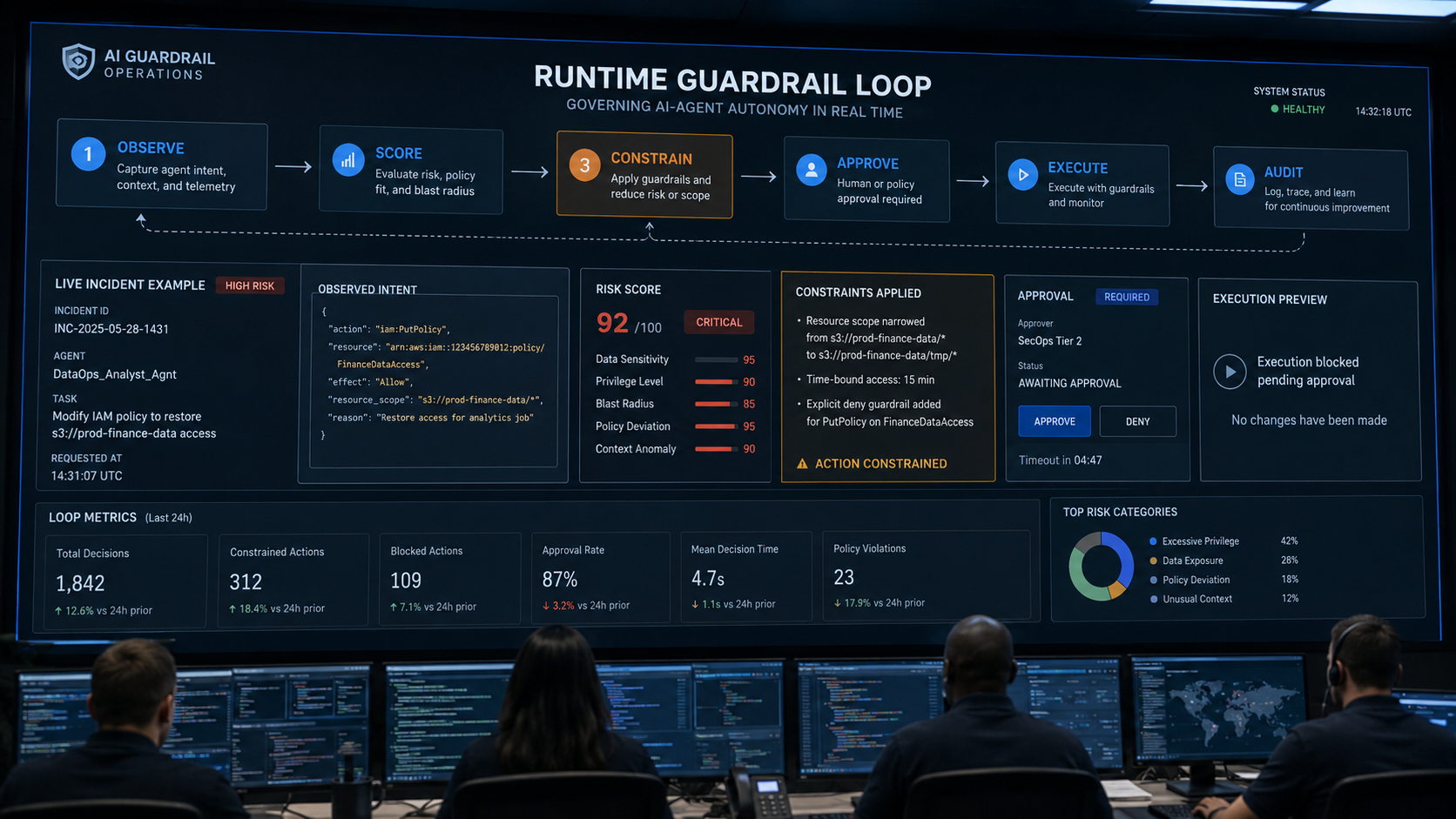
AIBound’s agentic-governance guidance emphasizes scoped identities, runtime behavioral monitoring, and human-in-the-loop checkpoints for high-risk actions. The organization needs evidence of what the agent actually did, not only documentation of what the agent was designed to do.
Useful runtime signals include:
New tools or connectors.
Permission expansion.
New data destinations.
Unusual action volume.
Repeated failed approvals.
Attempts to access restricted data.
Changes from read to write behavior.
Actions outside the expected business process.
Unusual use of administrative APIs.
Agent behavior at unexpected times or from unexpected environments.
A runtime control should be able to change the response when context changes.
Figure 4. Runtime agent governance is a continuous loop of observation, context, decision, enforcement, and audit.
9. Build a Policy Model That Can Be Enforced Technically
Written policy is necessary, but it should translate into machine-enforceable conditions.
Instead of saying “agents must be safe,” define rules such as:
Agents using privileged identities cannot perform production writes without approval.
Agents handling regulated data must use approved enterprise destinations.
External communications above a defined risk threshold require confirmation.
Financial actions require dual approval and transaction limits.
Agents may not grant permissions to themselves or create long-lived credentials.
New connectors require security review before activation.
High-risk agents must produce complete activity logs.
Review agent permissions after material configuration changes.
Identity systems, application controls, gateways, policy engines, workflow approvals, and AI-specific security controls can then apply these rules.
10. Use an Autonomy Review Before Production Deployment
Every production agent should have a short, structured autonomy review.
The review should answer:
What business outcome is the agent responsible for?
Which actions can it perform?
Which actions can it perform autonomously?
Which actions require human approval?
Which identity does it use?
What is the maximum permission scope?
Which data types can it access?
Which external destinations can it contact?
Which actions are irreversible?
What happens when the agent behaves unexpectedly?
How can access be revoked quickly?
Who owns the agent and the risk decision?
The review does not need to be slow. Low-risk agents can follow a fast path. High-impact agents need deeper technical validation.
11. Red-Team High-Autonomy Workflows
The more autonomous an agent is, the more important adversarial testing becomes.
Red-team scenarios should test whether the agent can be manipulated into:
Bypassing approval.
Revealing confidential information.
Calling an unapproved tool.
Expanding its own scope.
Reusing credentials outside the task.
Sending data to an external destination.
Repeating an action at scale.
Acting on malicious instructions embedded in retrieved content.
The objective is to test effective authority under stress, not merely prompt quality.
AIBound’s enterprise-security framing is useful here because the important unit of risk is the full path from AI resource to identity to connection to action.
12. Create Emergency Stops and Fast Revocation
Autonomous systems need rapid containment options.
Security teams should be able to:
Disable the agent.
Revoke tokens or OAuth grants.
Block a connector.
Remove a tool.
Reduce permission scope.
Force the workflow into approval-only mode.
Quarantine a compromised identity.
Stop a high-risk external destination.
Test these controls before an incident.
Human approval is not enough if the organization cannot stop the agent after suspicious behavior begins.
A Practical Autonomy Tier Model
A useful enterprise model can use four tiers.
Tier 1: Observe and Assist
The agent reads low-sensitivity data, summarizes information, classifies content, and makes recommendations. No consequential action is executed.
Default: autonomous operation with logging.
Tier 2: Prepare and Draft
The agent creates drafts, suggested changes, tickets, pull requests, or workflow steps but does not commit high-impact actions.
Default: autonomous preparation, human review at the commit point.
Tier 3: Execute Reversible Business Actions
The agent can update records, send approved internal messages, or perform bounded actions that can be rolled back.
Tier 4: Execute High-Impact or Irreversible Actions
The agent can change permissions, transfer money, modify production infrastructure, delete sensitive data, or make legally significant commitments.
Default: mandatory human approval, often dual approval, and in some cases prohibition.
Metrics CISOs Should Track
Useful metrics include:
Number of production AI agents by autonomy tier.
Percentage of agents with dedicated identities.
Agents using privileged identities.
High-impact actions requiring human approval.
Approval bypass attempts.
Agents with new or expanded tools.
Average time to revoke a risky agent identity.
Percentage of agent actions covered by audit logging.
Exceptions to autonomy policy.
Number of incidents prevented by runtime guardrails.
Changes in agent risk after permission or tool updates.
These metrics show whether autonomy is becoming more controlled as adoption scales.
Frequently Asked Questions
Should enterprises require human approval for every AI-agent action?
No. Universal approval would eliminate much of the value of agents and create unnecessary operational friction. Approval should focus on actions with meaningful consequence, high privilege, sensitive data, external impact, or low reversibility.
Is least privilege enough to make agents safe?
Least privilege is essential, but it is not sufficient. An agent can still misuse narrowly scoped authority if the task is sensitive or if the agent is manipulated. Identity scope should be combined with action boundaries, data controls, monitoring, and approval.
Can an approved agent become high risk later?
Yes. Permissions, tools, connectors, models, business processes, and data access can change. Reassess autonomy when material changes occur, and monitor it continuously.
What is the safest way to introduce agentic AI into production?
Start with read-only or draft-only workflows, use dedicated identities, limit tools, preserve approval for consequential actions, instrument runtime behavior, and expand autonomy only after the organization has evidence that the controls work.
Conclusion
Safe agentic AI is not created by choosing between autonomy and human control. It is created by assigning the right level of autonomy to each action.
Enterprises should classify actions, map identities, reduce permissions, consider data sensitivity and reversibility, define explicit approval thresholds, restrict tool scope, monitor runtime behavior, and maintain rapid revocation paths.
The most important design principle is simple: an agent should have enough authority to complete its approved job, but not enough authority to create unnecessary blast radius.
The NIST Generative AI Profile reinforces the need for risk management across the AI lifecycle. AIBound’s approach adds the operational security context needed to see which agent is acting, under whose authority, with access to what, and where intervention should occur.
As agent adoption accelerates, organizations that make these boundaries explicit can expand AI use faster because they will know exactly where autonomy is safe and where human judgment still belongs.
See Your AI Attack Surface
Discover every AI tool, agent, and model running in your enterprise — before attackers do.



%401x.png)