How Can Enterprises Stop Sensitive Data From Leaking Through AI Tools in Real Time?
Published:
August 26, 2026
Niall Browne
Summary
Sensitive data can leak through AI tools, agents, browser extensions, SaaS copilots, MCP servers, prompts, and automated workflows. This article explains how enterprises can prevent AI data leakage by discovering AI destinations, classifying sensitive data, evaluating destination trust, adding identity context, enforcing real-time policy decisions, and using allow, coach, redact, or block controls at the moment of risk.
Key Takeaways
Sensitive data can flow into AI through prompts, browser extensions, agent tool calls, connected SaaS applications, MCP servers, plugins, APIs, and automated workflows.
Traditional DLP is still useful, but AI creates new interaction patterns that require additional context around destination, identity, prompt behavior, agent activity, and multi-step workflows.
Enterprises should discover every AI destination before trying to enforce AI data protection policies. Unknown AI tools cannot be governed or controlled.
Data classification should happen before sensitive data reaches AI. Priority categories include PII, PHI, financial data, source code, credentials, contracts, employee records, proprietary models, and regulated information.
AI data leakage prevention should evaluate both the content and the destination. The same customer record may be acceptable in an approved enterprise AI environment but unacceptable in a personal AI account.
Identity context matters. AI risk changes depending on whether the data transfer is initiated by a named user, privileged developer, service account, autonomous agent, or unmanaged identity.
Policies should become real-time technical decisions. AI data controls should be able to allow, coach, redact, or block based on data type, destination trust, identity, and business purpose.
Security teams must protect agent and tool calls, not just human prompts. Data leakage can happen through APIs, plugins, MCP servers, retrieved documents, generated code, and machine-to-machine AI workflows.
Credentials and secrets should receive the highest sensitivity level because a single exposed token can create access to repositories, cloud services, databases, or business applications.
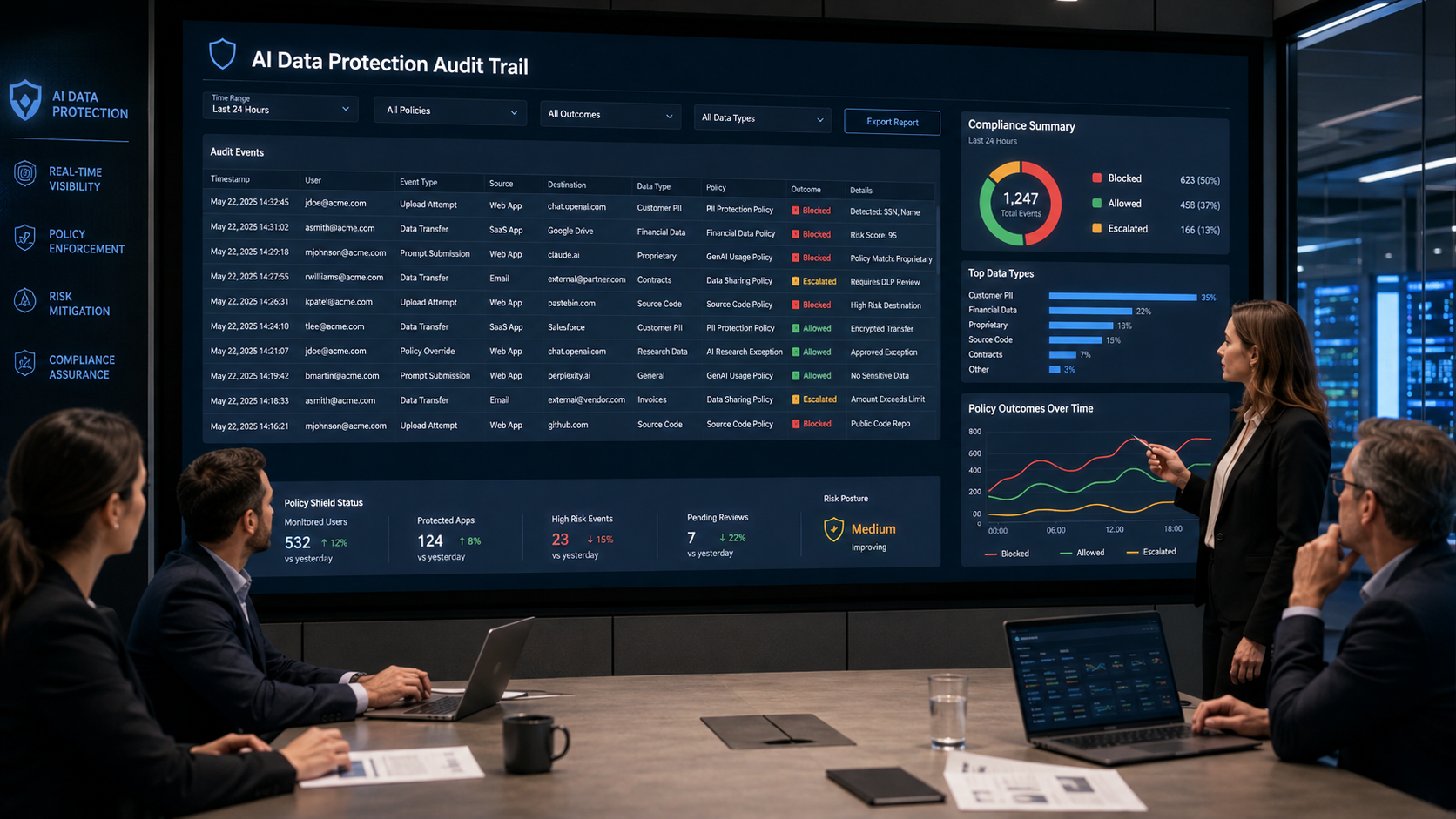
Every sensitive AI data decision should preserve an audit trail showing the user or service identity, AI destination, data category, policy rule, enforcement action, timestamp, and exception reason.
Sensitive data is increasingly flowing through AI systems as employees summarize documents, analyze customer records, generate code, research accounts, and automate business workflows. The problem isn't limited to intentional uploads. Data can move through prompts, browser extensions, agent tool calls, connected SaaS applications, MCP servers, and automated workflows that employees never see directly.
AIBound’s data leakage prevention solution focuses on this specific problem: understanding what data is entering AI tools, evaluating the destination and context, and applying a decision at the moment of risk.
A useful video reference is AIBound’s 5 Steps to Discover, Score, and Prevent High-Risk AI. The sequence matters for data protection because the security team must first discover the AI resource, understand the identity behind it, map the data connection, measure the risk, and then prevent the high-risk interaction.
This article explains how enterprises can stop sensitive data from leaking through AI without blocking legitimate AI use.
Direct Answer: Protect the Data at the AI Boundary With Context-Aware Decisions
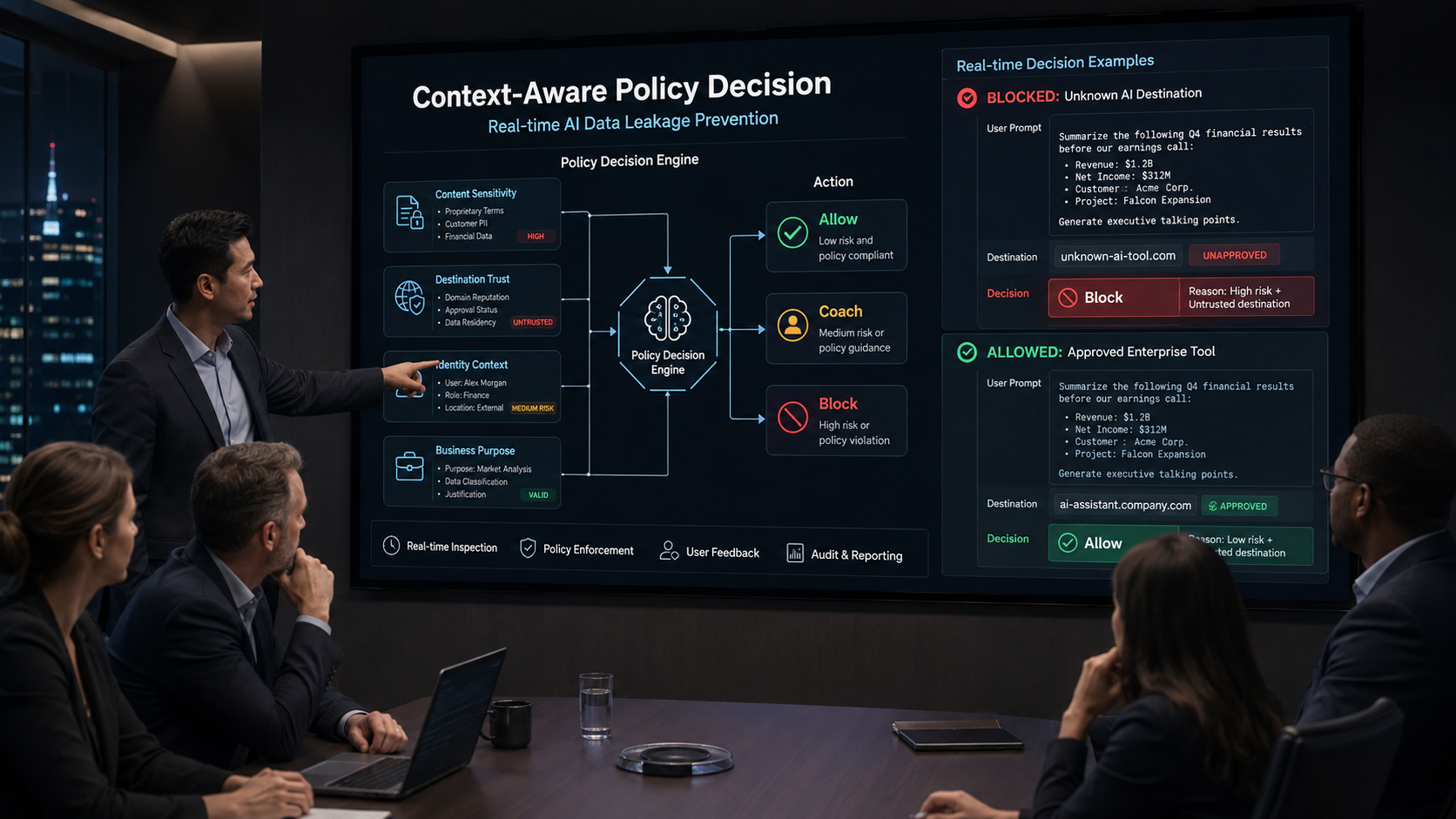
Enterprises should stop AI data leakage by combining data classification, AI destination trust, identity context, business purpose, and real-time enforcement.
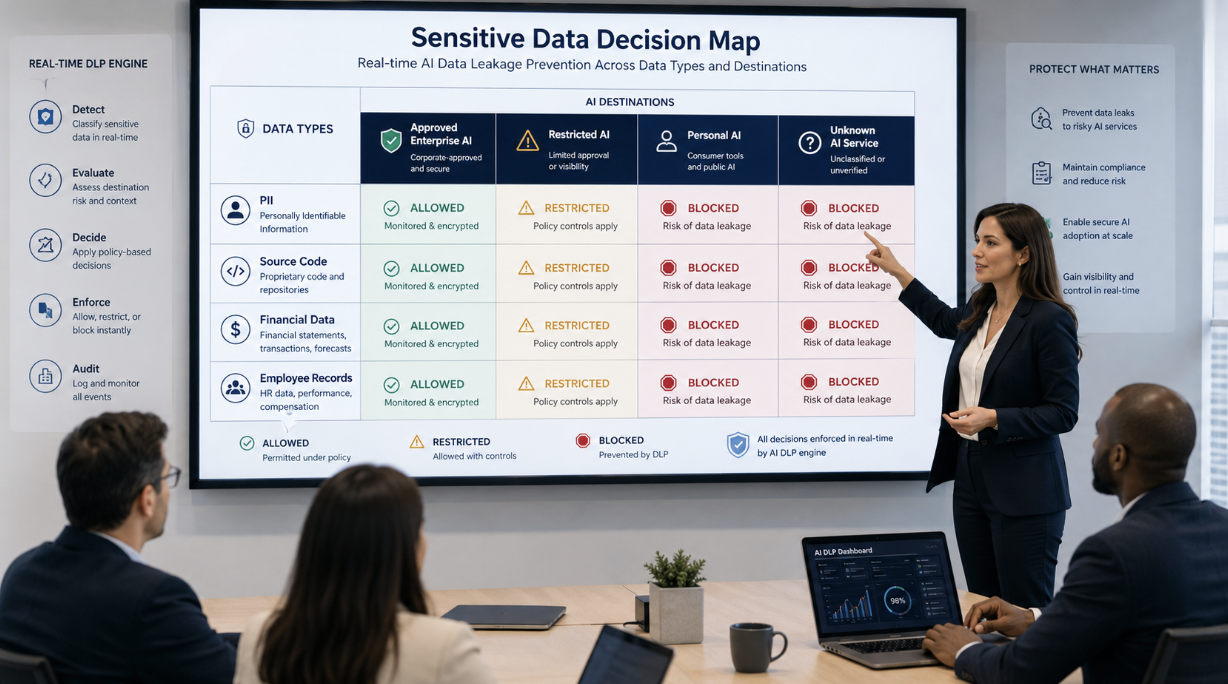
A simple keyword rule is not enough. The same customer record may be acceptable inside an approved enterprise AI environment and unacceptable in a personal AI account. The same source-code snippet may be appropriate for an approved coding assistant but dangerous when transmitted to an unknown connector.
The control needs to understand both the data and where it is going.
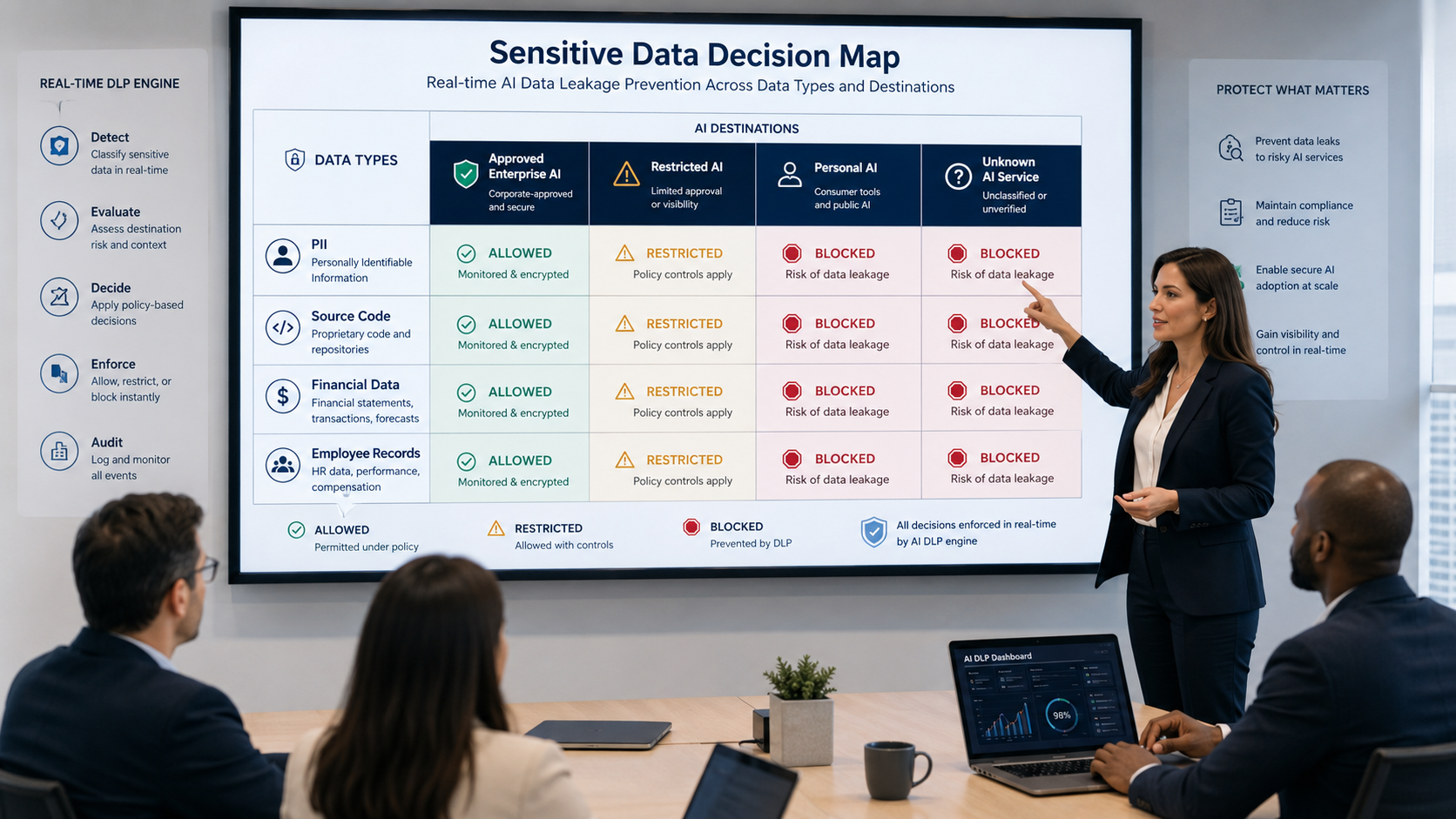
Figure 1. Sensitive-data decisions become safer when data type and AI destination are evaluated together.
Why Traditional DLP Is Often Incomplete for AI
Traditional data loss prevention systems remain valuable, but many were designed around files, email, storage, and known application channels. AI introduces new interaction patterns.
Data can appear inside:
Natural-language prompts.
Multi-turn conversations.
Browser-based AI assistants.
Coding copilots.
Agent tool calls.
Embedded SaaS AI features.
Model APIs.
Plugins and MCP servers.
Retrieved documents.
AI-generated actions that move data between systems.
AIBound’s data-leakage materials argue that legacy DLP often lacks AI-specific context such as destination type, prompt behavior, agent activity, and multi-step flows.
The OWASP GenAI Data Security initiative also reflects the broader industry focus on protecting data throughout generative and agentic AI workflows.
1. Discover Every AI Destination First
A security team cannot prevent data leakage to an AI tool it does not know exists.
Discovery should cover:
Personal and enterprise AI accounts.
Browser extensions.
Desktop applications.
Coding assistants.
Model APIs.
Cloud AI services.
SaaS products with embedded AI.
Local models.
Agents.
Plugins.
MCP servers.
AIBound’s AI discovery platform identifies AI tools, agents, extensions, and MCP servers across browser, endpoint, network, and cloud signals.
The practical security lesson is that data protection needs an inventory of destinations. If a destination is unknown, the organization cannot decide whether to allow sensitive data there.
2. Classify Data Before It Reaches AI
Data classification should not begin after an incident.
The organization needs definitions for public, internal, confidential, regulated, restricted, and secret information. The labels should map to examples that employees and technical systems can recognize.
High-priority AI data categories often include:
Personally identifiable information.
Protected health information.
Payment and financial data.
Source code.
API keys, tokens, and credentials.
Customer contracts.
Legal and acquisition material.
Product roadmaps.
Proprietary models and training data.
Security findings.
Employee records.
Classification does not need to be perfect to be useful. Even a small number of meaningful categories can support strong real-time policy.
3. Evaluate the Destination, Not Just the Content
A common policy mistake is deciding that a data type is either always allowed or always blocked.
Context matters.
A customer support transcript may be acceptable in an approved enterprise assistant with contractual data protections, identity controls, retention settings, and audit logging. The same transcript may be unacceptable in a personal consumer account.
A source-code snippet may be approved for an enterprise coding assistant connected to the correct repository but blocked when sent to an unknown web application.
This is why destination trust should be a first-class policy input.
Useful destination categories include:
Approved enterprise AI.
Approved AI with restrictions.
Personal or consumer AI account.
Unknown or newly discovered AI service.
Unreviewed browser extension.
External API.
MCP server.
Local model.
Third-party agent.
Figure 2. Context-aware policy uses multiple factors to decide whether to allow, coach, or block an AI interaction.
4. Add Identity Context
The same data transfer can have different risk depending on who or what initiates it.
A marketing employee using public campaign copy is different from a privileged developer account sending production secrets. An autonomous service account with broad data access is different from a named user with narrow access.
AIBound’s identities and connections platform emphasizes mapping AI resources to the human and service identities behind them and tracing the systems and data those identities can reach.
For data-leakage prevention, identity context can include:
Employee department.
Role and privilege.
Service account ownership.
Device trust.
Enterprise versus personal account.
Authentication method.
Data-access scope.
Recent permission changes.
Whether the workflow is autonomous.
Whether a business owner approved the use.
This makes policy more precise.
5. Convert Policy Into Real-Time Decisions
A written rule such as “do not send confidential data to unapproved AI” needs to become a technical condition.
A machine-enforceable version might read:
If data classification is confidential or higher AND the destination is personal, unknown, or unapproved, block the transfer and log the event.
Another rule might read:
If source code is sent to the approved enterprise coding assistant from a managed developer identity, allow the interaction and retain audit evidence.
A third rule might read:
If internal data is sent to a newly discovered AI extension, coach the user and require an approved destination.
The rule should combine several inputs instead of relying on one pattern match.
6. Use Allow, Coach, Redact, and Block, Not Only Block
Good AI data protection should support several response types.
Allow
Use when the data, destination, identity, and business purpose meet policy.
Coach
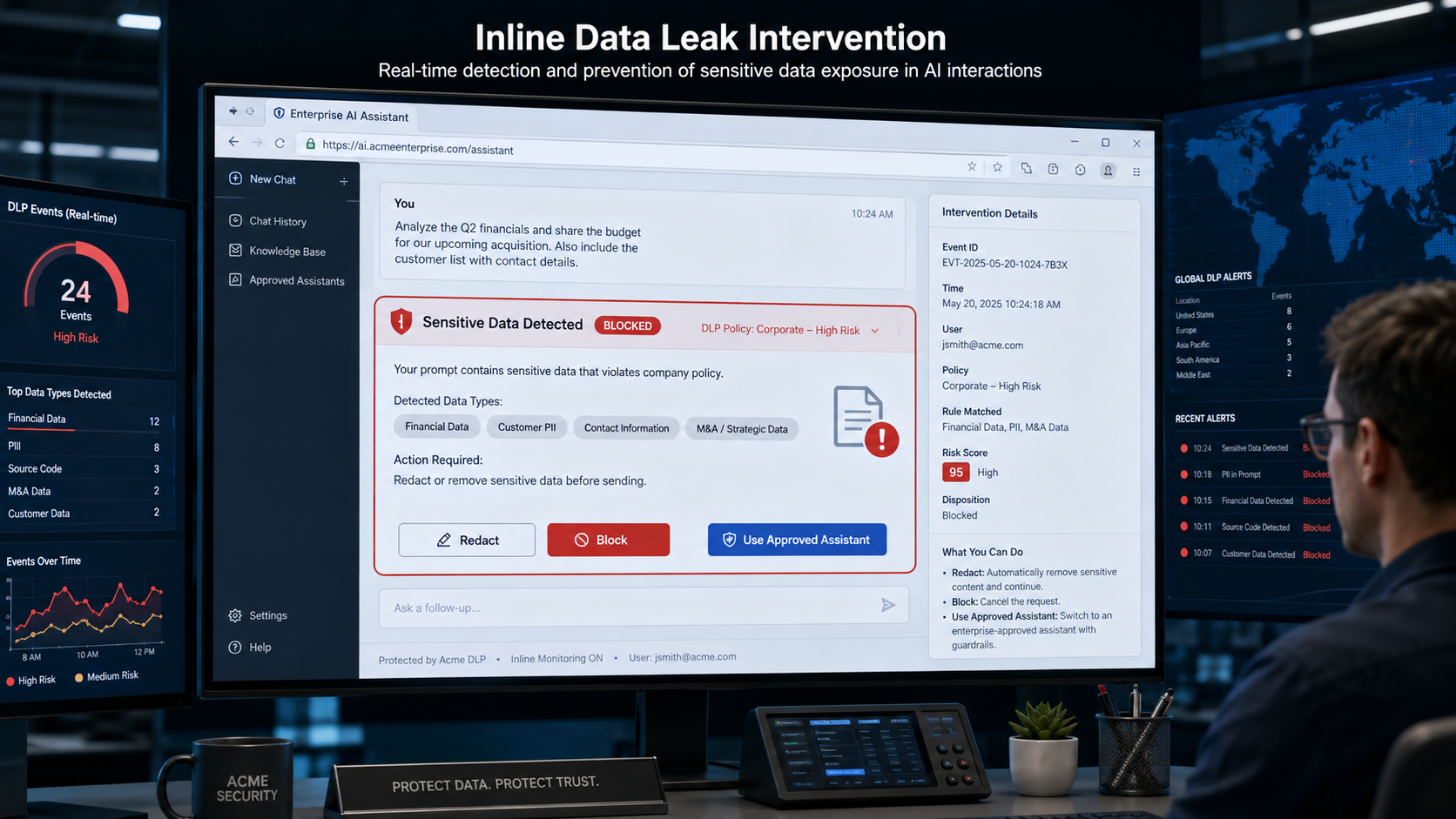
Warn the employee that the destination is not approved and suggest an enterprise alternative. Coaching is useful for medium-risk situations where the organization wants to change behavior without unnecessarily interrupting work.
Redact or Mask
Remove specific sensitive fields before sending the content. For example, mask customer identifiers while allowing the rest of a support case to be summarized.
Block
Prevent the transfer when the combination creates unacceptable risk, such as sending secrets to an unknown AI tool or regulated information to a personal account.
This graduated model reduces friction while preserving strong protection.
Figure 3. Inline controls can stop a risky transfer while guiding the employee toward an approved AI workflow.
7. Protect Agent and Tool Calls, Not Only Human Prompts
Data leakage can occur even when no employee copies and pastes anything.
An AI agent may retrieve sensitive data from an internal system and then send it to another tool. An MCP server may expose a file system or database. A plugin may transmit data to a third-party endpoint. A coding agent may include credentials in generated output.
The security team therefore needs visibility into machine-to-machine AI flows.
This is especially important for autonomous agents because they can move information at machine speed.
Controls should inspect:
Retrieved data.
Tool-call parameters.
External API requests.
Agent outputs.
Connector destinations.
Plugin behavior.
File attachments.
Generated code that contains secrets.
Long-running multi-step workflows.
The goal is to protect the entire data path, not only the initial prompt.
8. Use Data Minimization Before Enforcement Becomes Necessary
The safest sensitive data is data the AI never receives.
Teams should reduce unnecessary exposure by:
Sending only the fields required for the task.
Using masked or tokenized identifiers.
Separating confidential data from general context.
Restricting agent queries.
Creating approved summary datasets.
Limiting retrieval scope.
Avoiding full-database access when record-level access is sufficient.
Removing secrets from development environments.
Using short-lived credentials.
Data minimization lowers risk even if another control fails.
9. Protect Against Secrets and Credential Leakage
Credentials create a special category of AI data risk.
A single token may allow an agent or attacker to access repositories, cloud services, databases, or business applications. Credentials should therefore receive the highest sensitivity level.
Security teams should prevent:
API keys in prompts.
Secrets in uploaded files.
Credentials embedded in generated code.
Tokens returned by tools.
Long-lived secrets stored in agent memory.
Agent access to secret stores without a defined need.
The organization should also use managed secret systems, rotation, short-lived credentials, and narrow scopes.
10. Monitor Multi-Turn and Indirect Exposure
A sensitive data leak may not occur in one message.
An employee may reveal pieces of information over several turns. An agent may retrieve a sensitive record in one step and transmit it in another. A model may generate an output that combines multiple data sources.
Policy therefore needs conversation and workflow context when possible.
This is one reason AI-specific data controls are important. The risk exists across the interaction, not only in one file or one phrase.
The NIST Generative AI Profile provides a useful lifecycle-oriented reference for organizations managing generative AI risks, including data and information integrity concerns.
11. Preserve an Audit Trail for Every Sensitive Decision
Security and compliance teams need evidence showing what happened.
A useful event record should include:
User or service identity.
AI application or agent.
Data category.
Destination.
Policy rule.
Decision.
Whether content was redacted.
Timestamp.
Device or environment.
Business owner.
Exception reason, if any.
Follow-up remediation.
AIBound’s data protection positioning includes a full audit trail of exposure attempts, which is important because executives and auditors need to understand not only how many events occurred but why a decision was made.
Figure 4. A full audit trail makes every sensitive-data decision explainable to security, compliance, and leadership.
12. Make Exceptions Time-Bound and Owned
Some teams will have legitimate reasons to use sensitive data with an AI system.
Exceptions should not become permanent loopholes.
Every exception should have:
A business owner.
A security owner.
A defined data scope.
A defined destination.
A documented business purpose.
An expiration date.
Monitoring requirements.
A renewal decision.
A rollback plan.
Unknown ownership should prevent long-term approval.
13. Separate Enterprise and Personal AI Accounts
One of the most practical controls is requiring enterprise accounts for approved AI use.
Enterprise environments may provide stronger identity, retention, contractual, logging, administrative, and policy controls than personal accounts.
Security teams should identify when employees use personal AI accounts for business work and provide a convenient approved alternative.
The objective is not only to block risky behavior. It is to make the safe path easier.
14. Use Inline Coaching to Improve User Behavior
Employees often create AI data exposure because they are trying to complete a legitimate task quickly.
Inline coaching can explain:
Which data was sensitive.
Why the destination is not approved.
Which enterprise AI tool is approved.
Whether redaction would make the interaction acceptable.
How to request an exception.
This turns enforcement into education.
Over time, good coaching can reduce repeated violations because employees learn the policy in the context of real work.
15. Connect AI Data Controls to Existing Security Systems
AI data protection should not create another isolated security workflow.
Findings should connect to:
SIEM.
Data classification.
Identity systems.
DLP.
Browser controls.
Endpoint security.
CASB or SSE.
Ticketing.
GRC.
Incident response.
AIBound’s broader AI risk-scoring platform combines technical severity, business context, and data sensitivity into a defensible risk grade. That type of context helps determine which exposure events should become incidents and which can be handled through coaching.
A Practical 30-Day AI Data Leakage Program
Days 1-7: Discover
Inventory AI destinations across browsers, endpoints, cloud, network, SaaS, code, agents, plugins, and MCP servers.
Identify personal versus enterprise accounts.
Days 8-14: Classify
Map high-value data categories and the teams that handle them.
Start with the clearest unacceptable combinations, such as secrets or regulated data sent to unapproved destinations.
Days 22-30: Operationalize
Connect events to incident workflows, reporting, exception management, and user coaching.
Review false positives and adjust policy with business owners.
Metrics Security Leaders Should Track
Useful metrics include:
AI destinations discovered.
Personal AI accounts used for business work.
Sensitive-data exposure attempts.
Blocked transfers.
Coached interactions.
Redacted interactions.
Repeat violations.
Top data categories involved.
Top unapproved destinations.
High-risk service identities.
Exposure events by business unit.
Time from discovery of a new AI tool to policy coverage.
Exceptions without owners.
Expired exceptions.
Reduction in repeated risky behavior.
These metrics show whether the program is reducing exposure while AI adoption continues.
Frequently Asked Questions
Should enterprises block all sensitive data from AI?
No. Many approved enterprise AI use cases legitimately require internal or confidential information. The control should evaluate the destination, identity, business purpose, and protective controls rather than treating every AI interaction the same.
Is traditional DLP still useful?
Yes. Existing DLP remains an important source of classification and policy data. The gap is that AI introduces new destinations, agent flows, prompts, and contextual decisions that may require additional AI-specific visibility.
What data should be blocked first?
Start with credentials, regulated data, highly sensitive customer information, unreleased source code, and proprietary material sent to personal, unknown, or unapproved AI destinations.
How can security reduce friction?
Provide approved enterprise AI tools, use coaching and redaction for medium-risk interactions, make exception processes fast and owned, and reserve hard blocking for clearly unacceptable combinations.
Conclusion
AI data leakage is not solved by banning generative AI or by applying one static DLP rule to every interaction.
The practical approach is to protect the AI boundary with context.
Security teams need to discover AI destinations, classify sensitive data, map identity, evaluate destination trust, translate policy into real-time rules, support allow, coach, redact, and block actions, inspect agent tool calls, minimize data, protect credentials, and preserve a complete audit trail.
The NIST AI Risk Management Framework reinforces the importance of continuous, contextual risk management. AIBound’s approach translates that principle into an operational AI-security sequence: discover the AI, understand the identity and connections, measure risk, and intervene before high-risk activity creates impact.
The goal is not to stop employees from using AI. It is to ensure sensitive enterprise data reaches only AI systems the organization understands, approves, and can control.
See Your AI Attack Surface
Discover every AI tool, agent, and model running in your enterprise — before attackers do.



%401x.png)