How to Evaluate an AISPM Platform for Enterprise AI Security
Published:
August 24, 2026
Ralf VonSosen
Summary
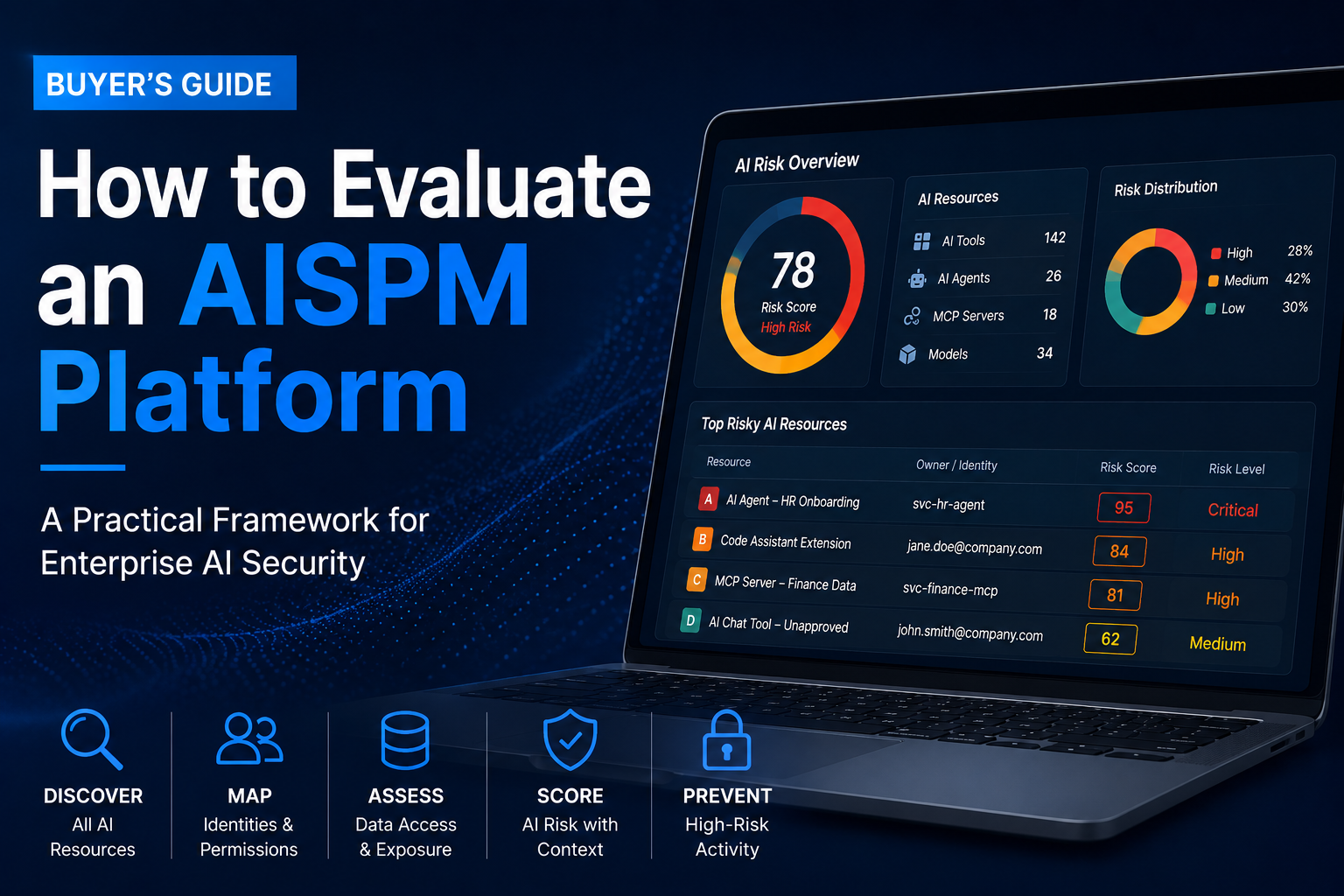
Enterprise AI risk now spans SaaS applications, coding assistants, copilots, AI agents, models, MCP servers, APIs, identities, permissions, and sensitive data connections. This article explains how security teams should evaluate an AI security posture management platform based on discovery coverage, identity context, data access mapping, agent and MCP visibility, explainable risk scoring, prevention capabilities, security-stack integrations, deployment model, governance reporting, and ability to reduce high-risk AI exposure.
Key Takeaways
AI security posture management should help enterprises continuously discover AI resources, assess exposure, monitor connections and behavior, prioritize risk, and apply controls.
The right AISPM platform depends on where AI is operating across the organization, not just which vendor has the longest feature list.
AI discovery should cover more than browser activity. Enterprises need visibility across SaaS applications, endpoints, cloud services, APIs, code repositories, embedded copilots, agents, and MCP servers.
AI agents and MCP servers require a different evaluation lens because they can retrieve files, call APIs, invoke tools, update records, and perform multi-step workflows.
An AI inventory alone is not enough. Security teams need to connect AI resources to users, service accounts, API keys, OAuth grants, tokens, roles, permissions, and business owners.
Data-connection mapping is critical because AI risk depends on what files, repositories, databases, SaaS applications, and cloud resources an AI system can read, write, or administer.
Risk scoring should be explainable. Analysts should be able to see why an AI resource is high risk, what evidence supports the rating, who owns it, and what action should happen next.
Visibility is not the same as control. AISPM platforms should support proportionate response actions such as warning, blocking, redirecting, revoking access, quarantining, opening incidents, or creating remediation workflows.
AISPM should integrate with the existing security stack, including identity providers, endpoint tools, cloud security platforms, network controls, SIEM, SOAR, ticketing, governance systems, and data-security products.
A control-plane approach is useful for enterprises that need to correlate AI resources with identities, permissions, data connections, risk context, and response actions across multiple environments.
Enterprise AI risk is no longer limited to employees pasting information into a chatbot.
Organizations now use AI-enabled SaaS applications, coding assistants, embedded copilots, homegrown AI applications, cloud AI services, autonomous agents, models, and Model Context Protocol (MCP) servers. These resources can access sensitive data, use human or machine identities, invoke tools, and take actions across enterprise systems.
That creates a new security question: Can you see every high-risk AI resource, understand what it can access, and stop dangerous activity before it has an impact?
AI security posture management (AISPM) helps organizations answer that question. But the category includes platforms with very different architectures and priorities. Some focus on workforce AI and SaaS governance. Some inspect prompts and uploads in real time. Others focus on securing AI applications, models, or autonomous agents.
This guide explains how to evaluate an AISPM platform based on the AI environment you actually need to protect.
A note on terminology: Organizations use “AISPM” differently. In this guide, it means the continuous discovery of AI resources, assessment of their exposure and risk, monitoring of their connections and behavior, and application of appropriate controls.
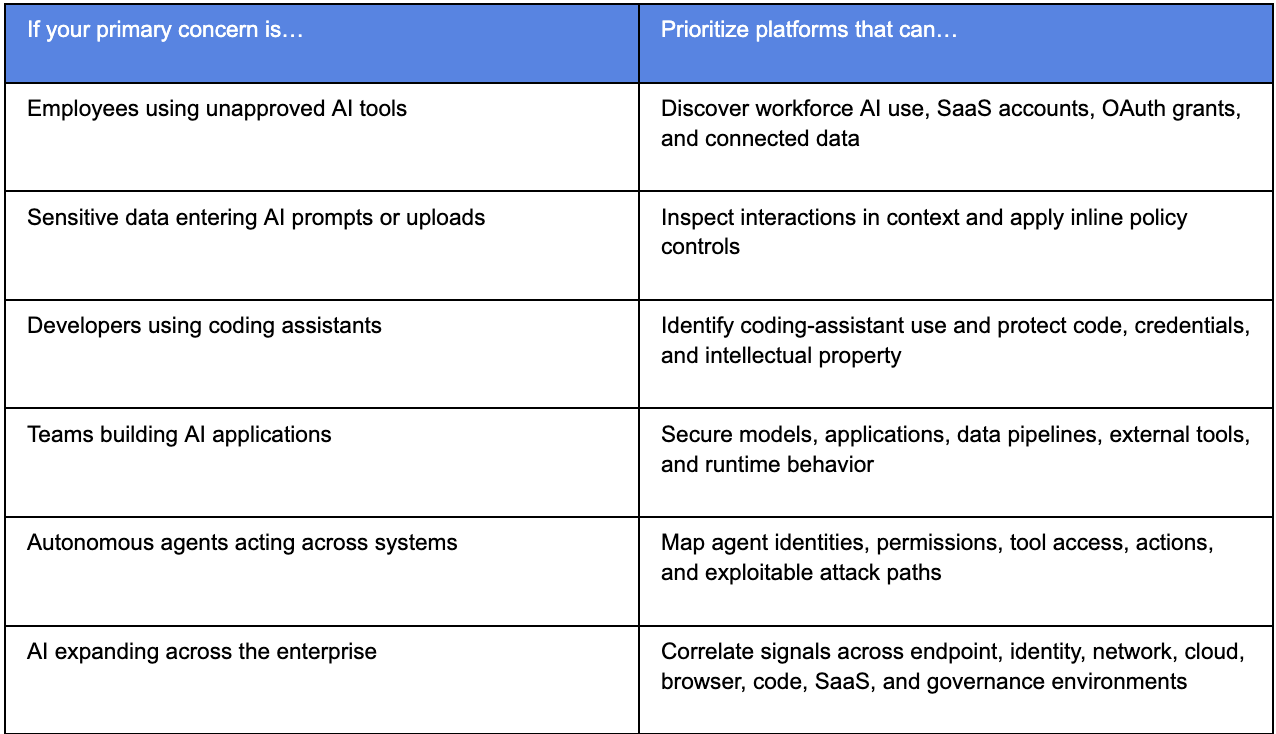
Start with your AI environment
The right platform depends less on which vendor has the longest feature list and more on where AI is operating in your organization.
Many enterprises will need more than one of these outcomes. The goal is not necessarily to buy the broadest product. It is to adopt an architecture that covers your material exposures without creating unnecessary deployment or operational overhead.
The AISPM evaluation framework
1. Multi-surface AI discovery
Browser activity is only one source of AI exposure. A discovery program should account for browser-based tools, desktop applications, endpoints, cloud services, APIs, code repositories, SaaS integrations, embedded copilots, agents, and MCP servers.
A platform that relies on a single signal can give a detailed view of one environment while missing relevant AI activity elsewhere. For example, browser monitoring may not reveal a locally running coding agent, an API-connected application, an embedded SaaS copilot, or a cloud-hosted model.
Ask vendors:
Which discovery signals does the platform use: browser, endpoint, identity, mailbox, network, cloud, code, SaaS, or agent platforms?
Can it identify AI resources that are not accessed through a browser?
How does it reconcile the same resource when it appears in multiple data sources?
Can it identify the business owner and relevant users for each discovered resource?
2. AI agents and MCP discovery
Agents and MCP servers need a different evaluation lens than ordinary chat tools. They may retrieve files, call APIs, invoke tools, update records, or perform multi-step tasks with limited direct human involvement.
A useful inventory should show where agents exist, who or what they act as, which MCP servers and tools they can reach, and whether they can affect sensitive systems.
Ask vendors:
Can the platform discover agents across SaaS, cloud, custom, and endpoint environments?
Can it identify MCP servers, tool connections, and agent-to-agent relationships?
Does it distinguish an AI tool that only generates text from an agent that can take action?
Can it map agent actions back to a human, service account, or machine identity?
3. Identity and permission context
An AI inventory alone does not show risk. The critical context is the identity behind an AI resource and the privileges attached to it.
An agent using a low-privilege account to summarize public documents presents a very different exposure from an agent using a production service account with access to customer records. Strong AISPM programs connect AI resources to users, service accounts, API keys, OAuth grants, tokens, roles, and permissions.
Ask vendors:
Which human and machine identities can be linked to an AI resource?
Can the platform show OAuth grants, API tokens, service accounts, and permissions?
Can it identify over-privileged agents or stale access?
Does it connect an AI finding to an accountable owner and remediation workflow?
4. Data-connection mapping
Prompt monitoring can reveal what a user typed into an AI tool. Data-connection mapping reveals the broader potential blast radius: the files, repositories, databases, SaaS applications, and cloud resources an AI system can access.
This matters because an AI resource may be safe in ordinary use yet dangerous when compromised, misconfigured, or instructed to perform an unsafe action.
Ask vendors:
Can the platform map which data sources an AI application or agent can read, write, or administer?
Does it classify data sensitivity or inherit context from existing data-security tools?
Can it show the path from AI resource to identity, permission, and sensitive data?
Does the finding explain why a specific connection creates material business risk?
5. Explainable risk prioritization
Discovery without prioritization can create a large, unmanageable inventory. A useful AISPM platform should help security teams focus first on high-risk combinations of AI resource, identity, permission, data access, observed activity, and business impact.
Risk scoring should be explainable. A security team should be able to understand why a resource is high risk, validate the evidence, identify the owner, and decide what to do next.
Ask vendors:
What inputs contribute to risk scoring?
Can analysts see the evidence behind a risk rating?
Does the platform distinguish between a low-risk writing assistant and an agent with access to sensitive systems?
Can teams filter and prioritize by business owner, department, data sensitivity, identity type, or environment?
6. Prevention and response
Visibility is not the same as control. Once a high-risk AI resource is identified, organizations need a proportionate response.
For lower-risk behavior, that may mean coaching an employee toward an approved tool. For a high-risk agent with sensitive permissions, it may require blocking an action, restricting access, revoking a token, opening an incident, or invoking an existing security control.
Ask vendors:
Which controls can the platform enforce directly, and which does it orchestrate through integrations?
Can it warn, block, redirect, revoke, quarantine, or create a remediation workflow?
Can it apply different actions based on resource type, user, identity, data sensitivity, or observed behavior?
How quickly can the platform move from detection to enforcement?
7. Integration with the security stack
AI security should not become an isolated dashboard. It needs to work with the systems that already hold relevant context and execute response actions: identity providers, endpoint tools, cloud-security platforms, network controls, SIEM and SOAR tools, ticketing systems, governance platforms, and data-security products.
For many enterprises, integration depth determines whether an AISPM program is operationally useful or simply another source of findings.
Ask vendors:
Which security, identity, cloud, network, code, workflow, and governance integrations are available today?
Are integrations read-only, or can they trigger prevention and remediation actions?
Can the platform use existing telemetry rather than requiring replacement of controls already in place?
How does the platform handle data normalization, retention, and access control?
8. Application and runtime protection
Organizations building AI applications have requirements beyond workforce AI governance. They may need security testing before deployment and runtime controls while applications and agents are operating.
Relevant capabilities can include AI application and model discovery, automated red teaming, prompt-injection defenses, output filtering, supply-chain monitoring, runtime guardrails, and validation of agent actions.
Ask vendors:
Does the product support internally developed applications through APIs, SDKs, gateways, or other deployment patterns?
Does it cover testing, deployment, and runtime—or only one stage of the lifecycle?
Can it identify and mitigate prompt injection, data leakage, unsafe outputs, and insecure tool connections?
What evidence can it provide after an incident or policy violation?
9. Governance and reporting
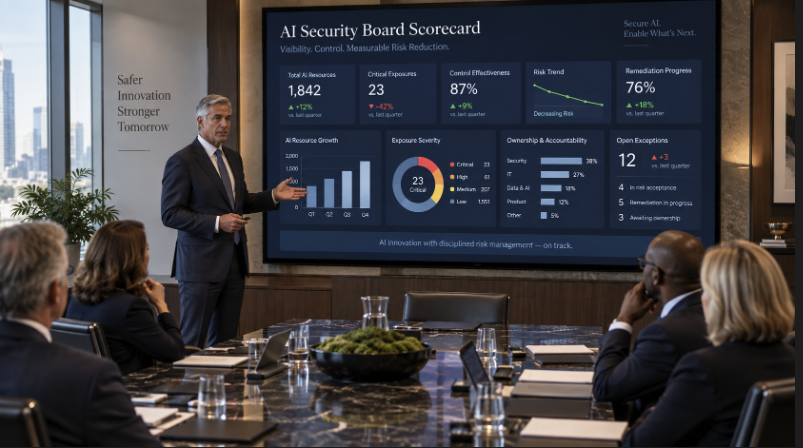
AI security leaders need to communicate AI adoption, risk, ownership, policy status, and remediation progress to executives, auditors, boards, and business stakeholders.
The best reporting turns technical signals into decision-ready information: what high-risk AI exists, what it can access, who owns it, which controls are working, and where risk is increasing.
Ask vendors:
Can reports show inventories, trends, ownership, risk drivers, and remediation status?
Can leaders see the difference between approved, unmanaged, and high-risk AI?
Does the platform preserve evidence that can support audit, investigation, and compliance workflows?
Can teams create role-based views for security, IT, governance, and executive audiences?
Choose the right deployment model
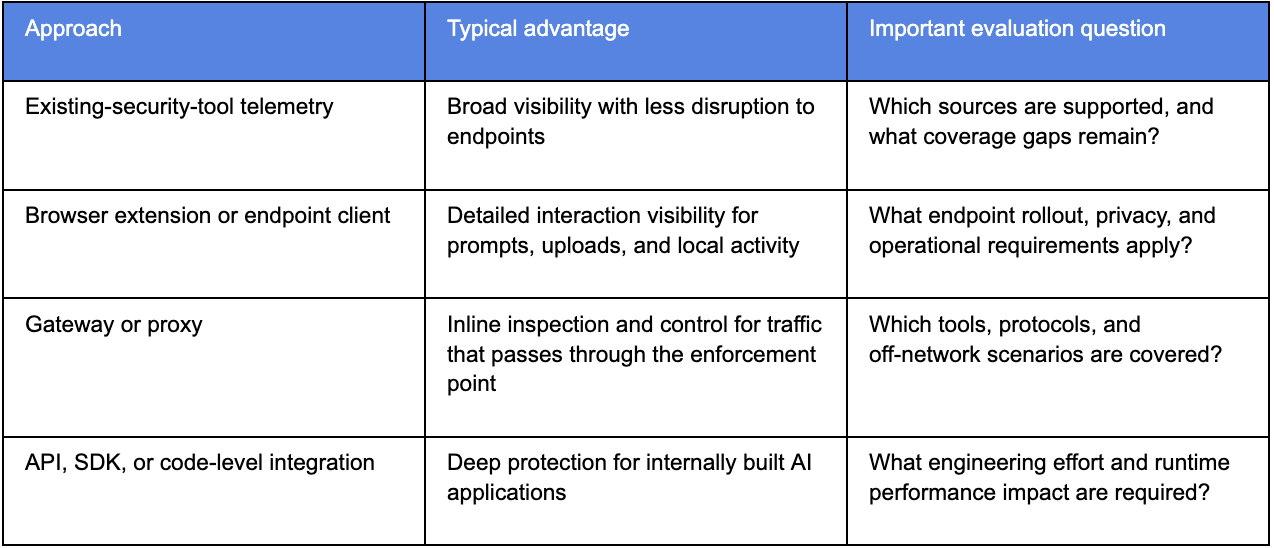
Deployment architecture affects both coverage and depth of control. There is no universal best approach.
Direct interaction monitoring can be valuable when preventing prompt and file-upload exposure is the central objective. Telemetry correlation can be valuable when the primary need is a broad, enterprise-wide view of high-risk AI resources and their relationships to identities, data, and existing controls.
During a proof of concept, test the actual environments that matter to you. Do not accept a generic dashboard demo as proof of coverage.
What a control-plane approach looks like
A control-plane approach is designed for enterprises that need to understand and manage AI risk across environments—not only within a single browser, endpoint, SaaS application, or AI runtime.
AIBound is built around five connected outcomes:
Discover AI applications, agents, models, and MCP servers across the enterprise.
Expose the human, service-account, and machine identities connected to those resources.
Map the data connections, permissions, and potential blast radius associated with them.
Prioritize risk using contextual, explainable ratings.
Prevent or remediate high-risk activity through the security tools and workflows an organization already operates.
This model is particularly relevant when an organization needs to correlate browser, endpoint, network, cloud, identity, code, workflow, and governance signals—and wants to avoid treating AI security as a separate, isolated control domain.
It may not be the only requirement. For example, organizations with a primary need for deep inspection of every AI prompt or for code-level runtime protection of homegrown applications should validate those capabilities directly as part of their evaluation.
A practical vendor-demo checklist
Bring these questions to every AISPM evaluation:
Show us an AI resource discovered outside a browser.
Show us the identity, permissions, data connections, and business owner associated with that resource.
Show us why the platform considers it high risk.
Show us a real response action, not only a finding or report.
Show us how the product handles an autonomous agent and its tool or MCP connections.
Show us the integration architecture, permissions required, and expected deployment effort.
Show us coverage gaps that the product does not address.
Show us reporting an executive can use to understand exposure and remediation progress.
The best question is not, “Which platform has the most features?” It is: Can this platform show us our material AI exposures, explain their context, and help us reduce risk before it becomes an incident?
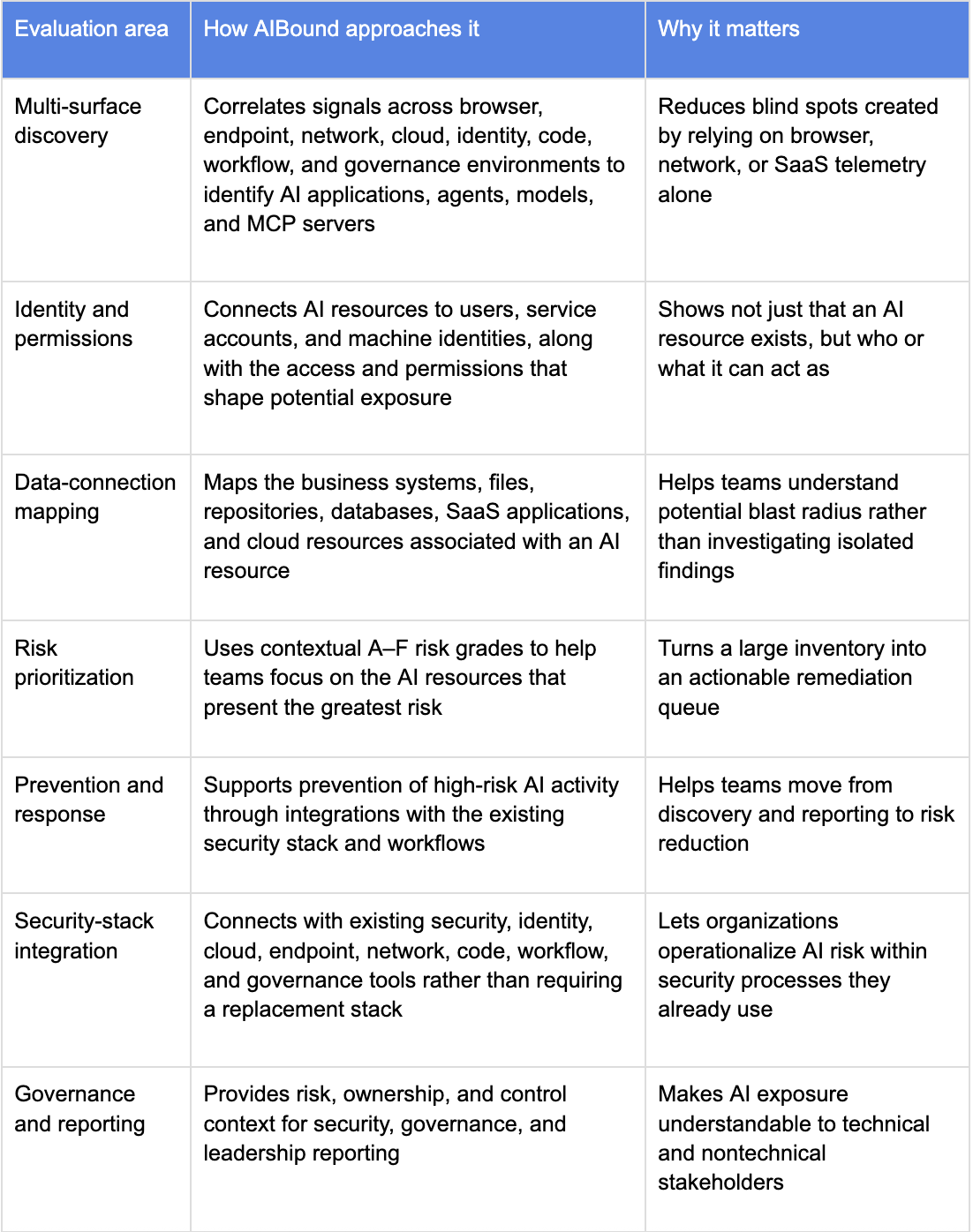
How AIBound maps to the AISPM framework
AIBound is designed for organizations that need to identify and control high-risk AI across the enterprise. Its approach connects AI discovery with the identities, permissions, sensitive data connections, risk context, and response actions associated with each resource.
AIBound is a strong fit when your AI exposure spans multiple environments and you need to correlate AI resources with identity, data access, permissions, business context, and prevention capabilities. It is especially relevant when you want to use telemetry and controls already deployed across the enterprise rather than introduce a separate, isolated AI-security stack.
Other AI security vendors to evaluate
AI security platforms often specialize in a particular part of the problem. Depending on your requirements, the following vendors may be relevant to evaluate alongside AIBound:
Nudge Security: A consideration for teams managing workforce AI within a broader SaaS-security and identity-governance program, especially where SaaS discovery and OAuth visibility are central.
Harmonic Security: A consideration when contextual, real-time governance of prompts, uploads, desktop AI, and AI interactions is a primary requirement.
Prompt Security: A consideration for organizations seeking workforce AI controls alongside security for homegrown AI applications, coding assistants, and agentic workflows.
Noma Security: A consideration for enterprises building AI applications, models, and agents that require security posture management, testing, and runtime protection.
Zenity: A consideration for organizations focused on autonomous agent discovery, permissions, exposure analysis, and runtime governance across enterprise environments.
Disclosure: This guide was prepared by AIBound. The vendor descriptions above are high-level, reflect publicly available information, and should not be treated as exhaustive. Product capabilities, packaging, and integrations change frequently; validate requirements directly with each provider.
See your high-risk AI exposure
AIBound helps security teams discover high-risk AI, connect it to the identities and data it can access, prioritize what matters, and take action through their existing security stack.
[Talk to AIBound about mapping your AI exposure.]
See Your AI Attack Surface
Discover every AI tool, agent, and model running in your enterprise — before attackers do.



%401x.png)