How Can Enterprises Detect Malicious AI Skills Before They Cause a Breach?
Published:
August 24, 2026
Niall Browne
Summary
Malicious AI skills can hide dangerous intent inside ordinary-looking instructions. This article explains how enterprises can detect risky skills by analyzing intent, mapping identities and permissions, reviewing data destinations, comparing stated purpose to actual capabilities, and continuously monitoring for changes before those skills become breach paths.
Key Takeaways
Treat every new AI skill as untrusted until its intent and authority are verified.
Review what a skill is instructed to do, not just the code or application it runs within.
Map every skill to the identity, OAuth grant, API key, service account, or other credential it can use.
Compare the skill’s stated business purpose with the actual tools, permissions, and actions available to it.
Pay close attention to external destinations and potential data-exfiltration paths.
Risk should be scored contextually using intent, privilege, sensitive data access, autonomy, ownership, and blast radius.
Use proportionate controls such as restricting permissions, requiring human approval, quarantining suspicious skills, or blocking high-risk activity.
Continue monitoring approved skills for new connectors, permission changes, version changes, and behavioral drift.
AI assistants are becoming operational systems, not just chat interfaces. They can load skills, call tools, use service accounts, access enterprise applications, and perform multi-step work on employees' behalf. That productivity changes the security question. The risk is no longer limited to what a model says. Security teams must also understand what an agent has been instructed to do, which identities it can use, and which systems those instructions can reach.
AIBound recently described this problem in its IntentSentry announcement, explaining that malicious skills can hide dangerous instructions in normal language. The company says its early use uncovered skills designed to steal credentials, access high-risk systems, or quietly move sensitive information. That framing aligns with the broader industry shift toward agentic AI security, where instructions, permissions, connectors, and identities all become part of the attack surface.
A useful companion is AIBound’s YouTube walkthrough, 5 Steps to Discover, Score, and Prevent High-Risk AI. The five-step sequence is important because malicious-skill detection is not a standalone scanning problem. It depends on discovery, identity context, data connections, risk scoring, and enforcement working together.
Direct Answer: Treat Every AI Skill as Untrusted Until Its Intent and Authority Are Verified
Enterprises can detect malicious AI skills before they cause a breach by combining four forms of evidence: what the skill says, what actions it can invoke, which identity and permissions it inherits, and what data or systems those permissions expose. A suspicious instruction with no meaningful access may be low impact. A subtle instruction running under a privileged service account with access to HR records, source code, payment systems, or cloud administration can become a critical exposure.
The practical objective is not to block all skills or all agents. It is to create a repeatable control process that continuously discovers skills, inspects intent, validates permissions, scores business impact, enforces proportionate controls, and monitors for change.
Why AI Skills Create a Different Kind of Security Problem
Traditional application security assumes that dangerous behavior is usually expressed through code, configuration, or observable runtime actions. AI skills introduce another layer: natural-language instructions. A skill may contain a sequence of steps that appear readable and ordinary to a person while still directing an agent to retrieve secrets, ignore normal approval steps, or send information to an unauthorized destination.
That matters because AI agents can interpret goals rather than simply execute a fixed sequence. The same skill can behave differently depending on the user request, available tools, model behavior, current data, and permissions present at runtime. Static scanning alone may therefore miss the difference between a legitimate workflow and a dangerous one.
The OWASP Agentic Security Initiative reflects this change. Its 2026 Top 10 addresses risks such as agent goal hijack, tool misuse, identity and privilege abuse, and agentic supply-chain vulnerabilities. These categories show why agent security has to combine instruction analysis with runtime authority and system context.
1. Start With a Complete Inventory of Agents, Skills, Plugins, and MCP Components
The first control is visibility. Security teams cannot assess a malicious skill if they do not know it exists. Inventory should extend beyond officially approved AI applications to include autonomous and semi-autonomous agents, reusable skills, plugins, browser extensions, MCP clients and servers, model APIs, local models, and AI features embedded inside existing SaaS products.
A useful inventory record should show the skill name, business owner, source, version, purpose, associated agent, execution environment, identities used, accessible tools, connected applications, data categories, external destinations, approval status, risk score, and date of last review. Unknown ownership should raise the review priority because no one can explain why the skill is needed or defend its current permission scope.
AIBound’s resources library repeatedly emphasizes that AI visibility must span applications, agents, models, MCP servers, identities, and data connections. This is a stronger foundation than a one-time questionnaire because skills and connectors can change far faster than an annual governance review.
2. Inspect the Skill’s Plain-Language Intent
A security review should read a skill the way an attacker would. The question is not only whether the syntax looks clean. The reviewer should determine what the instructions are trying to achieve, whether that intent matches the stated business purpose, and whether the instructions contain behavior that should never be delegated to an agent.
Requests to retrieve API keys, passwords, tokens, private keys, or session credentials.
Instructions to ignore policy, bypass a confirmation step, suppress logging, or conceal activity.
Directions to export files or data to an external destination unrelated to the approved workflow.
Broad prompts such as “collect everything relevant” when the task requires a narrow data set.
Instructions that ask the agent to modify security settings, identity policies, repositories, or production infrastructure.
Content that attempts to redefine the agent’s role, authority, priorities, or safety boundaries.
Intent analysis should also consider indirect instructions. A skill does not need to contain the sentence “steal a credential” to be dangerous. It may ask the agent to search local configuration files, copy the results to a staging area, and send the output to a remote endpoint. Each step looks operational; together, they reveal the intent.
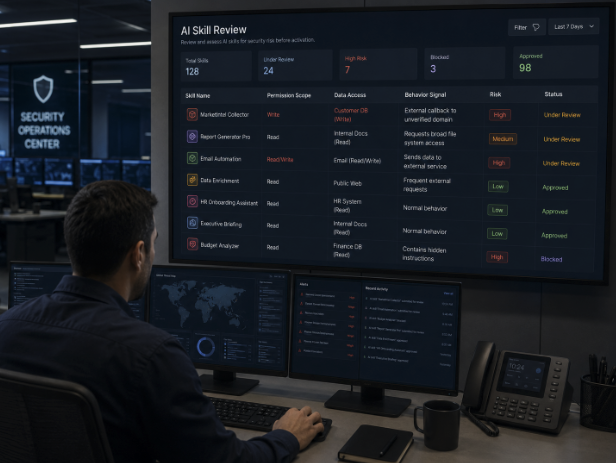
Figure 2. Intent risk becomes materially more serious as permission scope expands.
3. Map Every Skill to the Identity It Uses
The agent identity often determines whether an odd instruction becomes a serious incident. A skill that runs under a restricted user account may have limited impact. The same skill running under a shared administrative service account can reach far more systems and may operate without the controls that normally apply to a named employee.
Security teams should identify whether the skill acts through an individual user, shared account, service account, OAuth grant, API key, workload identity, cloud role, or other machine identity. Then they should map the effective permissions rather than relying on the intended role description.
Can the identity only read data, or can it write, delete, publish, deploy, transfer, or approve transactions?
Does the identity have access to production systems when the use case only requires testing?
Are OAuth scopes broader than the task actually requires?
Can the agent call multiple tools with one shared credential?
Are credentials long-lived, reused, or stored where the skill can retrieve them?
Can the downstream application independently enforce authorization and transaction limits?
Least privilege is especially important for agentic systems because automation can amplify mistakes. A person may notice an unusual request before approving it. An autonomous workflow can repeat the same action at machine speed.
4. Compare the Skill’s Stated Purpose With Its Real Capabilities
Every skill should have a narrow, reviewable purpose. A calendar lookup skill should not need payment permissions. A summarization skill should not need the ability to delete source files. A support-ticket classifier should not need administrative access to the identity provider.
Security teams should create a capability map showing every tool the skill can invoke and every action each tool exposes. The review should distinguish read, search, create, modify, delete, execute, send, deploy, export, and financial actions. This simple classification makes excessive agency much easier to identify.
AIBound’s approach to AI security is useful here because it connects the resource to the identity and then to the data or systems reachable through that identity. That chain provides the context needed to decide whether the skill’s authority is proportionate to the business task.
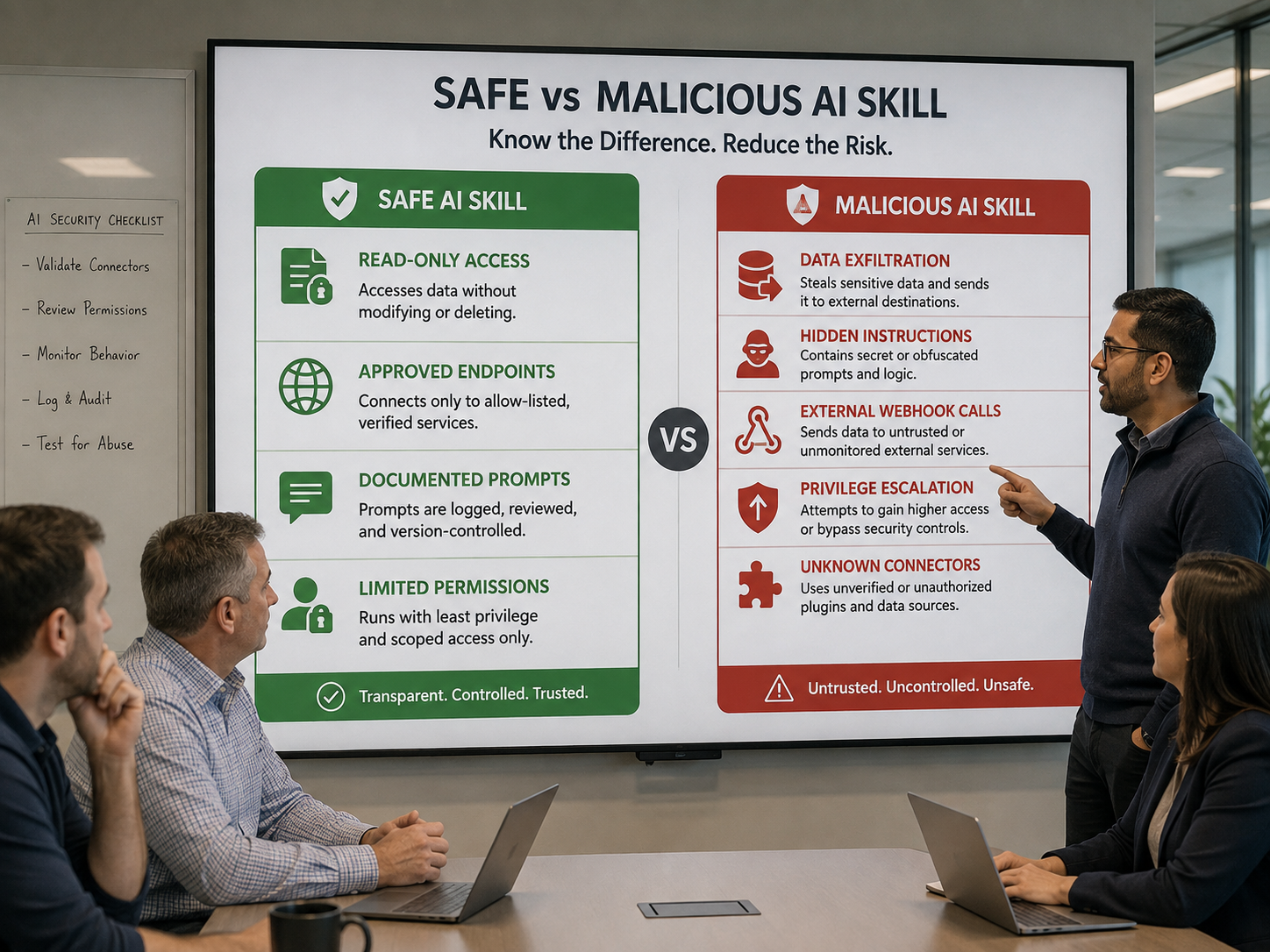
Figure 3. Safe and high-risk skills differ most clearly in ownership, intent, identity, actions, and destinations.
5. Review Data Destinations and Exfiltration Paths
A malicious or poorly designed skill may become dangerous because of where it can send information. Review all external destinations, webhooks, model providers, cloud storage locations, email domains, chat platforms, and APIs involved in the workflow. If a skill can access sensitive information and communicate with an uncontrolled external endpoint, the risk rises immediately.
Data classification should be connected to the skill review. Public marketing copy, internal operational data, confidential business information, source code, credentials, financial data, personal information, and regulated records should not be treated as equivalent. The same instruction can require completely different controls depending on the data it can touch.
6. Use Contextual Risk Scoring Instead of a Simple Good-or-Bad Label
A binary decision is often too crude. Many skills are useful but need narrower permissions or stronger monitoring. A contextual risk score should consider intent, privilege, data sensitivity, external connectivity, autonomy, business criticality, ownership, and blast radius.
For example, a suspicious phrase inside a low-privilege test skill may deserve investigation but not emergency blocking. A similar phrase inside a finance agent with payment authority and access to customer data should trigger a much faster response. The risk comes from the combination.
NIST’s AI Risk Management Framework and its Generative AI Profile encourage organizations to manage AI risk through structured governance, mapping, measurement, and management. Those functions are particularly relevant to skill security because a team needs both technical evidence and organizational context to justify enforcement decisions.
7. Enforce Proportionate Controls
Once risk is understood, the organization needs response options more nuanced than “allow everything” or “block AI.” Useful controls include requiring enterprise identities, reducing OAuth scopes, replacing shared accounts, limiting tools to read-only operations, requiring human approval for high-impact actions, restricting data categories, blocking unapproved destinations, quarantining suspicious skills, and revoking skills that violate policy.
AIBound positions its control plane around moving from discovery to prevention. That sequence matters because a finding only reduces risk when the organization can act on it through the controls it already uses.
8. Monitor Skills Continuously for Drift
Approval is not permanent. A skill may change instructions, gain a new connector, inherit a broader role, move to a new model, or become available to more users. Security teams should therefore monitor version changes, permission changes, new external destinations, ownership changes, unusual execution patterns, and repeated policy violations.
Continuous review also helps detect supply-chain risk. A third-party skill that was safe at onboarding may later introduce dangerous behavior. The organization needs a way to notice the change before the skill quietly operates across hundreds of users.
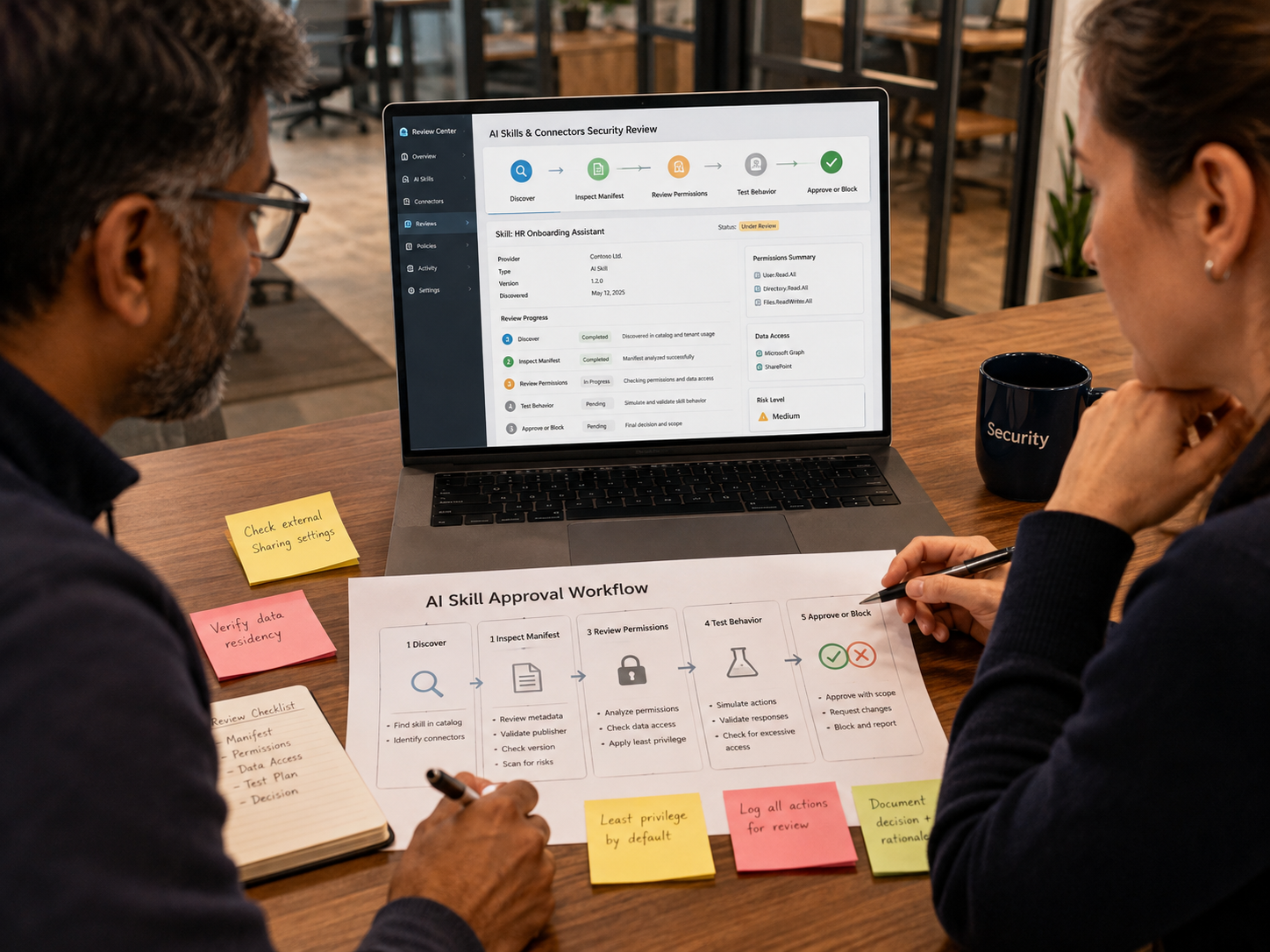
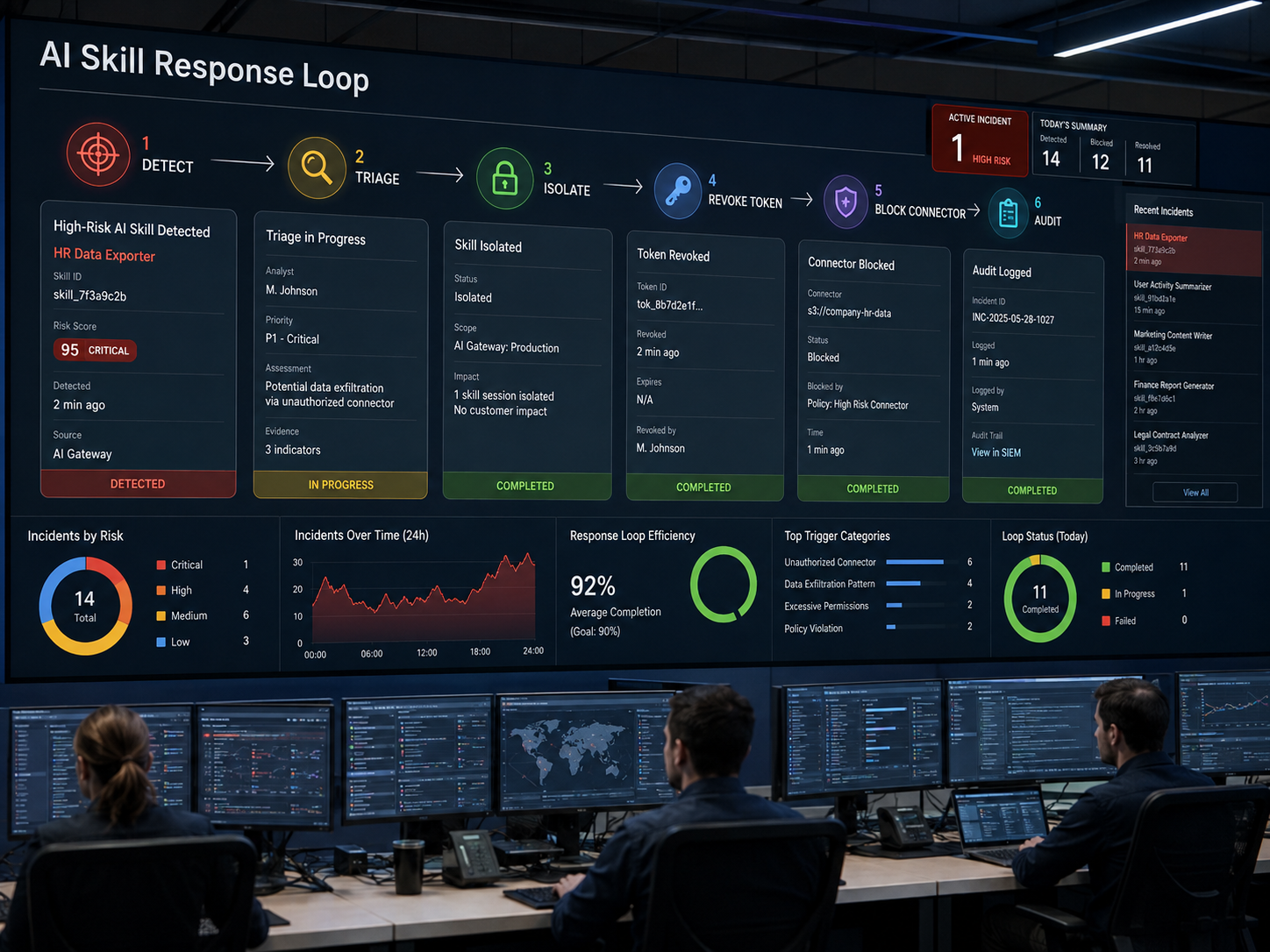
Figure 4. AI skill security should operate as a continuous control loop, not a one-time approval gate.
A Practical 30-Day AI Skill Security Program
Inventory agents, skills, plugins, MCP servers, identities, connected systems, and business owners.
Prioritize skills with privileged identities, sensitive data access, external connectivity, or autonomous actions.
Review plain-language instructions for hidden intent, policy bypasses, credential access, and exfiltration behavior.
Map each skill to the effective permissions of the identity it uses.
Reduce excessive permissions and require human approval for high-impact actions.
Create allow, restrict, quarantine, and block response paths that can be executed quickly.
Monitor for new versions, new connectors, permission changes, and newly discovered risky behavior.
Metrics CISOs Should Track
Total agents and skills discovered.
Percentage with a named business owner.
Skills using privileged or shared identities.
Skills with external data destinations.
High-risk skills blocked or quarantined.
Average time from discovery to review.
Average time from high-risk finding to remediation.
Percentage of approved skills operating with least-privilege access.
Number of material changes detected after initial approval.
Frequently Asked Questions
Are all third-party AI skills dangerous?
No. Third-party skills can be useful and legitimate. The issue is that you must review source, ownership, intent, permissions, and update behavior rather than assume safety.
Can code scanners detect malicious AI skills?
They may detect conventional vulnerabilities in surrounding code. Still, harmful intent can be expressed in natural language and may only become dangerous when combined with particular tools, identities, or data access. Skill review therefore needs both instruction analysis and runtime context.
Should organizations block autonomous agents?
Not automatically. Autonomy is one risk factor. A low-impact agent working with public data may be acceptable. A high-impact agent with write access to sensitive systems needs much stronger controls and often human approval.
What should be blocked immediately?
Prioritize skills that attempt to steal credentials, bypass controls, exfiltrate sensitive data, invoke destructive actions, or operate through privileged identities without a defensible business need.
Conclusion
Malicious AI skills represent a new security blind spot because the dangerous part may not look like malware. It may look like an ordinary set of instructions attached to an otherwise useful assistant. That is why enterprises need to evaluate intent, identity, permissions, data, destinations, autonomy, and business impact together.
The strongest programs will treat every new skill as untrusted by default, verify what it is trying to do, constrain what it is allowed to do, and continue monitoring after approval. That approach allows organizations to benefit from agentic AI without giving hidden instructions unrestricted access to enterprise authority.


%401x.png)