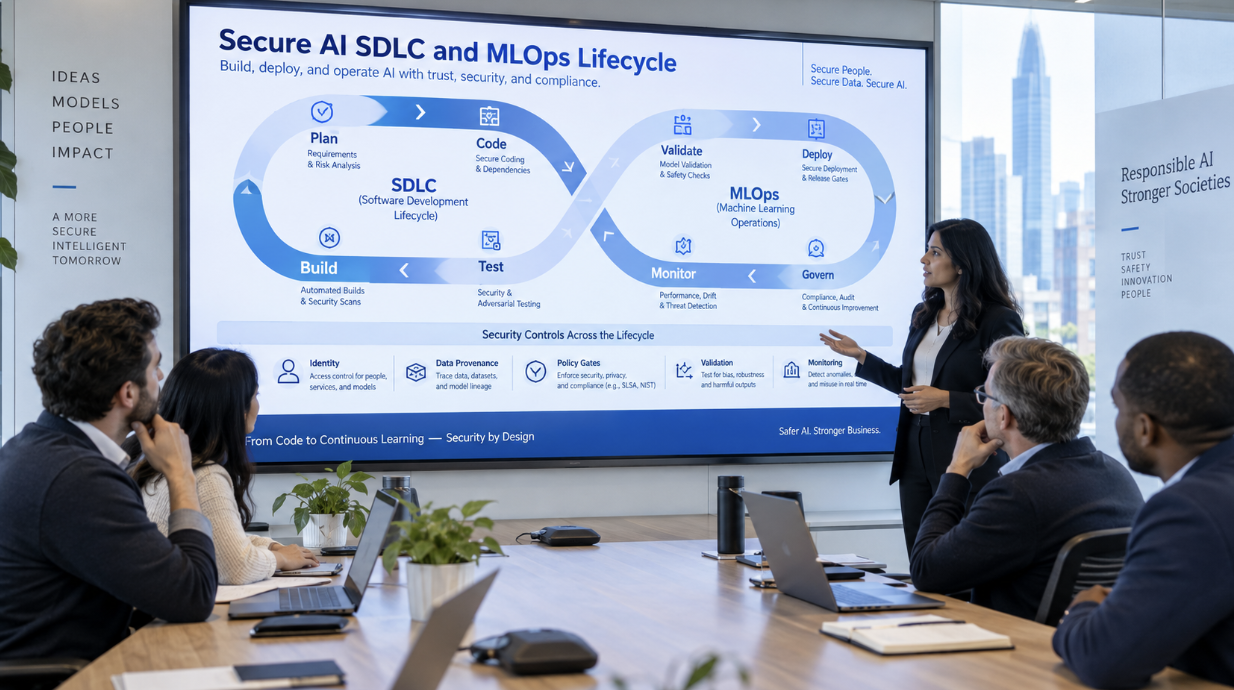
AI security is often added too late. A team selects a model, builds an application, connects data, deploys an endpoint, and only then asks security to review the finished system. By that stage, architectural decisions, permissions, dependencies, and operational assumptions are already difficult to change.
A more durable approach is to build AI security into the software development lifecycle and the MLOps lifecycle from the beginning. Security requirements should travel with the AI system from use-case definition through data preparation, model or application development, evaluation, release, deployment, runtime monitoring, and retirement.
AIBound’s 5 Steps to Discover, Score, and Prevent High-Risk AI provides a useful operational model after deployment. Still, the same five ideas can be shifted left: know what is being built, identify its identities and capabilities, map the systems and data it will reach, assess risk before release, and define how dangerous behavior will be prevented in production.
AIBound’s AI security posture video is also relevant because lifecycle security depends on turning fragmented security signals into one understandable posture rather than running isolated checks at the end.
This article shows how to connect secure software engineering, MLOps discipline, AI-specific testing, governance, and runtime enforcement into one repeatable lifecycle.
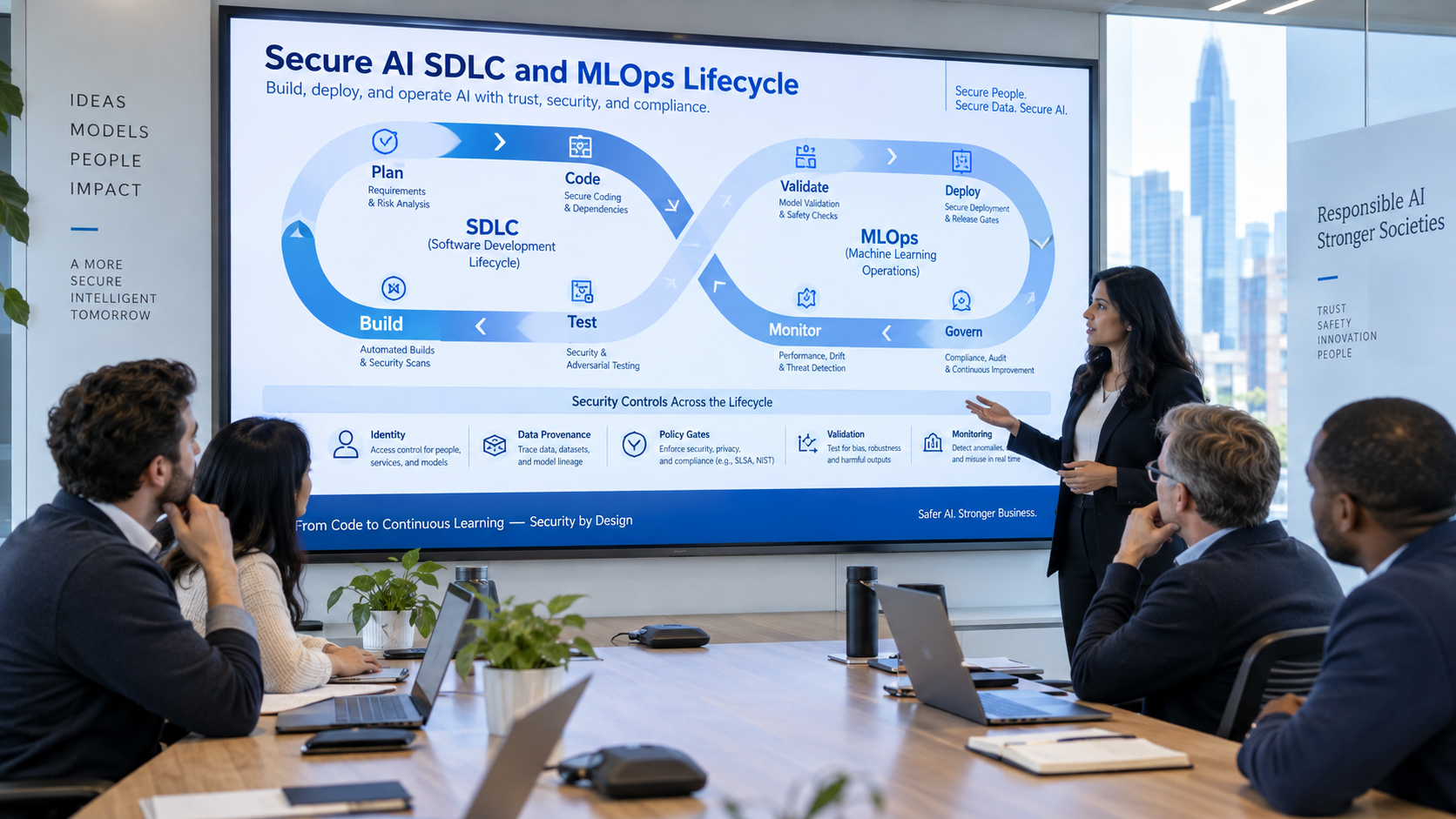
Direct Answer: Make AI Security a Lifecycle Requirement, Not a Release Checklist
Enterprises should embed AI security into every lifecycle stage by defining security requirements during planning, controlling data and dependencies during build, validating model and agent behavior before release, enforcing approvals for high-risk changes, and continuously monitoring production behavior after deployment.
The most important design principle is traceability. The organization should be able to trace a production AI behavior back to the use case, code version, model or provider, data sources, model artifact, identity, permissions, evaluation evidence, approver, and deployment configuration that produced it.
Why Traditional Secure SDLC Is Necessary but Not Sufficient
Traditional secure SDLC controls remain essential. Teams still need secure coding, dependency management, secret scanning, vulnerability testing, change control, and incident response. AI adds additional questions that conventional application security does not fully answer.
- Which model, agent, or AI service is being used, and can its version change independently of the application code?
- What data is used for training, retrieval, prompting, fine-tuning, or evaluation?
- Can untrusted prompts or retrieved content influence tool calls or downstream actions?
- Which identity does the AI runtime use, and what systems can that identity reach?
- Can the model or agent act autonomously, and which actions require human approval?
- How will the team detect drift, abnormal behavior, data leakage, new connectors, or permission changes after release?
The lifecycle therefore needs both software-security controls and AI-specific controls.
1. Plan the AI Use Case and Threat Model Before Development Starts
Security should begin with the use case, not the model. Teams should document what the AI system is supposed to do, who uses it, which business process it affects, what data it requires, whether it can take actions, and what happens if it makes a wrong or manipulated decision.
Threat modeling should include prompt injection, retrieval poisoning, malicious tools or skills, excessive agent permissions, data exfiltration, insecure model endpoints, unsafe output handling, third-party model dependencies, and abuse of automated actions.
A risk tier can then determine which later controls are mandatory. A low-risk internal summarizer may need basic data and access checks. A production agent with write access to customer or financial systems should require stronger testing, approvals, monitoring, and rollback.
2. Control Data Provenance and Training or Retrieval Inputs
AI systems depend heavily on the integrity and governance of their data. Teams should track where training, fine-tuning, evaluation, and retrieval data came from, who approved it, how it is classified, and whether it contains regulated, confidential, copyrighted, or poisoned content.
For retrieval-augmented generation, the data index itself becomes part of the production attack surface. Security teams should know which repositories feed the index, how documents are authorized, whether embeddings preserve tenant boundaries, and whether untrusted content can inject instructions into downstream agent behavior.
Treat data lineage as release evidence, not documentation assembled later.
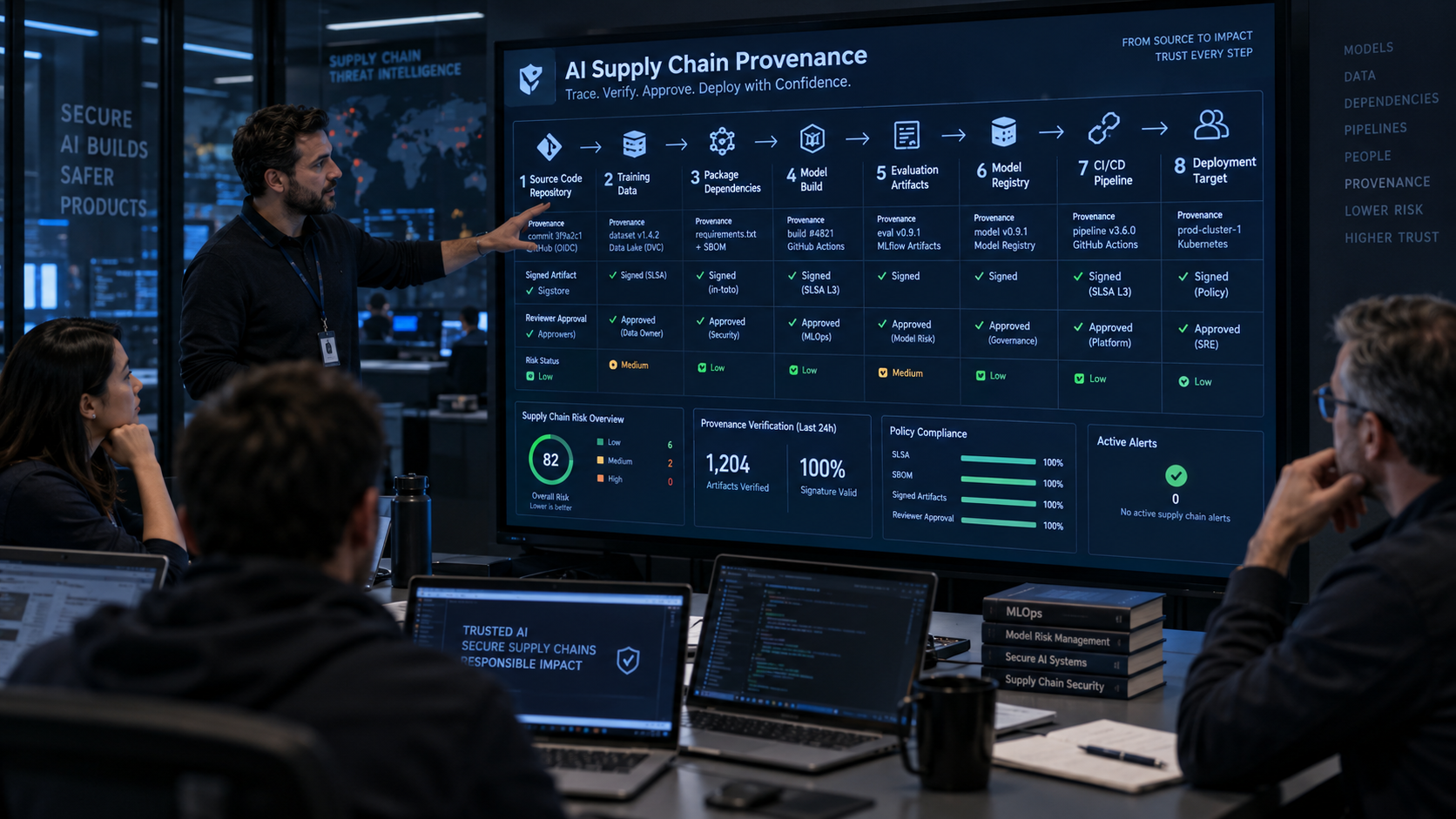
3. Secure Code, Dependencies, Models, and AI Supply Chain Components
AI applications inherit software supply-chain risk from libraries, containers, model packages, open-source components, skills, plugins, MCP servers, and third-party APIs. A signed application build is not enough if the model or connector can change outside the same release process.
Teams should maintain an inventory of model providers, model versions, container images, Python packages, AI skills, connectors, and external endpoints. Where possible, pin artifacts to known versions, scan them, sign them, and promote them through controlled environments.
The goal is to make the AI release reproducible. If an incident occurs, the team should be able to identify exactly which model, data set, connector, and configuration were running at the time.
4. Validate Identity and Least Privilege Before Integration Testing
The AI system should not enter testing with broad production credentials. Development and test environments should use isolated identities with the minimum permissions needed for realistic testing.
Before release, teams should validate the effective permissions of users, service accounts, OAuth applications, workload identities, API keys, and agent identities. Any ability to export data, change permissions, deploy code, initiate transactions, or modify production.
AIBound’s identity-security model is useful at this stage because it resolves AI resources to the identities they use and maps the systems and data those identities can reach.
5. Add AI-Specific Security Testing Before Release
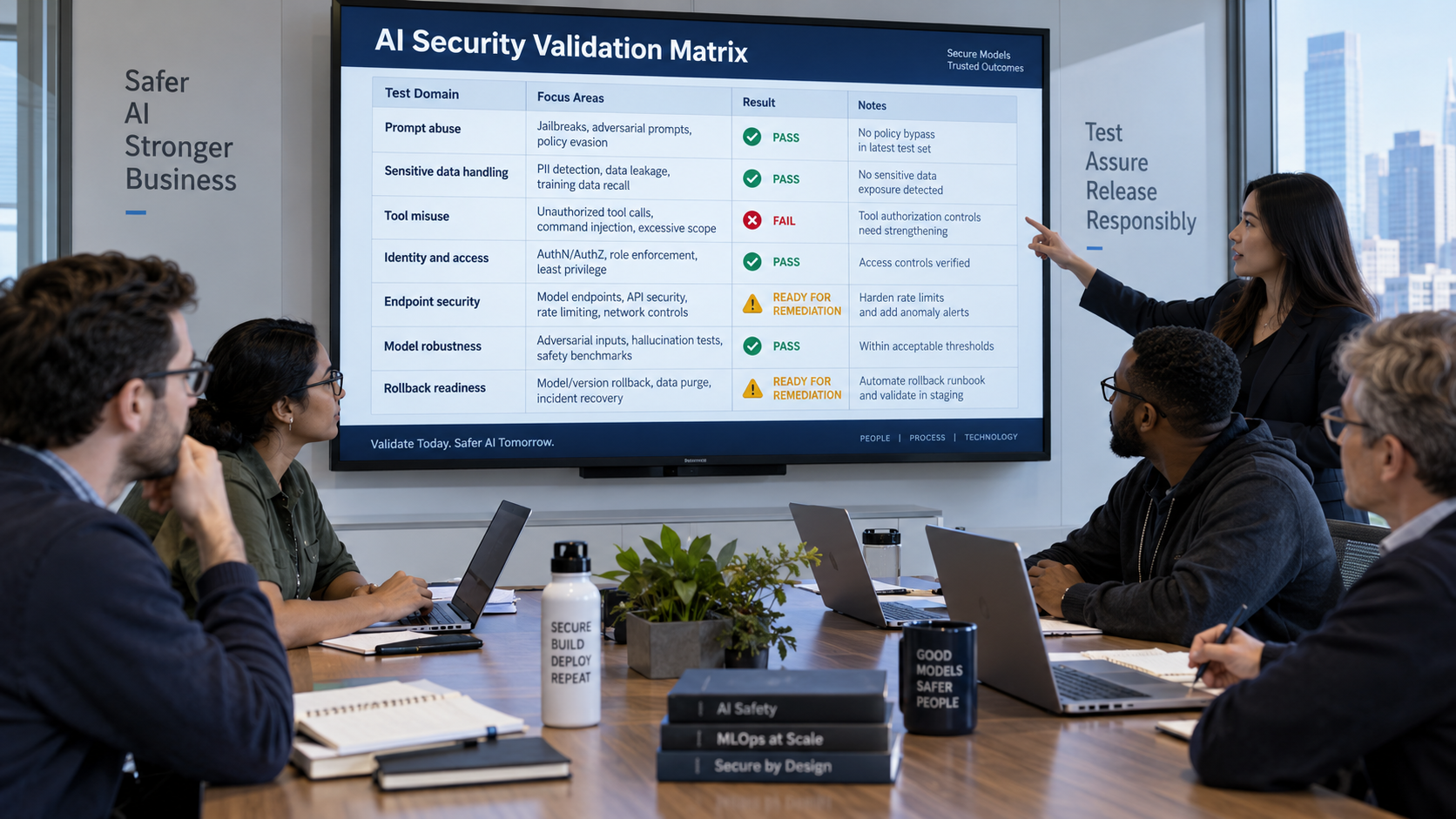
Pre-production validation should test how the AI behaves under hostile and unexpected conditions, not only whether normal prompts produce accurate results. Security and quality teams should test the system as a whole, including the model, system prompt, retrieval layer, tools, identities, connected APIs, and downstream business actions.
High-value scenarios include prompt injection, indirect prompt injection through retrieved content, sensitive data exposure, tool-call abuse, permission bypass, malicious files, poisoned retrieval data, external destination changes, and attempts to make the agent perform actions outside its approved business purpose.
The pass condition must be operational. Instead of documenting that prompt injection is possible, the team should verify that a high-risk tool call is blocked, a sensitive data transfer is redacted, or a human approval gate is enforced.
6. Use Release Gates for High-Risk AI Changes
Not every AI change needs a committee. Release gates should be proportional to risk. Low-risk prompt changes for public content can move quickly. Changes to a model provider, tool permissions, data sources, agent autonomy, or production identity deserve stronger review because they can change behavior and blast radius even when the application code barely changes.
Release evidence should include security-test results, model and dependency versions, data-lineage confirmation, identity and permission review, policy configuration, known limitations, rollback instructions, and named approval.
This is where AI governance becomes practical: the policy defines which evidence is required, and the pipeline refuses promotion until the evidence exists.
7. Secure Model and Agent Endpoints at Deployment
Treat production AI endpoints as high-value application surfaces. Authentication, authorization, network exposure, rate limits, input validation, output handling, secret management, encryption, logging, and tenant isolation all matter.
For agents, deployment also includes the tool and identity boundary. Teams should confirm which tools are enabled, what scopes they receive, which destinations are allowed, and which high-impact actions require approval.
AIBound’s agent and MCP security approach matters because runtime risk isn't defined by the model alone. The complete combination of agent, skill, tool call, inherited identity, and reachable system defines it.
8. Monitor Runtime Behavior, Not Just Model Health
MLOps monitoring often emphasizes latency, availability, token usage, quality, and statistical drift. Security monitoring needs additional signals: new AI resources, new model versions, unexpected identities, permission changes, sensitive data movement, unusual tool calls, unknown destinations, policy violations, and changes in autonomy.
Security teams should correlate these events with business context. A spike in model calls may be operationally normal, while one privileged agent accessing a restricted repository and an unknown external endpoint may be critical even at low volume.
AIBound’s control-plane model is designed around that contextual correlation: AI resource, identity, connections, risk, and enforcement should exist in one operational record.
9. Design Rollback and Containment Before Release
AI systems should have a known-safe rollback path. Teams need to know how to revert the application, model version, prompt configuration, retrieval index, agent tools, permissions, and policy settings independently.
Containment should also be designed in advance. Security should be able to isolate an agent, revoke a token, turn off an MCP server or connector, block a destination, suspend a service identity, and preserve evidence without taking down unrelated business services.
10. Feed Production Findings Back Into Engineering
The lifecycle is incomplete if production incidents and near misses do not change development practice. Post-incident review should identify which control failed, why the test environment did not catch it, what new scenario should be added to evaluation, and which policy or architecture needs to change.
This creates a secure learning loop. New attack patterns become tests. New policy violations become pipeline checks. Permission drift becomes access-review logic. Data leaks become destination-aware controls. The organization improves without relying only on training or memory.
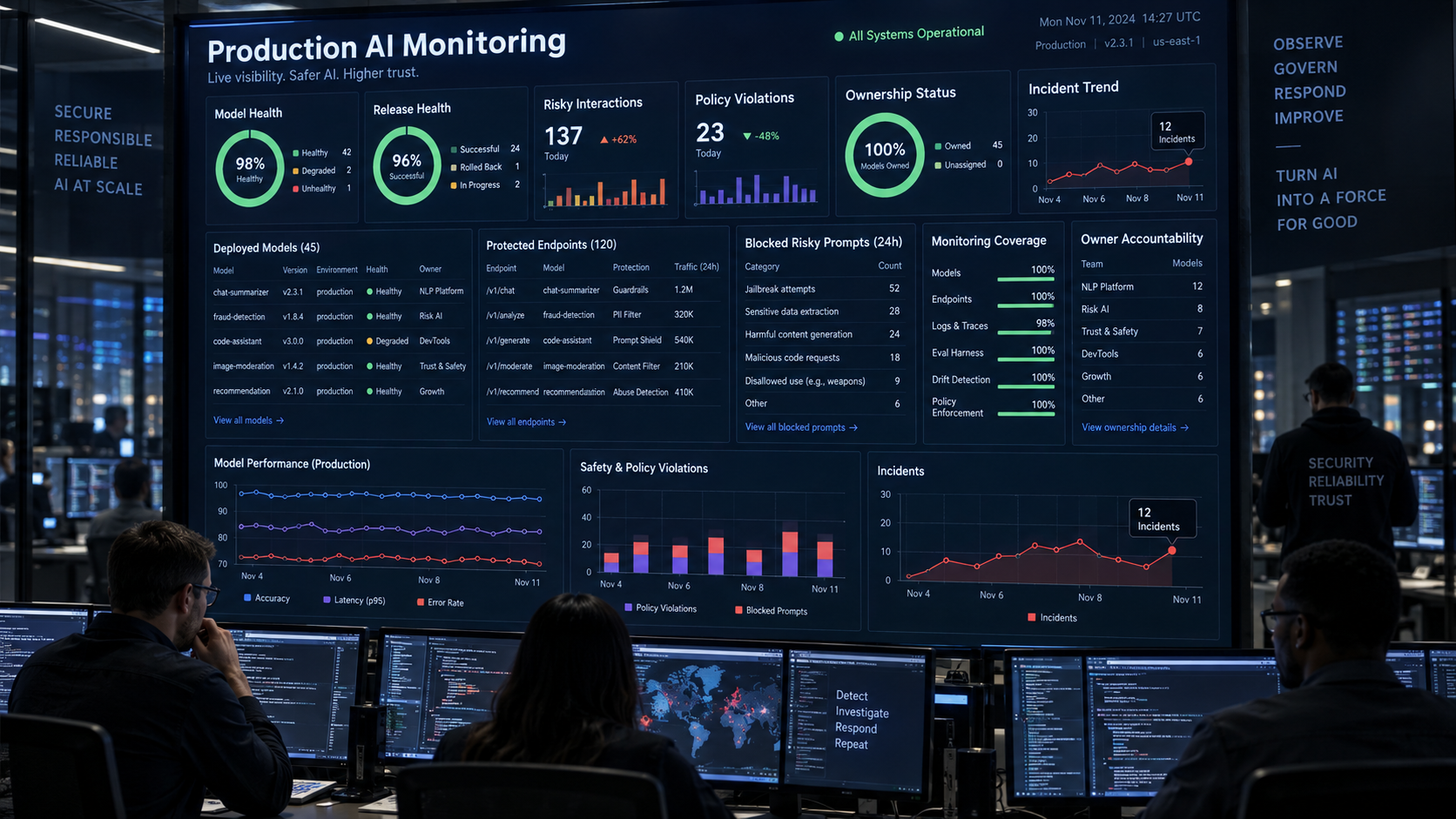
A Practical Secure AI SDLC and MLOps Control Set
- Document the AI use case, business owner, risk tier, intended data, and allowed actions before development begins.
- Threat-model prompt, retrieval, tool, identity, data, third-party, and model-endpoint risks.
- Track data lineage and classify training, fine-tuning, retrieval, and evaluation data.
- Pin and inventory model versions, libraries, containers, skills, plugins, MCP servers, and external AI providers.
- Use isolated development identities and validate least privilege before production integration.
- Run AI-specific security testing for prompt injection, data leakage, tool abuse, permission bypass, and unsafe actions.
- Require risk-based release evidence and approvals for material AI changes.
- Secure production endpoints and define explicit tool, destination, and autonomy policies.
- Monitor runtime identity, data access, model versions, policy violations, and configuration drift.
- Maintain tested rollback and containment procedures and feed lessons back into engineering.
Metrics Engineering and Security Leaders Should Track
- Percentage of production AI systems with named business and technical owners.
- Percentage with complete model, data, and dependency provenance.
- High-risk AI releases with completed security evaluation before deployment.
- Open-source models, skills, plugins, or connectors without current validation.
- Production AI identities that exceed documented least-privilege requirements.
- Prompt-injection, data-leakage, and tool-abuse tests passing by release.
- Mean time to rollback or contain a high-risk AI change.
- Runtime policy violations by model, agent, application, and business unit.
- Configuration or model changes detected outside the approved release process.
- Number of production findings converted into new automated tests or pipeline controls.
Frequently Asked Questions
Is secure AI SDLC the same as DevSecOps?
It builds on DevSecOps but adds AI-specific requirements for model and data provenance, prompt and retrieval behavior, agent identities, tool permissions, model endpoints, AI-specific testing, and runtime AI risk.
Should every model change require a security review?
No. Reviews should be risk-based. Material changes such as a new model provider, new data source, wider tool permissions, higher autonomy, or production identity changes deserve stronger gates than low-impact prompt or UI updates.
What is the most important pre-production AI security test?
There is no single test. The highest-value suite validates prompt and indirect prompt injection, sensitive data handling, effective identity permissions, tool-call abuse, destination controls, and rollback for the specific business workflow.
Can MLOps monitoring detect security incidents on its own?
Traditional MLOps monitoring is valuable but often focuses on availability, performance, quality, and drift. Security teams also need identity, permission, data, destination, tool-call, and policy-enforcement signals.
Conclusion
AI security is strongest when it is built into the lifecycle rather than added after deployment. Secure planning, data provenance, dependency control, least privilege, AI-specific validation, risk-based release gates, hardened endpoints, runtime monitoring, rollback, and continuous learning should operate as one system.
This approach also improves speed. Teams that know the required controls can design for them early instead of waiting for a late security review to discover architectural problems. Low-risk changes can move quickly, while high-risk changes receive the evidence and approvals they actually need.
AIBound complements this engineering discipline by providing the operational AI control layer after and around deployment: discover the AI, resolve identity, map connections, measure contextual risk, enforce policy, and preserve evidence continuously.
Recommended Internal AIBound Links
- AIBound Control Plane
- AI Agent and MCP Server Security
- AI Identity Security
- Policy Enforcement and Automation
External Resources and Video References
Find the AI already running on your devices.
Install takes 15 minutes. A full AI inventory arrives within 24 hours of deployment.