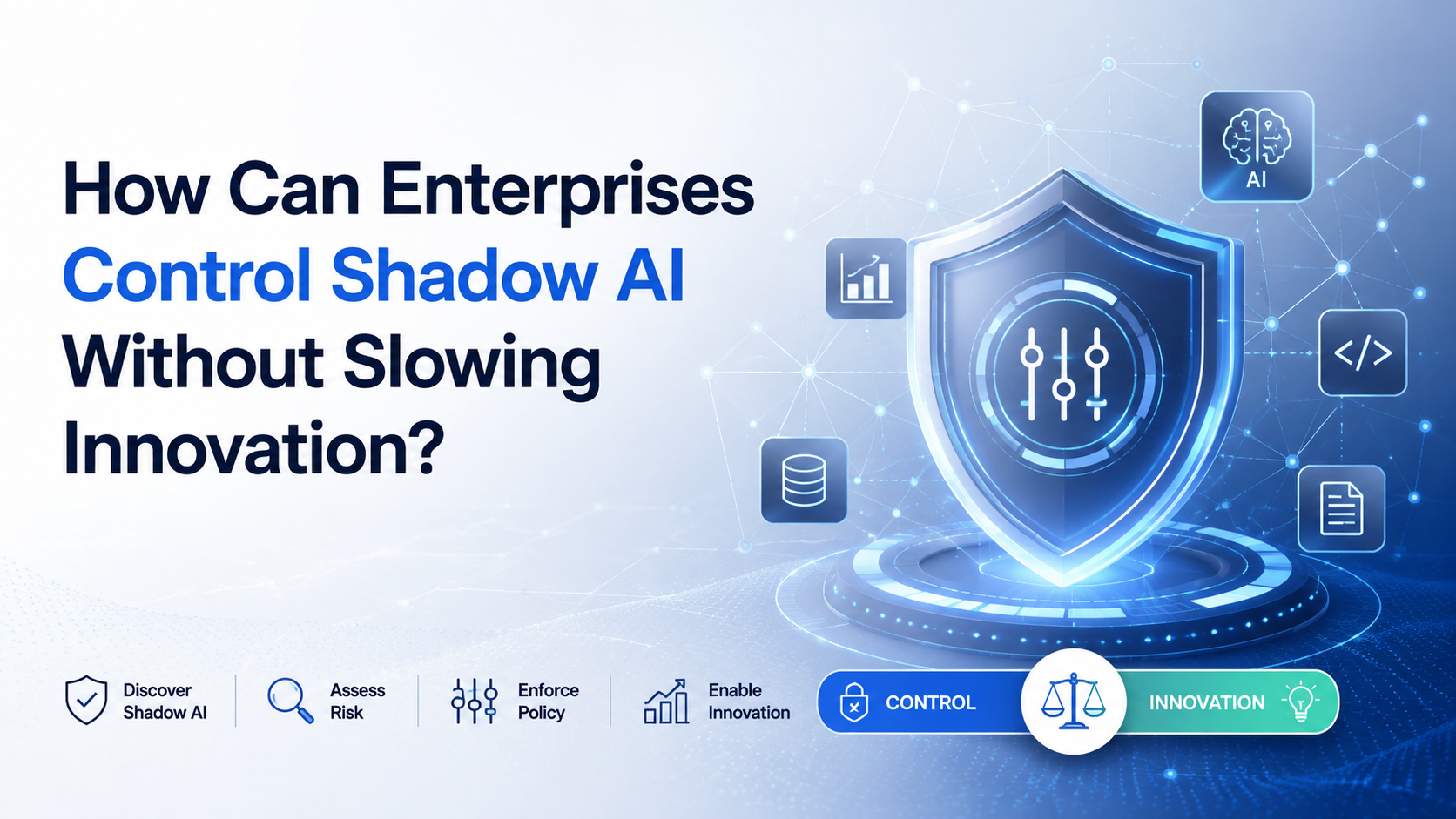
How Can Enterprises Control Shadow AI Without Slowing Innovation?

Summary

Enterprises do not need to choose between AI innovation and security. Learn how organizations can discover Shadow AI, assess risk, enforce policies, and enable responsible AI adoption without slowing employees down.

Key Takeaways
  • Shadow AI grows when employees adopt tools faster than security teams can review them.
  • Blocking every AI tool can push usage further underground and reduce visibility.
  • Enterprises need continuous discovery, risk scoring, and policy enforcement.
  • Controls should be based on data access, user identity, application behavior, and business risk.
  • The goal is not to stop AI adoption, but to prevent high-risk AI while enabling approved use.
  • How Can Enterprises Control Shadow AI Without Slowing Innovation?

    Artificial intelligence is spreading through enterprises faster than most IT and security teams can document it.

    Employees are experimenting with AI writing assistants, coding copilots, meeting tools, browser extensions, research platforms, design applications, and automated agents. Developers are connecting models to repositories, cloud services, and internal APIs. Business teams are enabling AI features inside software that the organization approved years ago.

    Much of this activity begins with a legitimate goal: completing work faster.

    The security problem begins when organizations cannot answer basic questions about that activity. Which AI applications are employees using? Who is using them? What information can those tools access? Which identities or service accounts are involved? Where is enterprise data being sent? Which uses are approved, and which create unacceptable risk?

    This is the challenge of Shadow AI.

    Controlling Shadow AI does not mean prohibiting every unfamiliar tool. It means creating sufficient visibility, context, and enforcement to enable safe AI adoption while stopping activity that could expose sensitive information or create compliance risk.

    What Is Shadow AI?

    Shadow AI is the use of AI applications, models, agents, extensions, or services without the organization’s IT and security functions' complete approval, visibility, or governance.

    The category is much broader than employees opening a public chatbot. It can include a browser extension that summarizes confidential webpages, a coding assistant connected to private repositories, an AI meeting tool that retains transcripts, an autonomous agent using a privileged service account, a SaaS application that activates a new AI feature by default, a developer running an open-source model locally, an unreviewed Model Context Protocol server, or an AI assistant with plugins that can access email, files, and cloud applications.

    Organizations therefore need to discover AI applications, agents, models, extensions, and connectors across the enterprise, create a usable inventory, and understand the information and systems connected to each resource. This makes Shadow AI an environment-wide visibility challenge, not simply a browser-control problem.

    Why Traditional Shadow IT Controls Are Not Enough

    Traditional Shadow IT programs usually concentrate on unsanctioned software, unmanaged devices, or unapproved cloud services. Those controls remain useful, but AI introduces additional layers of risk.

    A conventional application generally performs functions defined by its code and configuration. An AI agent can interpret instructions, select tools, call external systems, and take actions based on generated output. Its behavior may depend on its prompt, model, plugins, permissions, memory, connected data, and the identity under which it operates.

    Consequently, knowing that an AI tool exists does not tell a security team whether it is safe. Two employees could use the same application with entirely different risk levels. One may use it to improve public marketing copy. Another may connect it to a repository containing proprietary code. The application name is the same, but the data sensitivity, permissions, identity, and potential impact are completely different.

    The Direct Answer: Control the Risk, Not AI Adoption

    Enterprises can control Shadow AI without slowing innovation by building a continuous process that discovers AI activity, creates a living inventory, connects every resource to users and identities, maps accessible data and systems, scores risk using technical and business context, applies proportionate policies, gives employees approved alternatives, and monitors changes continuously.

    This approach separates productive experimentation from genuinely dangerous activity. A low-risk application used with public information may be approved quickly. A tool processing regulated records may require additional controls. An autonomous agent with administrative access may need immediate restriction, regardless of whether the underlying model comes from a trusted vendor.

    The goal is not one universal AI policy. The goal is a defensible process for making different decisions about different risks.

    Step 1: Discover AI Across Every Relevant Layer

    The first requirement is comprehensive discovery. AI activity can appear across browsers, endpoints, network traffic, cloud environments, development tools, and existing SaaS applications. Looking at only one layer creates predictable blind spots.

    Endpoint management may reveal an installed coding assistant but miss a web-based chatbot. Network logs may identify traffic to an AI service but fail to explain which browser extension initiated it. Cloud monitoring may identify deployed models but overlook employees using consumer AI accounts.

    A complete discovery program should combine signals from browser, endpoint, network, identity, and cloud environments to identify AI applications, extensions, agents, models, MCP servers, plugins, and other connected resources.

    Discovery should run continuously. A spreadsheet created during an annual assessment will become outdated as employees install new extensions, vendors release AI features, and developers introduce new agents.

    Step 2: Build a Living AI Inventory

    Discovery results must be converted into an inventory that security, IT, privacy, and compliance teams can use.

    An AI inventory should contain more than the vendor name. Useful records include the application, model, or agent name; resource category; vendor and hosting model; browser, endpoint, network, or cloud location; users and business departments; business owner; approval status; connected identities; accessible systems and datasets; permissions; data-retention practices; model-training practices; risk rating; required remediation; review history; and current enforcement status.

    The difference between a list and an operational inventory is ownership. Every material AI resource should have someone responsible for explaining why it is needed, what information it processes, and what controls are in place.

    Step 3: Map Users, Service Accounts, and AI Identities

    The next step is understanding identity. Security teams should determine whether the AI resource acts as an individual employee, a shared account, a service account, a cloud role, an API key, an OAuth application, a machine identity, an autonomous agent, or a plugin operating through another assistant.

    The identity determines what the AI can reach. An AI summarization tool running in a user’s browser may have access to pages the user can view. A coding agent using a service account could reach multiple repositories. An assistant connected to email, cloud storage, and a CRM may be able to combine information from previously separate systems.

    Identity mapping moves the conversation from “Which AI tool is this?” to “What could this AI do inside our environment?” That second question is far more important.

    Step 4: Understand Data Exposure and Permissions

    An AI tool becomes materially risky when it combines access to sensitive information with the ability to act.

    Security teams should examine whether prompts contain confidential information, whether uploaded documents include personal or regulated data, whether outputs are stored or used for model improvement, whether the tool can index internal repositories, whether it can send information outside the organization, whether plugins can modify or delete records, whether access is limited to the minimum required, whether the application uses personal or enterprise accounts, and whether administrators can audit activity.

    Risk often comes from combinations rather than individual findings. An unapproved assistant may be relatively low risk when used with public information. The same assistant becomes high risk when connected to employee records, financial data, proprietary code, or administrative credentials.

    Step 5: Score Risk Using Business Context

    Not every unknown tool deserves the same response. A practical risk-scoring system should consider the tool’s security posture, the identities involved, the type of data being processed, the permissions available, the level of autonomy, the business impact of misuse, regulatory implications, and the potential blast radius.

    Tool risk asks what is known about the application, vendor, model, and security posture. Identity risk asks which user, service account, or machine identity is used to run the AI. Data risk asks what information it can access, process, or transmit. Permission risk asks whether it can only read information or also modify, delete, publish, or transfer it. Autonomy risk asks whether a person approves of actions or whether the agent can act independently.

    The value of scoring is prioritization. Security teams do not need to investigate every AI event with equal urgency. They need to focus first on the combinations most likely to create meaningful harm.

    Step 6: Apply Proportionate Policies

    Once context is available, the enterprise can choose an appropriate response. A tool may be allowed because it meets organizational requirements. It may be allowed with monitoring because the use is acceptable, but it should remain visible. Certain data types, departments, identities, or features may be restricted. The organization may require enterprise licensing instead of personal accounts. High-impact actions may require human approval. Permissions may be reduced to read-only or narrowly scoped access. A resource may be quarantined while security completes its assessment or blocked when its risk cannot be reduced to an acceptable level.

    A blanket prohibition may prompt employees to resort to workarounds. Proportionate controls give the organization more options. Security can approve a useful design tool while preventing uploads of confidential product material. It can permit an AI coding assistant while limiting access to selected repositories. It can allow an agent to draft changes while requiring a person to approve deployment.

    Step 7: Give Employees a Secure Path to “Yes”

    Shadow AI frequently grows when the approved process is too slow, unclear, or disconnected from what employees need. A mature program should make safe adoption easier than unapproved adoption.

    That may involve publishing a searchable catalog of approved tools, offering enterprise accounts for common use cases, creating a rapid review process for low-risk applications, providing clear data-handling rules, explaining why certain tools are restricted, suggesting approved alternatives, allowing time-limited pilots, giving developers secure testing environments, and defining escalation paths for urgent business requirements.

    The best outcome is not always blocking an application. Sometimes, the best outcome is turning Shadow AI into sanctioned AI.

    Step 8: Monitor Continuously

    Approval is not the end of the process. AI tools change. Vendors introduce new models. Plugins gain functionality. Permissions expand. Employees connect new datasets. Autonomous workflows become more complex. A resource that was low risk during its original assessment may become high risk later.

    Continuous monitoring should detect changes in user adoption, data access, permissions, plugins, skills, connected systems, vendor practices, model versions, risk scores, policy violations, unusual activity, and autonomous actions.

    Without continuous monitoring, yesterday’s approval can become tomorrow’s blind spot.

    A Practical 90-Day Shadow AI Control Plan

    During the first 30 days, connect existing browser, endpoint, network, identity, and cloud telemetry. Identify the most widely used AI applications and the departments adopting them. Create an initial inventory and classify resources as approved, unapproved, or unknown. Prioritize applications interacting with sensitive information or privileged identities.

    During days 31 through 60, assign business owners to material AI resources. Map users, service accounts, permissions, and connected systems. Document the business purpose of each high-use tool. Introduce a contextual risk-scoring model and create response thresholds.

    During days 61 through 90, approve low-risk use cases that meet policy. Restrict high-risk permissions and block clearly unacceptable applications. Publish approved alternatives and give employees a clear request process. Create executive reporting that shows adoption, risk trends, remediation progress, and major exposures.

    Metrics Security Leaders Should Track

    A Shadow AI program should measure more than the number of applications discovered. Useful metrics include total AI resources detected, percentage with identified owners, approved versus unapproved resources, users of sanctioned and unsanctioned AI, high-risk applications, AI resources accessing sensitive data, agents using privileged identities, average assessment time, average remediation time, policy violations by department, repeated use after restriction, percentage of employees with approved alternatives, and changes in risk posture over time.

    These metrics show whether governance is becoming more effective, not merely more restrictive. They also help leadership distinguish between growing AI adoption and growing unmanaged AI exposure.

    Frequently Asked Questions

    Should enterprises block all unapproved AI tools?

    No. Unapproved does not automatically mean dangerous. It means the tool has not yet received sufficient review. Organizations should evaluate data access, identity, permissions, autonomy, and business context before choosing whether to approve, restrict, or block it.

    Can existing security tools discover Shadow AI?

    Existing tools often contain valuable signals, but those signals may be distributed across endpoints, browsers, network, identity, and cloud platforms. An AI security control layer can consolidate them into a single inventory and risk model.

    Is Shadow AI primarily an employee-training problem?

    Training matters, but education alone cannot provide complete visibility or enforcement. Employees may not know that an existing SaaS feature uses AI, what a browser extension sends externally, or which permissions an agent has inherited. Training should support technical controls, not replace them.

    What should be investigated first?

    Begin with AI resources that combine sensitive data, privileged identities, broad permissions, and autonomous actions. These combinations create a larger potential impact than ordinary productivity tools used with public information.

    How can security avoid becoming the department of no?

    Provide approved alternatives, explain risk decisions, publish fast review timelines, and distinguish low-risk experimentation from high-risk access. Employees are more likely to follow policy when secure options support the work they are trying to complete.

    Conclusion

    Shadow AI is not a temporary problem that will disappear when employees become more familiar with generative AI. It is a structural result of decentralized technology adoption.

    The organizations that manage it successfully will not attempt to stop every experiment. They will provide continuous visibility, connect AI activity to identities and sensitive systems, score risk based on context, and enforce policies proportionately.

    That approach protects the enterprise while preserving the productivity and innovation that made employees adopt AI in the first place.

    AIBound provides an AI security control plane that discovers Shadow AI across browsers, endpoints, networks, and cloud environments, maps its connections, assesses risk, and helps security teams prevent high-risk use.

    The first step is understanding what is already operating inside the organization. Once that visibility exists, security teams can replace uncertainty with a governed, secure approach to AI adoption.
    See Your AI Attack Surface

    Discover every AI tool, agent, and model running in your enterprise — before attackers do.
    Request a Demo

    Related Articles

    Why Do Enterprises Need an AI Control Plane Now?
    Governance
    1
    min read

    Why Do Enterprises Need an AI Control Plane Now?

    July 20, 2026
    Read more

    Most enterprise security teams already own tools for endpoints, browsers, networks, identities, cloud environments, data protection, incident response, and compliance.

    Yet many still cannot answer a fundamental question: Which artificial intelligence systems are operating inside the organization, and what are they capable of doing?

    The difficulty is not necessarily a lack of telemetry. The information may already exist in endpoint events, DNS records, browser activity, cloud logs, identity platforms, and security alerts.

    The problem is fragmentation. One tool may identify an AI application. Another may contain information about the employee, using it. A third may display the service account associated with it. A fourth may know that the associated repository contains sensitive code. Unless those signals are connected, the security team sees isolated events rather than the complete risk.

    An AI control plane provides the missing coordination layer. Its purpose is not to replace every existing security tool. It is to connect their signals so the organization can understand and control AI-specific risk.

    What Is an AI Control Plane?

    An AI control plane is the centralized layer through which an organization can discover AI resources, maintain an enterprise AI inventory, connect AI activity to users and machine identities, map data access and system relationships, evaluate application, model, and agent risk, prioritize remediation, apply AI usage policies, produce governance evidence, monitor changes continuously, and prevent high-risk activity.

    The concept is similar to other control-plane architectures in technology. Individual systems continue performing their operational roles, while a central layer provides coordinated policy, visibility, and management.

    For enterprise AI, the control plane should span more than applications officially deployed by the organization. It must account for public AI services, embedded SaaS features, local models, coding assistants, agents, extensions, plugins, skills, APIs, and MCP servers.

    A useful operational model moves through five connected stages: discover AI, identify its users and identities, map its data and system connections, measure the resulting risk, and prevent dangerous activity. These stages clearly distinguish an AI inventory product from an operational AI security platform.

    Why AI Discovery Alone Is Not Enough

    Discovery answers, “What is present?” Security also needs to answer who or what is operating it, which credentials it uses, what information it can access, which actions it can perform, what happens if it is manipulated, how large the potential impact is, whether the use complies with policy, and whether the organization can stop it.

    An inventory containing hundreds of AI tools does not automatically explain which few require immediate action.

    Consider three applications. The first is an unapproved writing assistant used with public marketing content. The second is an approved coding assistant connected to a single test repository. The third is an autonomous development agent using an administrative service account across production repositories.

    A discovery-only product may identify all three. A risk-aware AIcontrol plane should reveal that the third has the most dangerous combination of autonomy, permissions, sensitive assets, and potential blast radius.

    The New Security Challenge: AI Can Act

    The most important change introduced by agentic AI is that the technology may do more than generate text or images.

    AI agents can call tools, query databases, modify files, create tickets, send messages, execute code, manage workflows, and interact with other agents. Their effective authority depends on their identities, permissions, plugins, and systems.

    This creates a fundamental security question: What is the agent allowed to do, and under whose authority?

    Excessive agency can result from excessive functionality, permissions, or autonomy. An AI system may cause harm when it responds incorrectly, follows manipulated instructions, or takes action without sufficient human oversight.

    The most effective protections include limiting functionality and permissions, preserving user-context authorization, enforcing least privilege, and requiring human approval for high-impact actions.

    A model assessment cannot answer every operational question. The enterprise needs to evaluate the complete chain of identity, access, behavior, and impact.

    From AI Resource to Business Impact

    An effective AI control plane connects five layers of context.

    The first layer is the resource. Security must identify whether the technology is a public application, enterprise copilot, model API, local model, browser extension, coding assistant, autonomous agent, plugin, skill, or MCP server.

    The second layer is identity. The organization must determine which employee, service account, API key, cloud role, OAuth application, or machine identity is used to operate the resource. This reveals the authority under which the AI acts.

    The third layer is access. Teams need to know which systems, repositories, datasets, applications, tools, and functions the AI can reach. Access may be direct, inherited through a user, or exposed through a connector.

    The fourth layer is behavior. Security must understand what the AI is actually doing. Relevant behavior may include reading documents, indexing files, generating code, modifying records, transferring information, invoking external services, or triggering another agent.

    The fifth layer is impact. Teams must estimate what could happen if the AI is misused, compromised, manipulated, or incorrectly configured. Potential consequences include information disclosure, unauthorized changes, regulatory exposure, operational disruption, financial loss, and loss of intellectual property.

    Without this chain of context, security teams receive alerts without understanding their importance.

    Why Existing Security Tools Create an Incomplete Picture

    Existing controls remain essential. The challenge is that each sees only part of the AI environment.

    Endpoint platforms may detect installed applications, browser extensions, and local processes. They may not understand whether the application is an AI resource, how risky it is, or which cloud systems it can reach.

    Network security logs may identify connections to AI domains or APIs. They may not reveal the business purpose, user identity, prompt content, or the application's permissions.

    Browser security can identify web applications and extensions, but may have limited visibility into agents operating through cloud workloads or development environments.

    Identity systems show users, roles, applications, and authentication events. They may not classify an identity as belonging to an AI agent or understand the model and tools behind it.

    Cloud security platforms can reveal AI services, models, workloads, and permissions within a particular environment. They may miss employee use of external applications or AI embedded inside SaaS products.

    Data-security products may identify sensitive information movement but may not connect that movement to a specific AI model, agent, plugin, or business use case.

    An AI control plane correlates these perspectives. It turns existing telemetry into an AI-specific inventory, relationship map, risk model, and enforcement process.

    The Five Operational Functions of an AI Control Plane

    1. Continuous Discovery

    The control plane should identify new applications, agents, extensions, models, AI services, plugins, skills, and MCP servers as they appear.

    Discovery should cover sanctioned and unsanctioned resources. It should also recognize AI functionality that vendors add to applications the organization already uses.

    The result should be a continuously updated inventory rather than an annual spreadsheet. Security teams should be able to see which resources are active, where they were detected, which departments use them, whether they have an owner, and whether their use has increased or changed.

    2. Identity and Relationship Mapping

    Every material AI resource should be connected to human users, machine identities, business departments, data repositories, cloud services, applications, plugins, skills, APIs, MCP servers, and business owners.

    Relationship mapping is what reveals dangerous combinations. An agent may appear harmless until security discovers that it operates through a service account with broad repository access. A meeting assistant may appear low risk until it is found retaining confidential transcripts. A browser extension may become critical when it can read internal administrative pages.

    The application name alone rarely tells the complete story. Its relationships determine the real exposure.

    3. Contextual Risk Scoring

    Risk scoring should consider more than vendor reputation. A mature model evaluates security posture, data sensitivity, permissions, identity privileges, autonomy, deployment location, business criticality, regulatory relevance, number of affected users, potential blast radius, known vulnerabilities, policy status, and compensating controls.

    Explainable scoring is essential. Security teams, application owners, executives, and auditors should be able to understand why a resource received its rating and which change would reduce the risk.

    A coding assistant with read-only access to a test repository may be low risk. The same assistant, connected to production repositories via an administrator account, may be critical.

    4. Policy Enforcement

    The control plane must turn insight into action. Depending on the context, security teams may approve an application, monitor its use, require enterprise authentication, prevent uploads of sensitive data, restrict access to certain departments, remove unnecessary permissions, disable a plugin, revoke a token, require human approval, block an application, generate a remediation ticket, or escalate an incident.

    Enforcement should integrate with the tools the enterprise already uses. Existing browser, endpoint, identity, network, cloud, and workflow controls can often execute the action once the AI control plane has provided the context and decision.

    5. Governance and Evidence

    Enterprise AI governance requires defensible records. Security and compliance teams may need to demonstrate which AI systems are in use, who owns them, how risks were assessed, which data they process, which controls are applied, when approvals occurred, how incidents were handled, whether high-risk systems are monitored, and how risk has changed over time.

    Why MCP Servers, Plugins, and Skills Need Special Attention

    The AI ecosystem increasingly relies on connectors that enable models to interact with external tools and data. MCP servers, plugins, and skills can make AI significantly more useful. They can also expand what an assistant can reach and what actions it can perform.

    The security issue is not limited to whether the primary AI vendor is trusted. A trusted assistant may load an untrusted connector. That connector may request excessive permissions, contain malicious instructions, expose credentials, or send information to an external system.

    Harmful instructions may be expressed in ordinary language rather than conventional code. That can make them difficult for tools designed primarily to identify code-based vulnerabilities.

    A control plane should therefore inventory the components inside the AI system, not only the top-level application.

    Security teams should ask which connectors are installed, who installed them, what permissions they request, what external services they contact, whether they can access credentials, whether they can modify or export information, whether their instructions are reviewed, whether one compromised component can affect other agents, whether a defined owner exists, and whether access can be revoked centrally.

    What High-Risk AI Looks Like in Practice

    High-risk AI is defined by context rather than a single product category. Examples include a coding agent with administrative access to production repositories; an HR assistant connected to employee records through an unreviewed MCP server; a public AI application processing customer financial information; a model using credentials shared across departments; an agent able to send payments without human approval; or a plugin that can read and export cloud-storage files.

    The underlying risk pattern is consistent. AI becomes more dangerous when it combines broad access, sensitive information, weak ownership, and the ability to act.

    How an AI Control Plane Supports Enterprise Leaders

    For CISOs

    For a CISO, the control plane provides prioritization and defensibility. Instead of reporting only how many AI applications were found, the security team can explain which resources create the greatest exposure, which identities have excessive privileges, which data connections require attention, which high-risk tools were restricted, which risks remain accepted, and whether the organization’s posture is improving.

    For CIOs and IT Leaders

    CIOs need visibility into adoption, duplication, cost, and business value. A control plane can help identify which departments use AI most heavily, which tools perform similar functions, which applications lack ownership, where enterprise licenses may replace personal accounts, which tools employees repeatedly request, and where Shadow AI reveals an unmet business requirement.

    For Privacy, Risk, and Compliance Teams

    Privacy and compliance teams need evidence about data processing, ownership, risk classification, and control effectiveness. An AI control plane can provide records showing which applications process personal information, where AI activity occurs, which departments are responsible, what permissions exist, whether assessments were completed, which policies were enforced, and how exceptions were approved.

    How to Evaluate an Enterprise AI Control Plane

    Begin with discovery coverage. Can the platform identify AI across browsers, endpoints, networks, cloud services, code environments, SaaS applications, and local deployments? Does it recognize applications, models, agents, extensions, plugins, skills, and MCP servers?

    Then examine identity context, data, and permission mapping, explainable risk scoring, enforcement capabilities, integrations, deployment effort, governance evidence, and continuous monitoring. These questions help distinguish a complete control plane from a narrow discovery dashboard.

    A Practical Implementation Roadmap

    The first phase is connecting existing telemetry. Begin with endpoint, browser, network, identity, and cloud sources already available. The immediate objective is to conduct an initial inventory and identify the most obvious high-risk combinations.

    The second phase is establishing ownership. Assign owners to important AI resources. Determine why each resource exists, what information it processes, and whether its current access is necessary. Resources without ownership should be subject to additional scrutiny.

    The third phase is defining risk thresholds. Create criteria for low, moderate, high, and unacceptable risk. Document which combinations require immediate restriction, such as privileged identities, regulated data, autonomous action, or unreviewed external connectors.

    The fourth phase is integrating response workflows. Push findings into the systems security teams already use. Create tickets, notify owners, track exceptions, preserve evidence, and automate repeatable actions where appropriate.

    The fifth phase is enabling approved adoption. Publish approved tools, review standards, and request procedures. Use discovery data to understand what employees need and where existing options are inadequate.

    The sixth phase is reporting and improving. Track adoption, high-risk activity, remediation times, policy exceptions, and changes in exposure. Use the data to refine policies and identify where the business needs better enablement.

    Frequently Asked Questions

    Is an AI control plane the same as an AI gateway?

    Not necessarily. An AI gateway commonly manages traffic between applications and model providers. It may handle authentication, routing, logging, cost controls, and prompt security. An AI control plane has a broader enterprise role. It identifies AI resources across multiple environments, maps identities and data connections, assesses risk, coordinates governance, and supports enforcement through existing security infrastructure.

    Does an AI control plane replace endpoint or network security?

    No. It should use and enrich the signals produced by those systems. Endpoint, browser, network, identity, cloud, and data platforms remain important sources for enforcement and telemetry.

    Can an AI control plane help with sanctioned AI?

    Yes. Approved applications can still become risky when permissions, integrations, data access, or behavior change. The control plane should monitor both sanctioned and unsanctioned resources.

    Why is identity important in AI security?

    Identity determines authority. It reveals which information and functions the AI can access and whether it acts as an individual, shared account, service account, application, or privileged machine identity.

    Should every autonomous agent be classified as high risk?

    Not automatically. Risk depends on access, permissions, autonomy, data sensitivity, business impact, and compensating controls. An agent operating in an isolated test environment presents a different risk from one with production administrative access.

    How quickly should an organization deploy an AI control plane?

    Organizations should begin by connecting the telemetry they already possess and identifying their highest-risk activity. Perfect governance is not required before improving visibility. Early discovery can help define priorities for the broader program.

    Conclusion

    AI security cannot stop at finding tools.

    Enterprises need to understand the identities behind those tools, the systems and data they can reach, the permissions they possess, and the actions they may take. They then need a consistent way to measure risk, enforce decisions, and provide evidence to leadership and regulators.

    An AI control plane brings these functions together. It converts fragmented security telemetry into a living inventory. It connects resources to identities and sensitive systems. It distinguishes ordinary AI use from dangerous combinations. It helps security teams act before an exposure becomes an incident.

    AIBound was built around this model: discover AI, expose its identities, map its connections, measure the risk, and prevent high-risk activity.

    As AI becomes more autonomous and deeply integrated with enterprise systems, this coordinated control layer will become increasingly important. The organizations that establish it early will be better positioned to accelerate AI adoption without losing visibility, accountability, or control.

    How Can Enterprises Control Shadow AI Without Slowing Innovation?
    Shadow AI
    1
    min read

    How Can Enterprises Control Shadow AI Without Slowing Innovation?

    July 20, 2026
    Read more

    Artificial intelligence is spreading through enterprises faster than most IT and security teams can document it.

    Employees are experimenting with AI writing assistants, coding copilots, meeting tools, browser extensions, research platforms, design applications, and automated agents. Developers are connecting models to repositories, cloud services, and internal APIs. Business teams are enabling AI features inside software that the organization approved years ago.

    Much of this activity begins with a legitimate goal: completing work faster.

    The security problem begins when organizations cannot answer basic questions about that activity. Which AI applications are employees using? Who is using them? What information can those tools access? Which identities or service accounts are involved? Where is enterprise data being sent? Which uses are approved, and which create unacceptable risk?

    This is the challenge of Shadow AI.

    Controlling Shadow AI does not mean prohibiting every unfamiliar tool. It means creating sufficient visibility, context, and enforcement to enable safe AI adoption while stopping activity that could expose sensitive information or create compliance risk.

    What Is Shadow AI?

    Shadow AI is the use of AI applications, models, agents, extensions, or services without the organization’s IT and security functions' complete approval, visibility, or governance.

    The category is much broader than employees opening a public chatbot. It can include a browser extension that summarizes confidential webpages, a coding assistant connected to private repositories, an AI meeting tool that retains transcripts, an autonomous agent using a privileged service account, a SaaS application that activates a new AI feature by default, a developer running an open-source model locally, an unreviewed Model Context Protocol server, or an AI assistant with plugins that can access email, files, and cloud applications.

    Organizations therefore need to discover AI applications, agents, models, extensions, and connectors across the enterprise, create a usable inventory, and understand the information and systems connected to each resource. This makes Shadow AI an environment-wide visibility challenge, not simply a browser-control problem.

    Why Traditional Shadow IT Controls Are Not Enough

    Traditional Shadow IT programs usually concentrate on unsanctioned software, unmanaged devices, or unapproved cloud services. Those controls remain useful, but AI introduces additional layers of risk.

    A conventional application generally performs functions defined by its code and configuration. An AI agent can interpret instructions, select tools, call external systems, and take actions based on generated output. Its behavior may depend on its prompt, model, plugins, permissions, memory, connected data, and the identity under which it operates.

    Consequently, knowing that an AI tool exists does not tell a security team whether it is safe. Two employees could use the same application with entirely different risk levels. One may use it to improve public marketing copy. Another may connect it to a repository containing proprietary code. The application name is the same, but the data sensitivity, permissions, identity, and potential impact are completely different.

    The Direct Answer: Control the Risk, Not AI Adoption

    Enterprises can control Shadow AI without slowing innovation by building a continuous process that discovers AI activity, creates a living inventory, connects every resource to users and identities, maps accessible data and systems, scores risk using technical and business context, applies proportionate policies, gives employees approved alternatives, and monitors changes continuously.

    This approach separates productive experimentation from genuinely dangerous activity. A low-risk application used with public information may be approved quickly. A tool processing regulated records may require additional controls. An autonomous agent with administrative access may need immediate restriction, regardless of whether the underlying model comes from a trusted vendor.

    The goal is not one universal AI policy. The goal is a defensible process for making different decisions about different risks.

    Step 1: Discover AI Across Every Relevant Layer

    The first requirement is comprehensive discovery. AI activity can appear across browsers, endpoints, network traffic, cloud environments, development tools, and existing SaaS applications. Looking at only one layer creates predictable blind spots.

    Endpoint management may reveal an installed coding assistant but miss a web-based chatbot. Network logs may identify traffic to an AI service but fail to explain which browser extension initiated it. Cloud monitoring may identify deployed models but overlook employees using consumer AI accounts.

    A complete discovery program should combine signals from browser, endpoint, network, identity, and cloud environments to identify AI applications, extensions, agents, models, MCP servers, plugins, and other connected resources.

    Discovery should run continuously. A spreadsheet created during an annual assessment will become outdated as employees install new extensions, vendors release AI features, and developers introduce new agents.

    Step 2: Build a Living AI Inventory

    Discovery results must be converted into an inventory that security, IT, privacy, and compliance teams can use.

    An AI inventory should contain more than the vendor name. Useful records include the application, model, or agent name; resource category; vendor and hosting model; browser, endpoint, network, or cloud location; users and business departments; business owner; approval status; connected identities; accessible systems and datasets; permissions; data-retention practices; model-training practices; risk rating; required remediation; review history; and current enforcement status.

    The difference between a list and an operational inventory is ownership. Every material AI resource should have someone responsible for explaining why it is needed, what information it processes, and what controls are in place.

    Step 3: Map Users, Service Accounts, and AI Identities

    The next step is understanding identity. Security teams should determine whether the AI resource acts as an individual employee, a shared account, a service account, a cloud role, an API key, an OAuth application, a machine identity, an autonomous agent, or a plugin operating through another assistant.

    The identity determines what the AI can reach. An AI summarization tool running in a user’s browser may have access to pages the user can view. A coding agent using a service account could reach multiple repositories. An assistant connected to email, cloud storage, and a CRM may be able to combine information from previously separate systems.

    Identity mapping moves the conversation from “Which AI tool is this?” to “What could this AI do inside our environment?” That second question is far more important.

    Step 4: Understand Data Exposure and Permissions

    An AI tool becomes materially risky when it combines access to sensitive information with the ability to act.

    Security teams should examine whether prompts contain confidential information, whether uploaded documents include personal or regulated data, whether outputs are stored or used for model improvement, whether the tool can index internal repositories, whether it can send information outside the organization, whether plugins can modify or delete records, whether access is limited to the minimum required, whether the application uses personal or enterprise accounts, and whether administrators can audit activity.

    Risk often comes from combinations rather than individual findings. An unapproved assistant may be relatively low risk when used with public information. The same assistant becomes high risk when connected to employee records, financial data, proprietary code, or administrative credentials.

    Step 5: Score Risk Using Business Context

    Not every unknown tool deserves the same response. A practical risk-scoring system should consider the tool’s security posture, the identities involved, the type of data being processed, the permissions available, the level of autonomy, the business impact of misuse, regulatory implications, and the potential blast radius.

    Tool risk asks what is known about the application, vendor, model, and security posture. Identity risk asks which user, service account, or machine identity is used to run the AI. Data risk asks what information it can access, process, or transmit. Permission risk asks whether it can only read information or also modify, delete, publish, or transfer it. Autonomy risk asks whether a person approves of actions or whether the agent can act independently.

    The value of scoring is prioritization. Security teams do not need to investigate every AI event with equal urgency. They need to focus first on the combinations most likely to create meaningful harm.

    Step 6: Apply Proportionate Policies

    Once context is available, the enterprise can choose an appropriate response. A tool may be allowed because it meets organizational requirements. It may be allowed with monitoring because the use is acceptable, but it should remain visible. Certain data types, departments, identities, or features may be restricted. The organization may require enterprise licensing instead of personal accounts. High-impact actions may require human approval. Permissions may be reduced to read-only or narrowly scoped access. A resource may be quarantined while security completes its assessment or blocked when its risk cannot be reduced to an acceptable level.

    A blanket prohibition may prompt employees to resort to workarounds. Proportionate controls give the organization more options. Security can approve a useful design tool while preventing uploads of confidential product material. It can permit an AI coding assistant while limiting access to selected repositories. It can allow an agent to draft changes while requiring a person to approve deployment.

    Step 7: Give Employees a Secure Path to “Yes”

    Shadow AI frequently grows when the approved process is too slow, unclear, or disconnected from what employees need. A mature program should make safe adoption easier than unapproved adoption.

    That may involve publishing a searchable catalog of approved tools, offering enterprise accounts for common use cases, creating a rapid review process for low-risk applications, providing clear data-handling rules, explaining why certain tools are restricted, suggesting approved alternatives, allowing time-limited pilots, giving developers secure testing environments, and defining escalation paths for urgent business requirements.

    The best outcome is not always blocking an application. Sometimes, the best outcome is turning Shadow AI into sanctioned AI.

    Step 8: Monitor Continuously

    Approval is not the end of the process. AI tools change. Vendors introduce new models. Plugins gain functionality. Permissions expand. Employees connect new datasets. Autonomous workflows become more complex. A resource that was low risk during its original assessment may become high risk later.

    Continuous monitoring should detect changes in user adoption, data access, permissions, plugins, skills, connected systems, vendor practices, model versions, risk scores, policy violations, unusual activity, and autonomous actions.

    Without continuous monitoring, yesterday’s approval can become tomorrow’s blind spot.

    A Practical 90-Day Shadow AI Control Plan

    During the first 30 days, connect existing browser, endpoint, network, identity, and cloud telemetry. Identify the most widely used AI applications and the departments adopting them. Create an initial inventory and classify resources as approved, unapproved, or unknown. Prioritize applications interacting with sensitive information or privileged identities.

    During days 31 through 60, assign business owners to material AI resources. Map users, service accounts, permissions, and connected systems. Document the business purpose of each high-use tool. Introduce a contextual risk-scoring model and create response thresholds.

    During days 61 through 90, approve low-risk use cases that meet policy. Restrict high-risk permissions and block clearly unacceptable applications. Publish approved alternatives and give employees a clear request process. Create executive reporting that shows adoption, risk trends, remediation progress, and major exposures.

    Metrics Security Leaders Should Track

    A Shadow AI program should measure more than the number of applications discovered. Useful metrics include total AI resources detected, percentage with identified owners, approved versus unapproved resources, users of sanctioned and unsanctioned AI, high-risk applications, AI resources accessing sensitive data, agents using privileged identities, average assessment time, average remediation time, policy violations by department, repeated use after restriction, percentage of employees with approved alternatives, and changes in risk posture over time.

    These metrics show whether governance is becoming more effective, not merely more restrictive. They also help leadership distinguish between growing AI adoption and growing unmanaged AI exposure.

    Frequently Asked Questions

    Should enterprises block all unapproved AI tools?

    No. Unapproved does not automatically mean dangerous. It means the tool has not yet received sufficient review. Organizations should evaluate data access, identity, permissions, autonomy, and business context before choosing whether to approve, restrict, or block it.

    Can existing security tools discover Shadow AI?

    Existing tools often contain valuable signals, but those signals may be distributed across endpoints, browsers, network, identity, and cloud platforms. An AI security control layer can consolidate them into a single inventory and risk model.

    Is Shadow AI primarily an employee-training problem?

    Training matters, but education alone cannot provide complete visibility or enforcement. Employees may not know that an existing SaaS feature uses AI, what a browser extension sends externally, or which permissions an agent has inherited. Training should support technical controls, not replace them.

    What should be investigated first?

    Begin with AI resources that combine sensitive data, privileged identities, broad permissions, and autonomous actions. These combinations create a larger potential impact than ordinary productivity tools used with public information.

    How can security avoid becoming the department of no?

    Provide approved alternatives, explain risk decisions, publish fast review timelines, and distinguish low-risk experimentation from high-risk access. Employees are more likely to follow policy when secure options support the work they are trying to complete.

    Conclusion

    Shadow AI is not a temporary problem that will disappear when employees become more familiar with generative AI. It is a structural result of decentralized technology adoption.

    The organizations that manage it successfully will not attempt to stop every experiment. They will provide continuous visibility, connect AI activity to identities and sensitive systems, score risk based on context, and enforce policies proportionately.

    That approach protects the enterprise while preserving the productivity and innovation that made employees adopt AI in the first place.

    AIBound provides an AI security control plane that discovers Shadow AI across browsers, endpoints, networks, and cloud environments, maps its connections, assesses risk, and helps security teams prevent high-risk use.

    The first step is understanding what is already operating inside the organization. Once that visibility exists, security teams can replace uncertainty with a governed, secure approach to AI adoption.
    AIBound Launches IntentSentry: Detecting Malicious AI
    Company News
    1
    min read

    AIBound Launches IntentSentry: Detecting Malicious AI

    July 20, 2026
    Read more

    SAN FRANCISCO — July X, 2026 — AIBound, the AI security company, today launched IntentSentry, a new product that inspects both Agents, and the "skills" running inside a company's AI assistants and flags the ones that are dangerous. On its very first day of use IntentSentry uncovered thousands of malicious skills — hidden instructions built to steal passwords, access high-risk systems, or quietly leak sensitive information.

    Companies increasingly rely on AI assistants, such as Claude to get work done, and to do those jobs an AI assistant loads small add-ons called skills, instructions that teach it a single task, a bit like installing an app on your phone. But skills are easy to create and share, and a bad one can use everything the assistant can reach: its logins, its access to company systems, and its ability to send money or export files. Because the harmful instructions are written in plain language rather than obvious code, ordinary security software walks right past them. One bad skill is all it takes to hand an attacker the keys to a company's systems.

    The risk is growing fast because AI assistants are being adopted faster than companies can keep track of them. Industry analyst Gartner predicts that by 2028, one in four company security breaches will be caused by AI assistants being misused or abused (Gartner). For a business, the stakes are straightforward: a single malicious skill can lead to a data breach, financial loss, regulatory fines, and lasting damage to trust, often without anyone noticing until it's too late.

    IntentSentry closes that gap by reading every skill a company's AI assistants use and judging what it is actually trying to do, not just how it looks on the surface. Just as important, it judges intent in context, so teams see the skills that are genuinely dangerous rather than a flood of false alarms.  Because harmful skills hide their intent in ordinary language, IntentSentry examines both the plain-language instructions and the underlying actions together, so it can spot a skill that is quietly trying to steal passwords or ship HR data out of the company even when it appears perfectly normal. In early use, it caught real skills that would have caused a breach if allowed to run: one disguised as a routine helper that was secretly copying a developer's private security keys, another that tricked the assistant into ignoring its own safety rules. Both map directly to the OWASP Agentic Security Initiative's Top 10 for AI agents, spanning risks like prompt injection, sensitive data exposure, and excessive permissions that legacy scanners aren't designed to catch.

    "Malicious skills are the biggest new blind spot in enterprise AI, and the danger is that they hide in plain sight — the harmful part is written in everyday language, so traditional security tools walk right past it," said Niall Browne, Co-founder and CEO of AIBound and former Global CISO of Palo Alto Networks and Workday. "IntentSentry found thousands of these in a single day that everyone else had missed."

    "We treat every skill as untrusted and read it the way an attacker would, combining deterministic checks with layered AI review that verifies its own conclusions, so a skill that tries to talk its way past the scanner only flags itself faster," said Sunil YC, head of engineering at AIBound.

    "For the first time, we can actually answer what our AI agents are allowed to do, and who told them to do it. IntentSentry flagged risky skills in our environment that nothing else had caught," said a CISO at a health care provider.

    AIBound helps companies find every AI assistant in use, understand what each one can access, score how risky it is, and automatically stop the dangerous ones before they cause harm. With IntentSentry, that coverage now extends to the instructions inside each assistant — closing the loop from the moment an AI appears to the moment a threat is stopped.

    IntentSentry is available now to AIBound customers.