What Is Enterprise AI Governance?
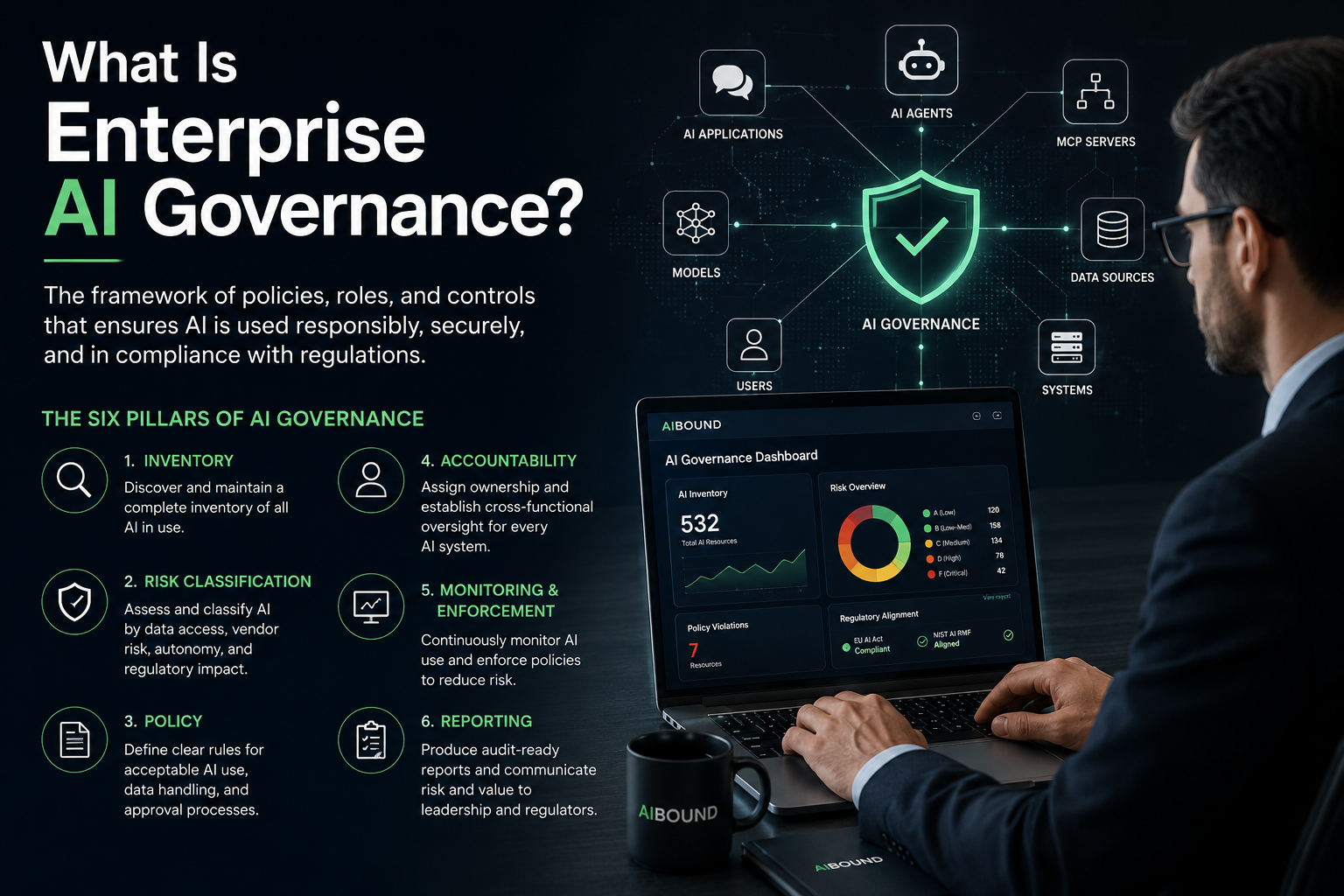
Enterprise AI governance is the system of policies, roles, processes, and controls an organization uses to manage how AI is adopted, used, and monitored across the business. Its purpose is to let the organization capture AI's value while keeping data exposure, regulatory risk, and autonomous AI behavior within defined limits.
Governance answers the questions security tooling alone cannot: which AI uses are permitted, who is accountable for each AI system, what data classes each may touch, and how compliance is demonstrated to regulators and boards.
Key facts about enterprise AI governance:
- Definition: the organizational system of accountability, policy, and control over all AI use
- Core pillars: AI inventory, risk classification, policy, accountability and ownership, monitoring and enforcement, compliance reporting
- Driving regulations: EU AI Act (phased obligations from 2025 onward), NIST AI RMF, ISO/IEC 42001
- Prerequisite: a complete, continuously updated inventory of AI in use; governance over an unknown inventory is paperwork
- Common failure mode: policies written for the AI the organization sanctioned, while most actual AI use is shadow AI
Why does enterprise AI governance matter now?
Three forces converged to make governance urgent rather than optional:
Regulation arrived. The EU AI Act entered into force in 2024 with obligations phasing in through 2026 and 2027, including inventory, risk classification, and transparency requirements for organizations deploying AI. ISO/IEC 42001 established a certifiable AI management system standard, and the NIST AI Risk Management Framework became the de facto reference in the US. All three assume the organization knows what AI it runs.
AI became an actor, not just a tool. Agents, copilots, and MCP-connected systems hold credentials and take actions. Governing them requires ownership and accountability structures, not just usage policies.
Boards started asking. AI spend, AI risk, and AI value are now board-level questions. Governance is what turns "we think teams are using AI" into a defensible answer with numbers.
What are the pillars of an enterprise AI governance framework?
A working framework has six pillars, and the order matters:
- Inventory. A live register of every AI application, agent, model, extension, and MCP server in use, sanctioned or not. This is the foundation; every other pillar operates on it. Because employees adopt AI faster than procurement approves it, the inventory must be continuously discovered, not periodically surveyed.
- Risk classification. Each AI resource is graded against consistent criteria: data access, vendor security posture, training and retention behavior, autonomy level, and regulatory category (the EU AI Act's unacceptable/high/limited/minimal tiers, for organizations in scope).
- Policy. Clear rules stating which AI uses are permitted, which data classes may enter which tools, and what approval path new AI follows. Effective policies are short, specific, and paired with sanctioned alternatives.
- Accountability. Every AI system gets a named owner. Cross-functional oversight (security, legal, data, and business leadership, often as an AI governance committee) resolves conflicts and approves exceptions.
- Monitoring and enforcement. Continuous verification that actual AI use matches policy, with the ability to restrict or block violations. A policy without enforcement is a suggestion.
- Reporting. Compliance evidence for regulators and auditors, and adoption-and-risk reporting for the board.
What is generative AI governance?
Generative AI governance is the subset of enterprise AI governance focused on generative tools: chatbots, image and code generators, and copilots. Its distinctive concerns are data entering prompts, ownership and accuracy of AI-generated output, disclosure of AI use, and training-data policies. Most organizations start here because generative tools are where employee adoption concentrates, then extend the same framework to agents, MCP servers, and embedded AI, which carry higher autonomy risk.
What is AI governance software?
AI governance software operationalizes the framework. The category spans two layers that are often confused:
- GRC-side platforms manage the paperwork of governance: policy documentation, risk registers, model cards, and compliance workflows. They are strong on process and weak on ground truth, because they govern the AI someone remembered to register.
- Discovery and enforcement platforms supply the ground truth: continuous detection of all AI in use, risk scoring, and real-time policy enforcement across the environment. AIBound operates in this layer, discovering AI across browser, endpoint, network, and cloud telemetry; grading each resource from A to F; aligning findings to the EU AI Act and NIST AI RMF; and automatically feeding risk data into existing GRC platforms.
Mature programs use both: discovery and enforcement as the sensory and control layer, GRC as the system of record.
How do you implement enterprise AI governance?
A realistic sequence for a mid-size or large organization:
- Establish the inventory first (weeks 1-2). Deploy continuous AI discovery before writing policy. Organizations that write policy first almost always regulate a fraction of actual use.
- Classify and triage (weeks 2-4). Grade discovered AI by risk. Block the small set of genuinely dangerous tools immediately; this builds credibility that governance has teeth.
- Write the policy against reality (weeks 4-6). Base permitted-use rules on what employees actually use and need, with sanctioned alternatives for blocked tools.
- Assign ownership (weeks 4-8). Stand up the governance committee, assign owners to high-risk AI systems, and define the approval path for new AI.
- Automate monitoring and reporting (ongoing). Wire discovery data into GRC and board reporting so governance runs continuously instead of by annual audit.
Enterprise AI governance vs. enterprise AI security
They are two halves of the same program. Security is the technical practice: discovering AI, mapping identities and data exposure, and enforcing controls. Governance is the organizational structure that directs it: who decides, what the rules are, and how compliance is proven. Security without governance produces alerts nobody owns; governance without security produces policies nobody can verify. The shared dependency is the AI inventory, which is why both functions typically run on the same discovery layer.
FAQ
What is enterprise AI governance in one sentence? It is the system of policies, ownership, and controls that determines how an organization adopts, uses, and monitors AI, and proves it to regulators and the board.
What is the difference between AI governance and AI compliance? Compliance is meeting external requirements like the EU AI Act; governance is the broader internal system that makes compliance achievable, covering inventory, policy, ownership, and enforcement even where no regulation applies.
What regulations drive enterprise AI governance? The EU AI Act is the primary binding regulation, with obligations phasing in through 2027. The NIST AI Risk Management Framework and ISO/IEC 42001 are the leading voluntary frameworks, and ISO 42001 is certifiable.
Why do AI governance programs fail? Most commonly because they govern only sanctioned AI. With roughly 71% of workers using unapproved AI tools, a program without continuous discovery covers a minority of actual AI use.
What is the first step in implementing AI governance? Build a complete AI inventory. Every pillar of governance, from risk classification to board reporting, operates on the inventory, and agentless discovery platforms can produce one within about 24 hours.