What Is AI Data Leakage?
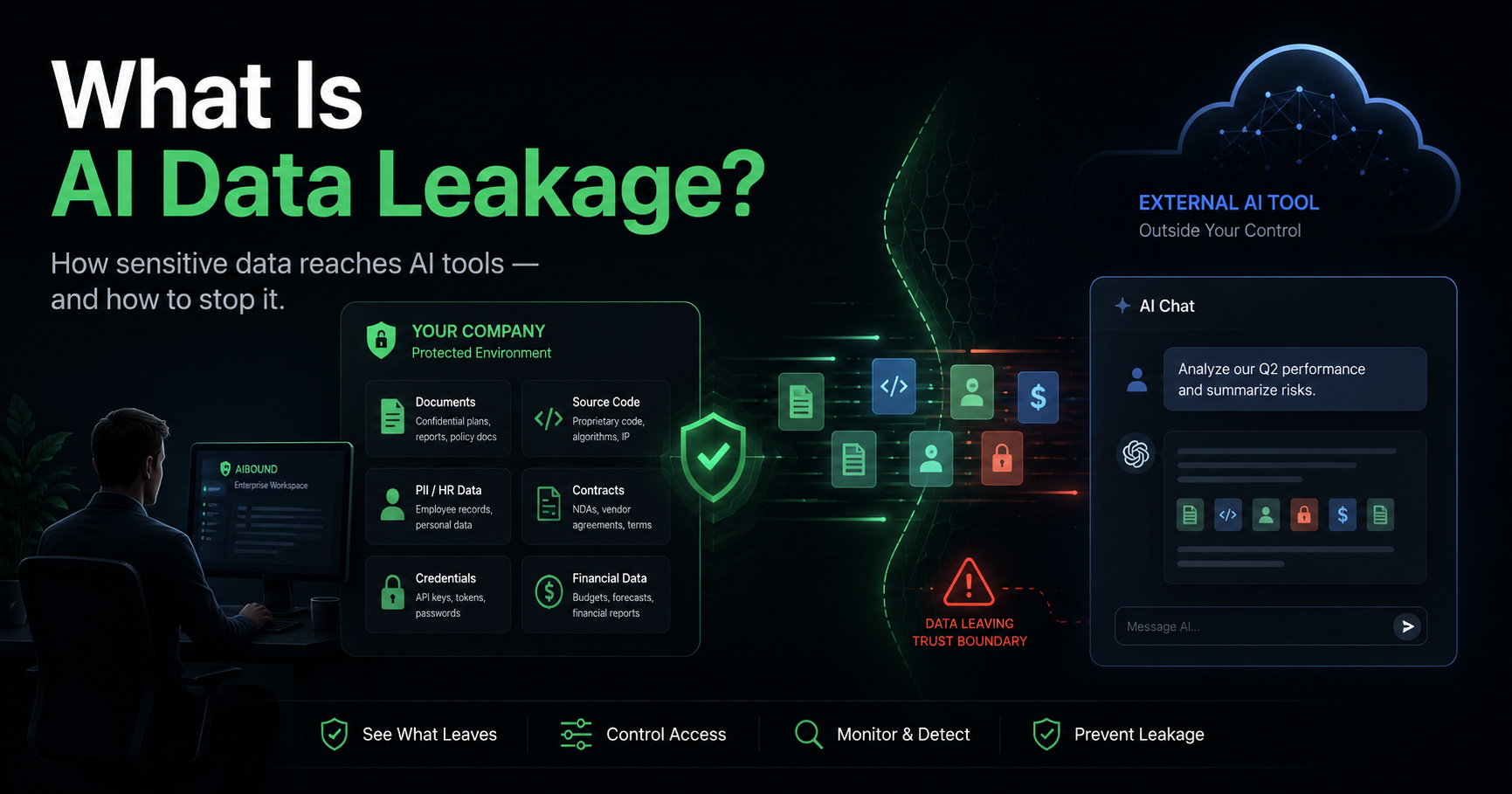
AI data leakage is the unintended exposure of sensitive company data through AI tools: employees pasting confidential information into chatbots, AI integrations reading data they should not access, or third-party models retaining and training on enterprise inputs. It is currently the most common way organizations lose data through AI.
Unlike a breach, AI data leakage usually involves no attacker. Data walks out through everyday productivity behavior, which is why traditional data loss prevention tools, built to catch exfiltration and policy violations, miss most of it.
Key facts about AI data leakage:
- Definition: sensitive data exposed to external AI systems without authorization or awareness
- Main channels: chatbot prompts, file uploads, AI integrations and agents, embedded AI features in sanctioned SaaS, AI browser extensions
- What leaks: source code, customer PII, financials, credentials, contracts, health data, meeting content
- Why DLP misses it: AI traffic is encrypted HTTPS to legitimate domains, and pasted prompts rarely match rigid DLP patterns
- Prevention model: discover AI in use, map its data access, then apply AI-aware controls, not blanket bans
How does data leak to AI tools?
Five channels account for nearly all AI data leakage:
1. Prompts and pasted content. The most common channel. An employee pastes a customer contract into ChatGPT to summarize it, or an error log containing credentials into an AI assistant to debug it. The data now sits on a third-party provider's infrastructure, subject to that provider's retention and training policies.
2. File uploads. AI tools increasingly accept documents, spreadsheets, and images. A single uploaded board deck or salary file exposes more data than months of pasted prompts.
3. Connected integrations and agents. OAuth-connected AI tools read data continuously. A meeting note-taker with calendar and mail scope, or an agent connected to a CRM, ingests sensitive data as a background process nobody watches.
4. Embedded AI features in approved software. A sanctioned tool ships an AI feature that routes data to an external model provider. The tool passed security review before the feature existed, so the new data flow was never assessed.
5. AI browser extensions and coding assistants. Extensions with page-read permissions see everything in the browser, including internal admin panels. Coding assistants send source code, and often secrets embedded in it, to external models.
What are real examples of AI data leakage?
The pattern that made the risk concrete was Samsung's 2023 incident, in which engineers pasted proprietary semiconductor source code and internal meeting notes into ChatGPT on three separate occasions within weeks of the company permitting its use. Samsung subsequently restricted generative AI tools company-wide.
Since then, the same pattern has repeated across industries: support teams pasting customer records into chatbots to draft replies, analysts uploading financial models for review, and developers leaking API keys through AI coding tools. Research consistently finds that a meaningful share of prompts sent to public AI tools from corporate environments contain sensitive data, and most of that flows through personal, unmanaged accounts.
Why do traditional DLP tools miss AI data leakage?
Data loss prevention was designed for a different threat model: files moved to USB drives, emailed attachments, uploads to known file-sharing domains. AI leakage evades it in four ways:
- Legitimate destinations. Traffic to OpenAI, Anthropic, or Google is indistinguishable from sanctioned business use at the network level.
- Unstructured content. DLP pattern-matching catches credit card numbers and SSNs, not a paraphrased customer complaint or a pasted strategy memo.
- Encrypted, in-browser flows. Prompt content travels inside HTTPS sessions that most network DLP cannot inspect meaningfully.
- No file event. Pasting text triggers none of the file-transfer events endpoint DLP watches for.
This is why AI data loss prevention starts with a different question. Instead of "what data is leaving," it asks "which AI tools are in use, and what can each one see."
How to prevent data leakage to AI tools
Effective prevention layers five controls, in order of impact:
- Discover all AI in use. You cannot control channels you cannot see. Continuous discovery across browser, endpoint, network, and cloud telemetry surfaces every AI app, extension, integration, and agent, including the shadow AI where most leakage happens.
- Map data exposure per tool. For each AI tool, establish what it can reach: OAuth scopes, connected systems, upload capability, and the vendor's retention and training policies. A grammar checker and a full-mailbox agent are not the same risk.
- Risk-grade and enforce. Block or restrict tools that train on inputs, hold excessive scopes, or have weak security postures. Allow low-risk tools so employees have sanctioned paths. AIBound implements this as A to F risk grades across 50,000+ cataloged AI apps, with one-click policy enforcement through the existing stack.
- Provide sanctioned alternatives. Enterprise AI accounts with training disabled, retention controls, and SSO remove the main reason employees use personal accounts.
- Set and communicate policy. A short, specific acceptable-use policy (what data classes may go into which tools) outperforms a vague ban that everyone ignores.
AI data leakage vs. AI data breach
A breach involves an external party gaining unauthorized access, such as an attacker compromising an AI vendor. Leakage is self-inflicted exposure through normal use. The distinction matters for response: breaches trigger incident response and disclosure obligations, while leakage requires visibility and policy controls before any incident exists. Leakage can also convert into breach risk later, since data sitting in third-party AI systems inherits every vulnerability of those systems.
FAQ
What is AI data leakage in simple terms? It is sensitive company data ending up in external AI systems without authorization, most often because an employee pasted or uploaded it into an AI tool, or connected an AI integration that reads it automatically.
Is ChatGPT data leakage still a risk on paid plans? Enterprise and Team plans that turn off training and offer retention controls reduce the risk substantially, but data still leaves the organization and inherits the vendor's security posture. The larger risk is employees defaulting to free personal accounts, which is why sanctioned enterprise access plus discovery of unsanctioned use is the standard control pair.
Can DLP tools stop AI data leakage? Only partially. DLP catches structured patterns like card numbers but misses pasted unstructured content, OAuth-connected integrations, and embedded AI features. AI-specific discovery and risk assessment fill the gap DLP was never designed to cover.
What data leaks to AI tools most often? Source code, customer and employee PII, internal documents and strategy content, financial data, and credentials embedded in code or logs.
How do companies detect AI data leakage that already happened? By reconstructing exposure: identifying which AI tools were in use, what data each could access, and which vendors retain or train on inputs. Platforms like AIBound automate this by correlating browser, endpoint, network, and cloud telemetry into a per-tool exposure map.