What Is an AI Governance Framework?
An AI governance framework is a structured set of principles, controls, and processes an organization adopts to manage AI risk, whether it's a published standard like NIST AI RMF and ISO/IEC 42001 or an internal policy structure built using one as a reference. Frameworks give governance programs a common vocabulary and a defensible structure, rather than ad hoc rules.
This guide covers the major published frameworks, how to build an internal framework using them, and how to evaluate the AI governance tools, platforms, and software that operationalize one.
Key facts about AI governance frameworks:
- Major published frameworks: NIST AI RMF (US, voluntary), ISO/IEC 42001 (international, certifiable), EU AI Act (binding regulation for organizations in scope)
- Common structure across frameworks: govern, map, measure, manage (NIST's own model, echoed by most others)
- What a framework is not: a substitute for an AI inventory. Every framework assumes the organization knows what AI it runs; none of them discover it for you
- Software category: AI governance tools/platforms/software span GRC-style documentation platforms and discovery-and-enforcement platforms; most mature programs need both
- Where to start: pick one framework as the reference structure, then build the AI inventory before writing detailed policy
Which AI governance frameworks matter most?
NIST AI Risk Management Framework (AI RMF). Published by the US National Institute of Standards and Technology, voluntary but the de facto reference for US organizations and increasingly cited in vendor contracts and procurement requirements. It organizes governance into four functions: Govern (culture, policy, accountability), Map (understand context and identify risks), Measure (assess and track risk), and Manage (prioritize and respond to risk). Most other frameworks and internal programs mirror this govern-map-measure-manage structure even when they don't cite NIST directly.
ISO/IEC 42001. The first international standard for an AI management system, structured like other ISO management standards (27001 for information security, 9001 for quality), meaning it is certifiable through third-party audit. Organizations pursue it when customers or regulators expect independent verification, not just a self-declared policy. It requires the same core elements as NIST: inventory, risk assessment, roles and responsibilities, and continuous improvement, formalized into an auditable management system.
EU AI Act. The one binding regulation on this list for organizations operating in or serving the EU market. It classifies AI systems into risk tiers- unacceptable, high, limited, and minimal- with obligations scaling by tier, and obligations phase in through 2027. Unlike NIST and ISO, it is not a framework an organization chooses to adopt; it is a legal requirement that a governance framework needs to satisfy.
Sector and regional variants. Financial services, healthcare, and public-sector organizations frequently layer sector-specific requirements (such as OCC guidance for banks, or FDA considerations for AI in medical devices) on top of one of the three above rather than replacing them.
How do you choose a framework?
For most organizations, the decision is not really "which one" but "which one first, and in what order":
- US-based, no near-term certification requirement: start with NIST AI RMF. It is free, well-documented, and widely understood by auditors and boards.
- Selling into regulated industries or to customers who require independent certification: pursue ISO/IEC 42001, since NIST alone cannot be externally certified.
- Operating in or serving the EU: EU AI Act compliance is not optional regardless of which voluntary framework you also adopt; treat it as the floor, not a choice.
- Global enterprise with all three in play: map controls once against NIST's govern-map-measure-manage structure, then layer ISO certification and EU AI Act obligations on top, since the underlying activities (inventory, risk classification, accountability, monitoring) are largely shared across all three.
What does an AI governance framework actually require in practice?
Every framework above converges on the same underlying activities, described with different vocabulary:
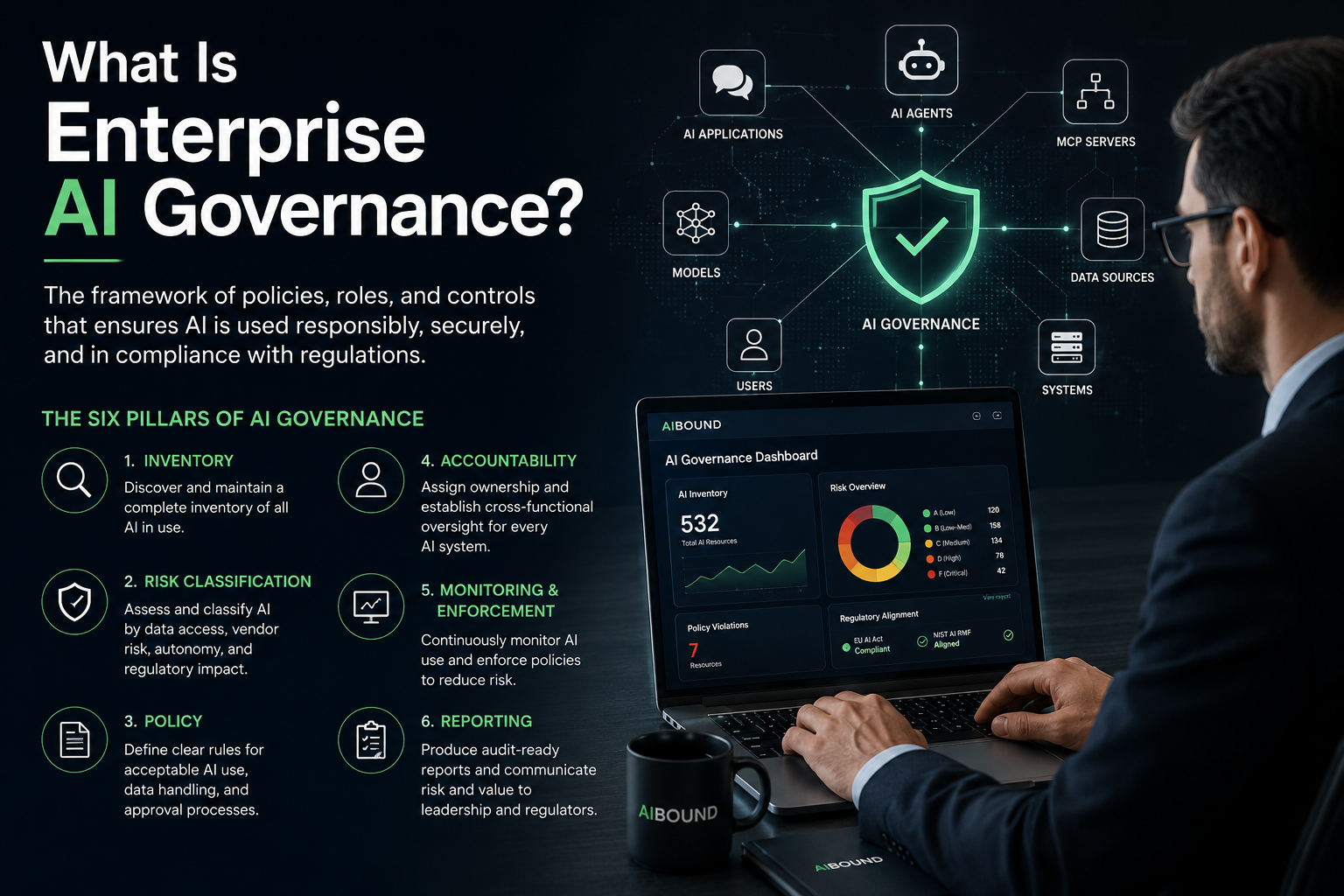
- Inventory and context. Know what AI systems exist, what they do, and who uses them. NIST calls this "Map"; ISO calls it establishing the scope of the AI management system; the EU AI Act requires it implicitly through its classification obligations.
- Risk classification. Assess each AI system's risk level using consistent criteria. NIST calls this "Measure"; the EU AI Act makes it a binding legal tier.
- Roles and accountability. Assign ownership for AI systems and decisions. All three frameworks require named accountability, not a diffuse "the AI team handles it."
- Controls and mitigation. Apply proportionate controls based on risk level. NIST calls this "Manage"; ISO requires documented controls mapped to identified risks.
- Monitoring and continuous improvement. Re-assess as AI systems and their usage change. None of the three treat governance as a one-time certification exercise.
The frameworks differ in rigor, auditability, and legal weight, but not in what they ask an organization to do.
How do AI governance tools, platforms, and software differ?
These three terms get used interchangeably in the market, but they describe genuinely different tools, and buying the wrong one for the job is the most common governance-program mistake.
AI governance tools are the broadest, vaguest term, generally covering any point solution that supports part of a governance program: a model registry, a bias-testing tool, a policy template library.
AI governance platforms are broader systems meant to run the whole governance workflow: risk assessment forms, policy documentation, approval routing, and reporting dashboards, typically sold to GRC and compliance teams. Strength: process and audit trail. Weakness: they govern the AI someone manually registers into them, and most AI adoption in a typical organization happens outside that registration step.
AI governance software is used even more loosely across vendor marketing, spanning everything from the GRC-style platforms above to narrower model-monitoring or model-risk tools used mainly by data science teams.
The practical gap across most of this category is discovery. A platform that manages beautifully documented risk assessments for 40 registered AI systems is not governing the organization's actual AI footprint if 400 more are in use and never registered. This is why the strongest programs pair a GRC-style platform (for documentation, workflow, and audit trail) with a discovery-and-enforcement layer that continuously finds AI in use regardless of whether anyone registered it, maps it to identities and data access, and feeds risk data back into the GRC system as the system of record. AIBound operates in that discovery-and-enforcement layer: it finds AI apps, agents, and MCP servers across browser, endpoint, network, and cloud telemetry, grades each A to F, aligns findings to NIST AI RMF and the EU AI Act's risk tiers, and pushes that data into whatever GRC platform a governance team already runs.
What is generative AI governance within a broader framework?
Generative AI governance is the subset of framework activity focused specifically on generative tools: chatbots, copilots, and content generators. Because generative tools drive most unmanaged employee AI adoption, most organizations' first real test of their governance framework is generative AI, well before agents or embedded AI systems become the primary concern. A framework that only accounts for generative tools is incomplete, but starting there is a reasonable, common sequencing choice.
How do you build an internal AI governance framework from these standards?
- Select a reference framework (NIST AI RMF is the most common starting point) rather than building policy from scratch.
- Build the AI inventory first, before writing detailed policy. Every framework assumes this exists; none of them create it for you.
- Classify discovered AI against the framework's risk tiers, using the EU AI Act's tiers directly if the organization is in scope, or an internal equivalent otherwise.
- Write policy and assign ownership mapped explicitly to framework functions (govern, map, measure, manage), so audit and board reporting can trace directly back to the reference standard.
- Select tooling last, once the process is defined: a GRC platform for documentation and workflow, a discovery-and-enforcement platform for ground truth, matched to the gaps the process actually has rather than bought first and worked backward from.