AIBound has launched AgentHarness, which brings security policy directly inside AI agents. AgentHarness ships with hundreds of predefined rules across the top risk categories, enforced natively by the AI agent itself on every action it attempts: allow, ask the user, or deny.
Key Takeaways
Hundreds of rules ship with AgentHarness across the top risk categories, built and maintained by AIBound.
Three actions are available per rule: allow, ask the user, or deny.
Two platforms are covered by the rule catalog: macOS and Windows.
Five products now make up the AIBound platform, with AgentHarness joining AISeeker, AgentTracer, SkillGuard and AIAssure.
53% of organizations have already had an AI agent exceed its intended permissions (CSA, April 2026).
What is AgentHarness?
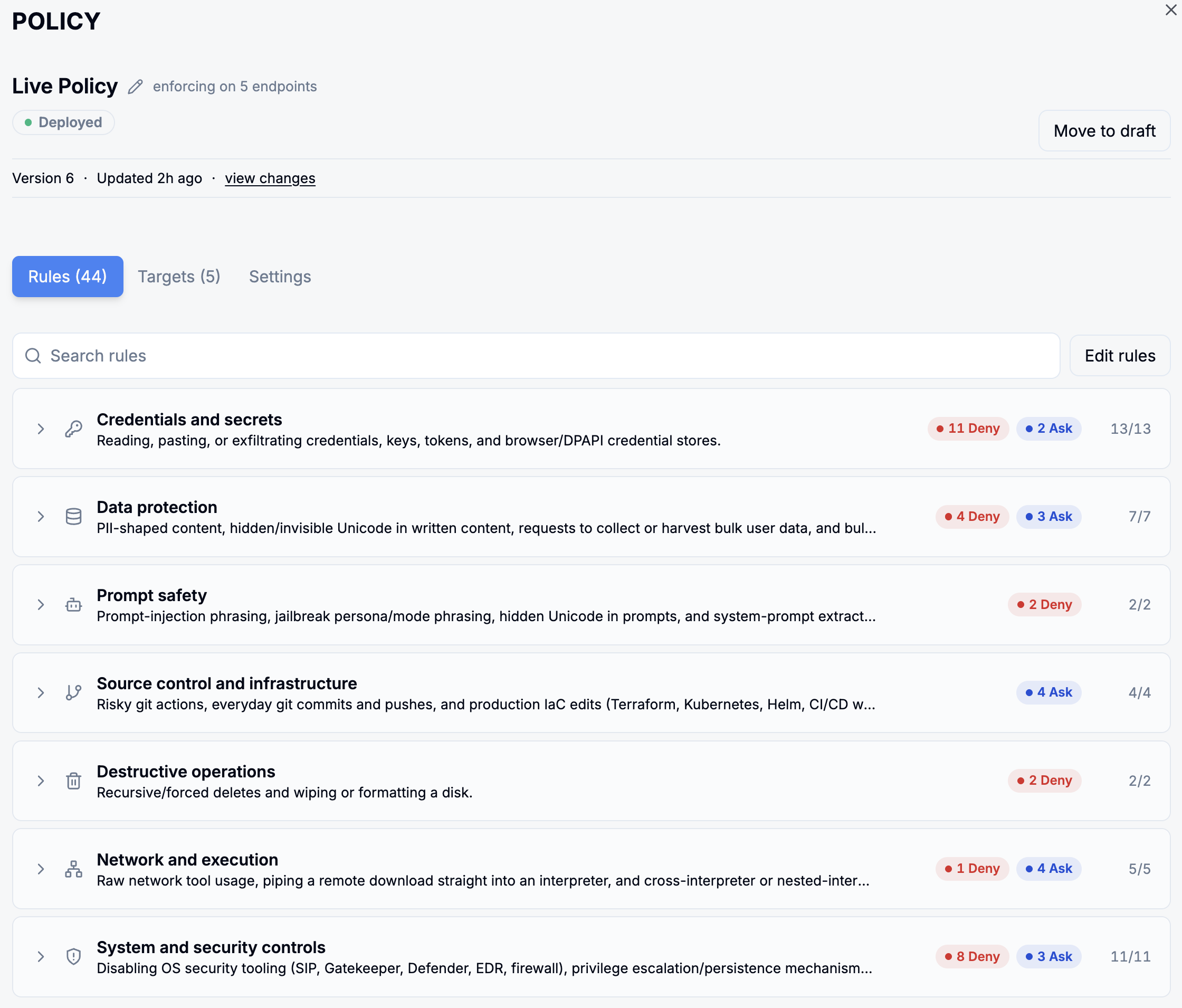
AgentHarness is an AIBound product that puts security policy inside the AI agent. It ships with hundreds of predefined rules across the top risk categories, and the agent itself enforces them on every action it attempts. Each rule resolves to one of three outcomes: allow, ask the user, or deny.
The rules are built and maintained by AIBound and ship as a curated catalog for macOS and Windows. You tune them to your own environment rather than writing them from scratch, and every rule arrives with a recommended default so teams are protected from day one.
Why existing controls do not reach the agent
AI agents run with their users' full access: repos, cloud credentials, SSH keys and production systems. Existing controls were not built for that. Gateways see network traffic and XDR sees endpoint processes, but neither governs what the agent itself decides to do. The decision is the part nobody was watching.
A speed camera records the car after it has already passed. A limiter in the engine acts while the driver's foot is still going down. Most AI controls are cameras, positioned where the traffic or the process can be observed, and an agent that decides to read a credential has made the decision before any of them has anything to look at.
The layers read different things, and that is what decides what each one can act on.
Control layerWhat it readsWhat it can act onNetwork gatewayNetwork trafficThe connectionXDREndpoint processesThe processAI-SPMCloud, code and SaaSThe cloud and code configurationPolicy inside the agentThe action the agent is about to takeThe action: allow, ask the user, or deny
Gateways and XDR both sit outside the agent, so neither governs what the agent itself decides to do. AgentHarness puts enforcement where the action happens: inside the agent.
What AgentHarness does, rule by rule
AgentHarness ships with a curated catalog of hundreds of rules for macOS and Windows, built and maintained by AIBound. You can enable or disable any rule, set its action to allow, ask the user, or deny, and deploy different rule sets to different teams. Every rule ships with a recommended default.
Three controls sit on every rule:
Enable or disable any rule to match your environment.
Set the action for each rule: allow, ask the user, or deny.
Tailor by group: deploy different rule sets to different teams, for example, tighter credential and git controls for Customer Support than for Engineering.
The group control is the one that gets used first. A hospital does not give the porters and the pharmacists the same set of doors, and it does not solve that by giving everybody the pharmacist's keys. Engineering can run git controls that would stop Customer Support working, and Customer Support can run credential controls that would stop Engineering working, from the same catalog on the same day.
Because the rule sits inside the agent and carries the same context the platform already holds, the enforcement is precise: a destructive command is blocked, a credential read is denied, and sensitive data never leaves the laptop.
Where AgentHarness sits in the AIBound platform
AgentHarness is a new product on the AIBound platform. It joins AISeeker, AgentTracer, SkillGuard and AIAssure within the See, Stop, Govern framework. The platform reads the AI itself, at the endpoint, through whatever UEM you already run, and discovers across seven artifact classes on the device.
Most security tools look at AI from the outside. Gateways read network traffic, XDR reads endpoint processes, and AI-SPM tools read cloud, code and SaaS. AIBound reads the AI itself, at the endpoint, through whatever UEM you already run, across seven artifact classes on the device: agents, MCP servers, skills, sub-agents, local models, CLIs and IDE extensions.
Each one is graded A-F on evidence and tied to the identity it runs as and the systems that identity can reach, and skills and sub-agents are scanned the moment they land. That is the context AgentHarness enforces with. AI discovery and policy enforcement are the two halves of the same record.
Where enforcement stops
Discovery runs read-only. Enforcement activates only on your explicit authorization, so nothing is blocked until you say so. AgentHarness feeds the GRC program you already run rather than standing up a new governance system alongside it, and every rule arrives with a recommended default you can change before you turn it on.
That boundary is worth saying out loud rather than discovering in week one. Switching AgentHarness on does not switch enforcement on. The rules arrive, the defaults are visible, and the deny actions do nothing at all until somebody with the authority to authorize them does so.
Availability and scope
AgentHarness is available today for AIBound customers, with no new agent to deploy. It deploys through whatever UEM your organization already runs, in one click, and the rule catalog covers macOS and Windows. Discovery runs read-only and enforcement activates only on your explicit authorization. A 30-day free trial is available.
Who can get it: AIBound customers, today.
On what: macOS and Windows, delivered through whatever UEM you already run, in one click.
In what state: discovery read-only; enforcement off until you authorize it; every rule shipping with a recommended default.
How AgentHarness output reaches your compliance program
AgentHarness is backed by approval workflows and reporting that feed the GRC program you already run, mapped to the EU AI Act, NIST AI RMF and ISO/IEC 42001. The NIST framework, published as NIST AI 100-1, is organized into four functions: GOVERN, MAP, MEASURE and MANAGE.
Those four functions are where an enforcement record earns its keep. A rule that denied a credential read is not a compliance outcome on its own; it is an entry against MEASURE and MANAGE that your own program can use. AIBound maps the evidence. Your program, and in the case of ISO/IEC 42001 an accredited certification body, does the rest. Reporting and governance is where that output lands, and the published results show what it looks like on a real estate.
Frequently asked questions
What does AgentHarness install on a laptop?
AgentHarness is available today for AIBound customers, with no new agent to deploy. It goes out through whatever UEM your organization already runs, in one click, the same way you push any other managed app.
What does AgentHarness not do?
It does not stand up a new governance system alongside the one you already run, and it does not start blocking anything on its own. Discovery runs read-only, and enforcement activates only on your explicit authorization. The rule catalog covers macOS and Windows, so anything outside those two platforms is outside its scope.
Which platforms does the rule catalog cover?
macOS and Windows. The catalog is built and maintained by AIBound for both, and every rule in it ships with a recommended default that you can change before you enable it.
Can different teams get different rules?
Yes. You can tailor by group and deploy different rule sets to different teams, for example, tighter credential and git controls for Customer Support than for Engineering. Each rule in each set carries its own action: allow, ask the user, or deny.
Does AgentHarness make us compliant with the EU AI Act?
No, and no product can. AgentHarness is backed by approval workflows and reporting that map to the EU AI Act, NIST AI RMF and ISO/IEC 42001, which means AIBound supplies evidence your compliance program runs on. The NIST AI RMF is voluntary guidance with no certification to hold, and ISO/IEC 42001 certification is granted by an accredited certification body, never by a vendor.
About AIBound. AIBound is an Enterprise AI Security Platform for AI usage control at the endpoint.
See what is already running
Your staff's AI agents hold the same keys your staff do. The first thing worth knowing is how many of them there are and what each one can reach.



%401x.png)