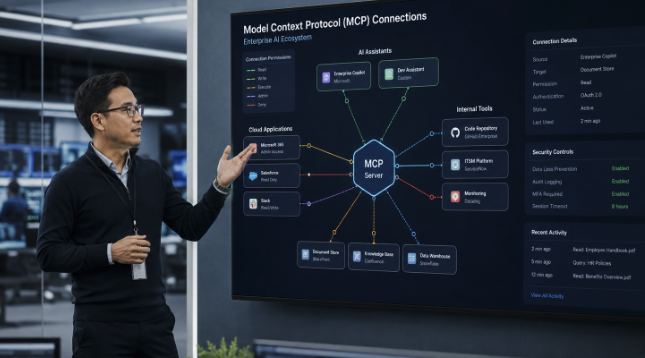
{ "@context": "https://schema.org", "@type": "FAQPage", "mainEntity": [ { "@type": "Question", "name": "What does MCP stand for in security?", "acceptedAnswer": { "@type": "Answer", "text": "Model Context Protocol, the open standard that connects AI models to external tools and data sources. MCP security is the discipline of managing the risk that those connections create." } }, { "@type": "Question", "name": "Are MCP servers safe to use?", "acceptedAnswer": { "@type": "Answer", "text": "Official servers from established vendors, configured with scoped credentials, are reasonably safe. The risk lies in unvetted community servers, plaintext secrets, and overly broad permissions. Safety is a property of how a server is sourced and configured, not of MCP itself." } }, { "@type": "Question", "name": "What is tool poisoning in MCP?", "acceptedAnswer": { "@type": "Answer", "text": "Tool poisoning is an attack where an MCP server embeds hidden instructions in its tool descriptions. The AI model reads those descriptions to decide how to use the tools, so hidden instructions can manipulate the model into leaking data or misusing other tools." } }, { "@type": "Question", "name": "Can firewalls or CASBs detect MCP servers?", "acceptedAnswer": { "@type": "Answer", "text": "Not reliably. MCP servers often run as local processes with no network signatures that a CASB recognizes, and remote MCP traffic appears as generic API calls. Detection requires correlating endpoint configuration data with network telemetry." } }, { "@type": "Question", "name": "Should companies ban MCP servers?", "acceptedAnswer": { "@type": "Answer", "text": "Blanket bans sacrifice significant productivity, especially for developers, and push usage underground. The stronger position is an allowlist: discover what is in use, sanction official and reviewed servers with scoped credentials, and block the rest." } } ] }