What Is ISO/IEC 42001?
ISO/IEC 42001 is the first international standard specifying requirements for an artificial intelligence management system (AIMS), published in December 2023 by the International Organization for Standardization. It is certifiable through independent third-party audits, following the same structure as other ISO management standards like ISO 27001 for information security, which makes it the reference point for organizations that need to prove AI governance to a customer or regulator rather than simply document it internally.
Key facts about ISO/IEC 42001:
- Published by: International Organization for Standardization (ISO) and International Electrotechnical Commission (IEC), jointly
- Released: December 2023
- Status: certifiable via accredited third-party audit
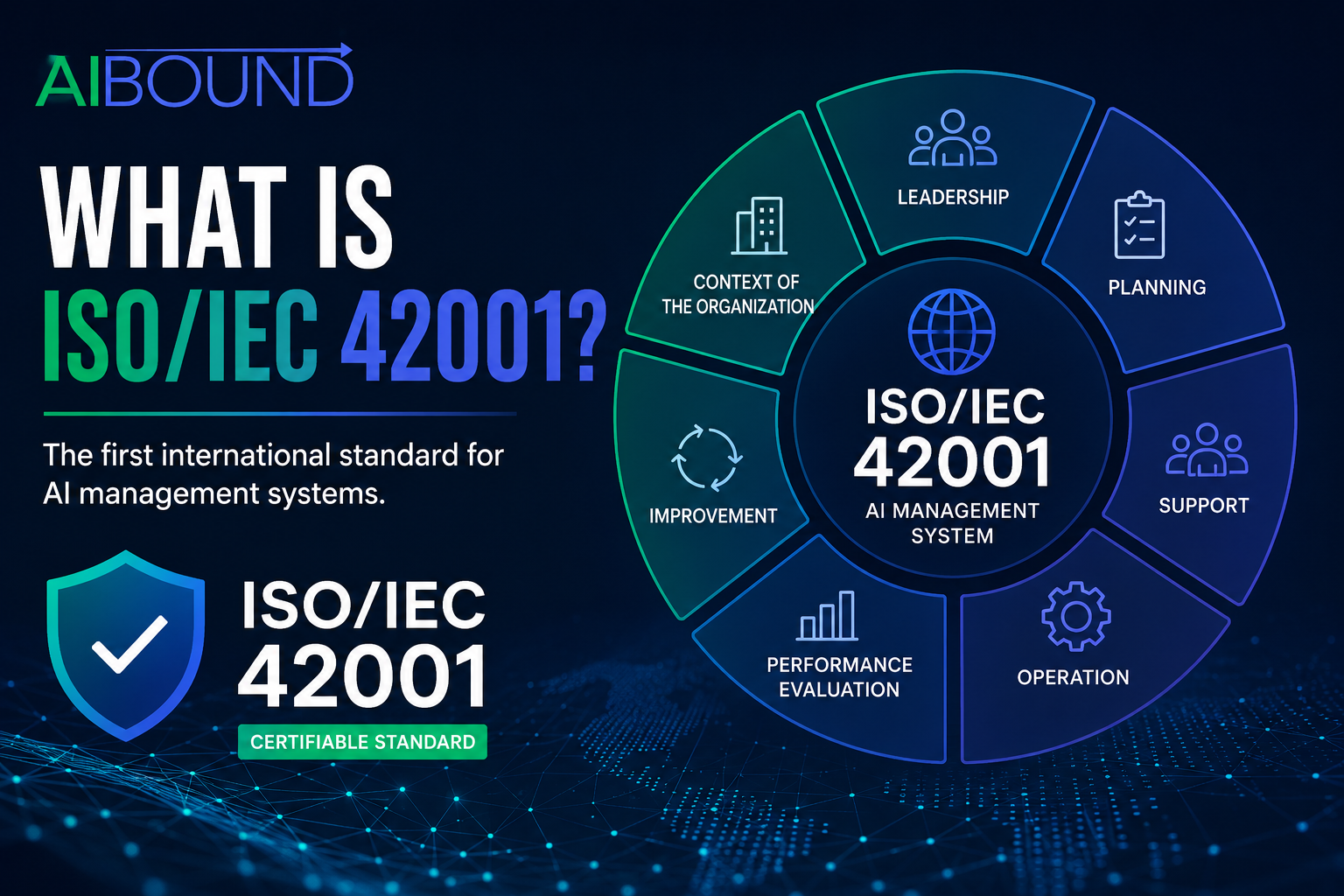
- Structure: follows ISO's common high-level structure (shared with ISO 27001, ISO 9001), covering context, leadership, planning, support, operation, performance evaluation, and improvement
- Applies to: any organization that develops, provides, or uses AI products or services, regardless of size or sector
- Distinct from: NIST AI RMF (free, voluntary, not certifiable) and the EU AI Act (binding law, not a management-system standard)
What does ISO/IEC 42001 actually require?
Because it follows ISO's common high-level structure, ISO 42001 requires the same categories of controls as other ISO management standards, applied to AI specifically:
Context of the organization. Define the scope of the AI management system: which AI systems, business units, and use cases it covers.
Leadership. Demonstrate top-management commitment, including an AI policy and clearly assigned roles and responsibilities for AI governance.
Planning. Identify AI-specific risks and opportunities, including a formal AI risk assessment process, and set objectives for managing them.
Support. Provide the resources, competence, awareness, and documentation needed to run the management system, including AI-literacy requirements for relevant staff.
Operation. Implement the planned controls, including an AI system impact assessment for each AI system in scope, covering factors like fairness, transparency, and potential harm.
Performance evaluation. Monitor, measure, and internally audit the management system's effectiveness on an ongoing basis, not just at certification time.
Improvement. Correct nonconformities and continually improve the system, consistent with the continual-improvement expectation found across all ISO management standards.
A dedicated annex (Annex A) provides a reference set of AI-specific controls, covering areas like data management, third-party and customer relationships, AI system lifecycle management, and use of third-party AI components, that organizations select from and implement based on their risk assessment.
How does ISO/IEC 42001 certification work?
Certification follows the standard ISO audit model: an organization builds its AI management system against the standard's requirements, then engages an accredited certification body for a two-stage external audit; the first stage reviews documentation and readiness, the second verifies the system is operating as documented. Certification is typically valid for three years, with annual surveillance audits in between to confirm ongoing conformance. Organizations already certified to ISO 27001 often find the process faster, since the shared high-level structure means governance, documentation, and audit processes can largely be extended rather than built from scratch.
Why would an organization pursue ISO 42001 instead of just following NIST AI RMF?
The two are not mutually exclusive, and most organizations that reach for ISO 42001 already have NIST's structure in place internally. The reason to go further is external proof. NIST AI RMF is self-declared: an organization can say it follows NIST's four functions, but nothing independently verifies that claim. An accredited third party issues ISO 42001 certification after an audit, which matters specifically when a customer's procurement process, a regulator, or a competitive RFP requires independent verification rather than a vendor's own assurance. Organizations selling AI-enabled products to enterprise or regulated customers increasingly see ISO 42001 requested explicitly in vendor security questionnaires, the same way ISO 27001 or SOC 2 get requested for general security posture.
Does ISO 42001 satisfy EU AI Act requirements?
Not automatically, but it helps materially. The EU AI Act is binding law with its own specific obligations, particularly for high-risk AI systems, and ISO 42001 certification is not a substitute for those legal requirements. However, the two overlap significantly in substance: both require risk assessment, documented governance, monitoring, and continuous improvement. Organizations already certified to ISO 42001 typically find EU AI Act compliance a smaller incremental step than organizations starting from nothing, since the underlying management-system muscle (inventory, risk classification, accountability) is already built. The European Commission has referenced ISO 42001 as one relevant standard organizations can draw on, though formal harmonized standards specific to the Act are handled through a separate EU standardization process.
What should an organization do before pursuing ISO 42001 certification?
- Build the AI inventory first. Like every framework in this space, ISO 42001 assumes the organization knows what AI systems are in scope. An incomplete inventory undermines the entire management system built on top of it.
- Conduct a gap assessment. Compare current AI governance practices against ISO 42001's clauses and Annex A controls to identify what's missing before engaging a certification body.
- Assign an AI management system owner. Certification requires demonstrated leadership commitment; this needs a named accountable party, not a distributed responsibility.
- Select a certification body. Choose one accredited for ISO 42001 specifically; not all bodies certifying ISO 27001 have extended accreditation to the newer AI standard yet.
- Run an internal audit before the external one. Catching nonconformities internally avoids a failed first-stage audit and the delay that creates.
FAQ
What does ISO 42001 stand for? ISO/IEC 42001 is the international standard specifying requirements for an artificial intelligence management system, published jointly by ISO and IEC in December 2023.
Is ISO 42001 mandatory? No. It is a voluntary standard, but enterprise customers increasingly request certification and include it in vendor security questionnaires, similar to how ISO 27001 or SOC 2 are requested for general security posture.
How long does ISO 42001 certification take? Timelines vary by organizational readiness, but building the management system, conducting a gap assessment, and completing the two-stage external audit typically takes several months to a year. Organizations already certified to ISO 27001 generally move faster given the shared high-level structure.
Does ISO 42001 replace the EU AI Act? No. The EU AI Act is binding law with its own specific legal obligations. ISO 42001 certification demonstrates strong AI governance practices that overlap substantially with the Act's requirements, but it does not substitute for direct legal compliance.
What is the difference between ISO 42001 and NIST AI RMF? NIST AI RMF is free, voluntary, and self-declared with no certification path. ISO 42001 is certifiable through independent third-party audit. Many organizations use NIST's structure internally first, then pursue ISO 42001 certification when external verification is specifically required.