What Is Generative AI Security?
Generative AI security is the practice of protecting an organization from the risks created by generative AI tools: chatbots, copilots, image and code generators, and the models behind them. It covers what data goes into these tools, what comes out of them, and how the outputs get used, which makes it distinct from security for traditional software that neither ingests unstructured input nor produces novel, unreviewed output.
Key facts about generative AI security:
- Scope: consumer and enterprise chatbots, AI copilots, code and image generators, and the underlying LLMs
- Also called: GenAI security
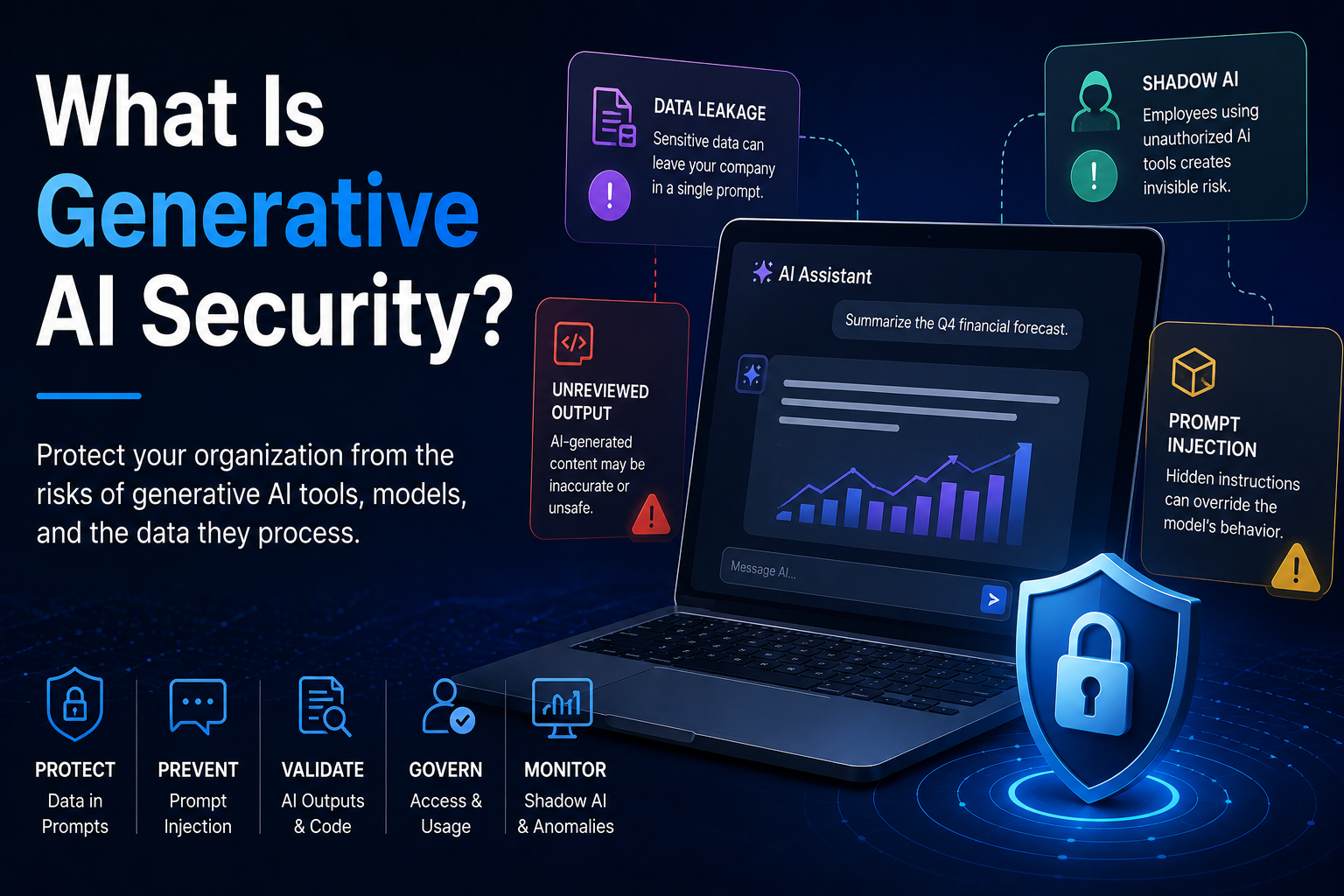
- Core risk categories: data leakage through prompts, prompt injection, hallucinated or unreviewed output, model and vendor risk, unauthorized tool use (shadow AI)
- Distinct from AI agent security: generative AI security focuses on the model interaction itself; agent security covers autonomous multi-step action
- Relationship to enterprise AI security: generative AI security is the largest subset of it, since generative tools are where most employee AI adoption concentrates
Why does generative AI need a distinct security discipline?
Generative AI tools behave unlike any software category security teams have secured before, in three specific ways.
They accept unstructured input as an attack surface. A generative model does not just execute commands; it interprets natural language, including language embedded in documents, web pages, and emails it is asked to process. That interpretation step is itself exploitable.
They produce output that looks authoritative but may not be accurate. Generated code, summaries, and answers carry the same confident tone whether correct or fabricated, and organizations increasingly ship that output into customer-facing products, legal documents, and code without adequate review.
They retain and sometimes learn from what they're given. Many consumer-grade generative tools use conversation data to improve their models by default, meaning a single prompt can turn into a permanent input to a third party's training pipeline.
What are the main generative AI security risks?
Data leakage through prompts. The most common risk in practice: employees paste confidential information into a generative tool to get an answer, and that data leaves the organization's control the moment it is submitted.
Prompt injection. Malicious instructions hidden in content a generative tool processes- an email, a web page, a document- can override the system's intended behavior. Indirect prompt injection is especially dangerous because the attacker never interacts with the organization directly; they plant the instruction somewhere the AI will later read it.
Hallucination and unreviewed output. Generative models produce plausible but false statements with no built-in signal that anything is wrong. Left unreviewed, hallucinated content ends up in customer communications, legal filings, financial analysis, or shipped code.
Jailbreaking and safety bypass. Techniques that manipulate a model into ignoring its safety instructions, producing content or actions the deployer did not intend to permit.
Model and vendor risk. Relying on a third-party model provider inherits that provider's security posture, uptime, data-handling practices, and susceptibility to its own supply-chain compromises.
Insecure output handling. When generated output is passed downstream without validation, into a database query, a script, or a webpage, it can carry the same injection risks as any untrusted input, a version of the classic problem of trusting user input, now with an AI in the middle.
Unauthorized and shadow use. The bulk of generative AI risk in most organizations is not sophisticated attacks; it is unmanaged, unapproved use of consumer-grade tools with no enterprise controls.
How is generative AI security different from traditional application security?
Traditional AppSec assumes fixed logic: an application does what its code says, and security review can enumerate its behavior. Generative AI breaks that assumption in two ways. The model's behavior is probabilistic and shaped by training data no security reviewer inspected line by line, and its "input" includes anything the model is asked to read at runtime, not just the fields a form was designed to accept. This is why standard code review and static analysis catch classic vulnerabilities in the application wrapped around a generative model, but miss risks native to the model itself, like prompt injection or training-data memorization.
What are the core controls for generative AI security?
Data controls. Enterprise-tier accounts with training disabled and defined retention limits, paired with a policy on what data classes may enter which tools, and discovery to catch use outside sanctioned tools.
Input and output validation. Treat generative output as untrusted input to whatever system receives it next: validate before executing generated code, sanitize before rendering generated content, and require human review before high-stakes output ships unchecked.
Prompt injection defenses. Segregate trusted instructions from untrusted content the model processes, apply the model's own moderation and safety layers, and monitor for anomalous output patterns that suggest a manipulated response.
Vendor assessment. Evaluate model providers on data handling, security certifications, incident history, and contractual commitments before adoption, the same diligence applied to any critical SaaS vendor.
Visibility into actual use. Because most generative AI risk originates in tools nobody approved, continuous discovery of AI use across the organization is a precondition for every other control working as intended.
Generative AI security vs. AI agent security
Generative AI security concerns the model interaction: a prompt goes in, an output comes out, and the risks live in that exchange. AI agent security concerns what happens when a generative model is wired to tools and given the ability to act autonomously, sending emails, modifying records, executing code, over multiple steps without a human reviewing each one. Every agent has a generative model at its core, so generative AI security is a subset of what agent security must cover. Still, agent security adds an entirely separate risk layer: standing credentials, autonomous action, and identity confusion that a standalone chatbot never creates.
Generative AI security vs. enterprise AI security
Enterprise AI security is the umbrella discipline covering every category of AI risk across an organization: generative tools, agents, MCP servers, embedded AI features, and open-source models. Generative AI security is the largest piece of that umbrella, since chatbots and copilots are where most unmanaged employee AI use occurs. Still, a program that stops at generative tools misses agents, MCP connections, and AI features embedded in already-approved software.
FAQ
What is generative AI security in simple terms? It is the practice of managing the risks created by AI tools that generate text, code, or images, primarily data leaving the organization through prompts, manipulated or false output, and unauthorized use of these tools.
Is generative AI security the same as GenAI security? Yes, GenAI security is shorthand for the same discipline. Both terms refer to securing the use of generative models and the tools built on them.
What is prompt injection? Prompt injection is an attack where instructions hidden in content a generative AI processes, such as an email or web page, override the model's intended behavior. Indirect prompt injection is particularly hard to defend against because the malicious instruction is planted somewhere the AI will later read, not sent directly by the attacker.
Can generative AI security risks be eliminated by using an enterprise-tier AI tool? Enterprise tiers with training disabled and retention controls reduce risk substantially, but they don't eliminate it. Hallucination, prompt injection, and unauthorized shadow use of other tools remain live risks regardless of which tier the sanctioned tool runs on.
How does generative AI security relate to AI agent security? Generative AI security covers the core model interaction: what goes into a prompt and what comes out. AI agent security covers what happens when that same model is given tools and autonomy to act on its own, which introduces standing access and identity risk that generative security alone does not address.