What Is AI TPRM?
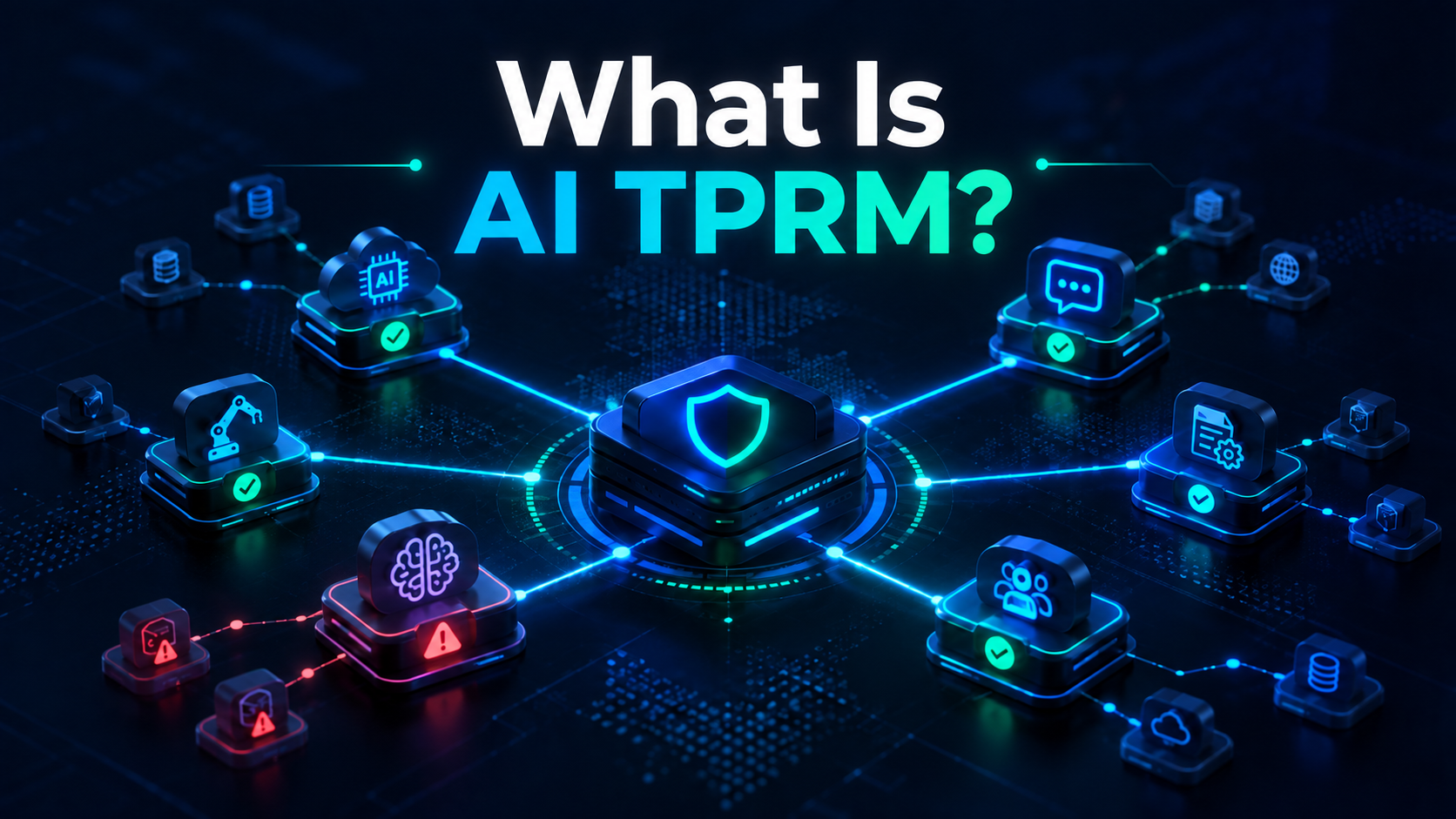
AI TPRM, short for AI third-party risk management, is the practice of assessing and managing the risk introduced by vendors, tools, and integrations that use AI, whether or not the AI is the product's headline feature. It extends traditional third-party risk management, built around questions like data handling and uptime, to a category of risk traditional vendor questionnaires were never designed to catch: what an AI component does with the data it's given, whether it trains on that data, and what autonomous actions it might take.
Key facts about AI TPRM:
- Definition: assessing and managing risk from any third-party vendor or tool that incorporates AI, extending beyond dedicated AI vendors to AI features embedded in already-approved software
- Why it's distinct from standard TPRM: traditional vendor questionnaires ask about data handling and security certifications, but rarely ask whether a vendor's AI feature trains on customer data, what model it uses, or what autonomous actions it can take
- Core assessment areas: data handling and training practices, model provenance, autonomy and agentic capability, sub-processor AI dependencies, security certifications
- Where it breaks down most: embedded AI features added to software after the original vendor security review, and fourth-party AI risk, where a vendor's own AI sub-processor was never disclosed or assessed
- Relationship to AI discovery: TPRM assumes the organization knows which vendors use AI; unmanaged AI features and shadow AI tools sit entirely outside a vendor-questionnaire-based process
Why does AI require its own third-party risk category?
Traditional TPRM was built around a stable question: what does this vendor do with our data, and how do they secure it? AI breaks that model in ways a standard questionnaire doesn't anticipate.
Vendors add AI features after approval. A project management tool passes security review with no AI, then ships an AI summarization feature eighteen months later that routes customer data to a third-party model provider. The vendor relationship was never reassessed because most TPRM processes don't trigger a re-review when a vendor adds a feature rather than replacing the whole product.
Vendors use their own AI sub-processors. A vendor's product may call OpenAI, Anthropic, or another model provider under the hood, meaning the organization inherits that model provider's data handling and security posture as a fourth party, one level removed from any relationship they directly assessed or contracted with.
Data handling questions are different for AI. Standard TPRM asks where data is stored and how it's encrypted. AI-specific TPRM needs to ask whether the vendor's model trains on customer inputs, how long prompts are retained, whether outputs could reveal information from other customers' data in a shared deployment, and what happens to data sent through an AI feature specifically- questions most existing vendor questionnaires simply don't include.
Autonomy changes the risk profile. A vendor whose AI feature only summarizes documents carries a different risk profile than one whose AI agent can take actions, send emails, modify records, and trigger workflows on the organization's behalf. Standard vendor risk scoring rarely accounts for this distinction.
What should an AI TPRM assessment actually cover?
Data handling and training practices. Does the vendor's AI feature use customer data to train or fine-tune models, for that customer or others? What's the data retention period specific to AI processing, separate from the vendor's general data retention policy?
Model provenance. Which model or models power the vendor's AI feature? Is it the vendor's own model, a fine-tuned version of a third-party model, or a direct pass-through to a third-party API? Each carries a different risk and accountability chain.
Sub-processor and fourth-party disclosure. Does the vendor disclose which AI model providers it relies on, and does that disclosure extend to any AI features added after the initial contract, not just the ones present at signing?
Autonomy and action scope. What can the vendor's AI feature actually do beyond generating text? Does it have access to modify records, send communications, or trigger downstream systems, and under what permissions?
Security certifications specific to AI. Beyond general certifications like SOC 2 or ISO 27001, does the vendor hold or reference AI-specific standards, and how does their security posture address AI-specific attack vectors like prompt injection?
Contractual protections. Do vendor contracts explicitly address AI use, data-for-training rights, and notification requirements if the vendor adds new AI capabilities after signing, rather than relying on general data-processing language that predates the AI feature entirely?
How does AI TPRM differ from AI vendor risk assessment for dedicated AI companies?
The terms get used interchangeably, but there's a useful distinction. Assessing a dedicated AI vendor, a company whose entire product is an AI model or AI-powered tool, is more straightforward: the AI is the product, and the assessment can focus entirely on it. AI TPRM as a discipline is broader and harder precisely because most AI risk in a vendor portfolio doesn't come from dedicated AI vendors; it comes from AI features quietly added to software that was never categorized as an AI vendor in the first place. A security team can maintain a clean list of dedicated AI vendors and still be blind to the AI risk sitting inside a dozen already-approved tools that added a copilot or an assistant feature without anyone re-triggering a review.
How is unmanaged AI risk in the vendor portfolio actually found?
Questionnaire-based TPRM depends on someone knowing to ask, which requires knowing a vendor's product now includes AI. This is where AI TPRM runs into the same underlying limitation as internal AI governance: the process covers only what's been registered. Continuous discovery closes that gap from a different angle, identifying AI tools and features actually in use across the organization, including ones embedded in already-approved vendor software, by observing actual usage and data flows rather than relying entirely on vendor self-disclosure. Pairing a structured AI TPRM questionnaire process for new vendor relationships with continuous discovery for the existing portfolio catches both the case TPRM is built for, a new vendor being onboarded, and the case it structurally misses, an existing vendor quietly adding AI to a product already in use.
FAQ
What does AI TPRM stand for? AI third-party risk management, the practice of assessing and managing risk from vendors and tools that incorporate AI, whether AI is the vendor's core product or a feature added to existing software.
How is AI TPRM different from regular vendor risk management? Traditional vendor risk management asks about data handling, security certifications, and uptime. AI TPRM adds AI-specific questions, whether the vendor's AI trains on customer data, which model powers a feature, and what autonomous actions the AI can take, that standard vendor questionnaires don't typically include.
Why do organizations miss AI risk in vendors they've already approved? Because AI features are often added to a product after the original vendor security review, and most TPRM processes have no trigger that re-opens a review when a vendor ships a new feature rather than a new product.
What is fourth-party AI risk? It's the risk introduced when a vendor's product relies on its own AI sub-processor, such as calling a third-party model provider under the hood, meaning the organization inherits that model provider's data handling and security posture without having directly assessed or contracted with them.
Can AI TPRM alone catch all AI risk in a vendor portfolio? No. Questionnaire-based TPRM depends on knowing to ask a specific vendor about AI, which breaks down when a vendor adds an AI feature nobody flagged for re-review. Continuous discovery of actual AI usage catches what a purely questionnaire-driven process structurally misses.