What Is AI Red Teaming?
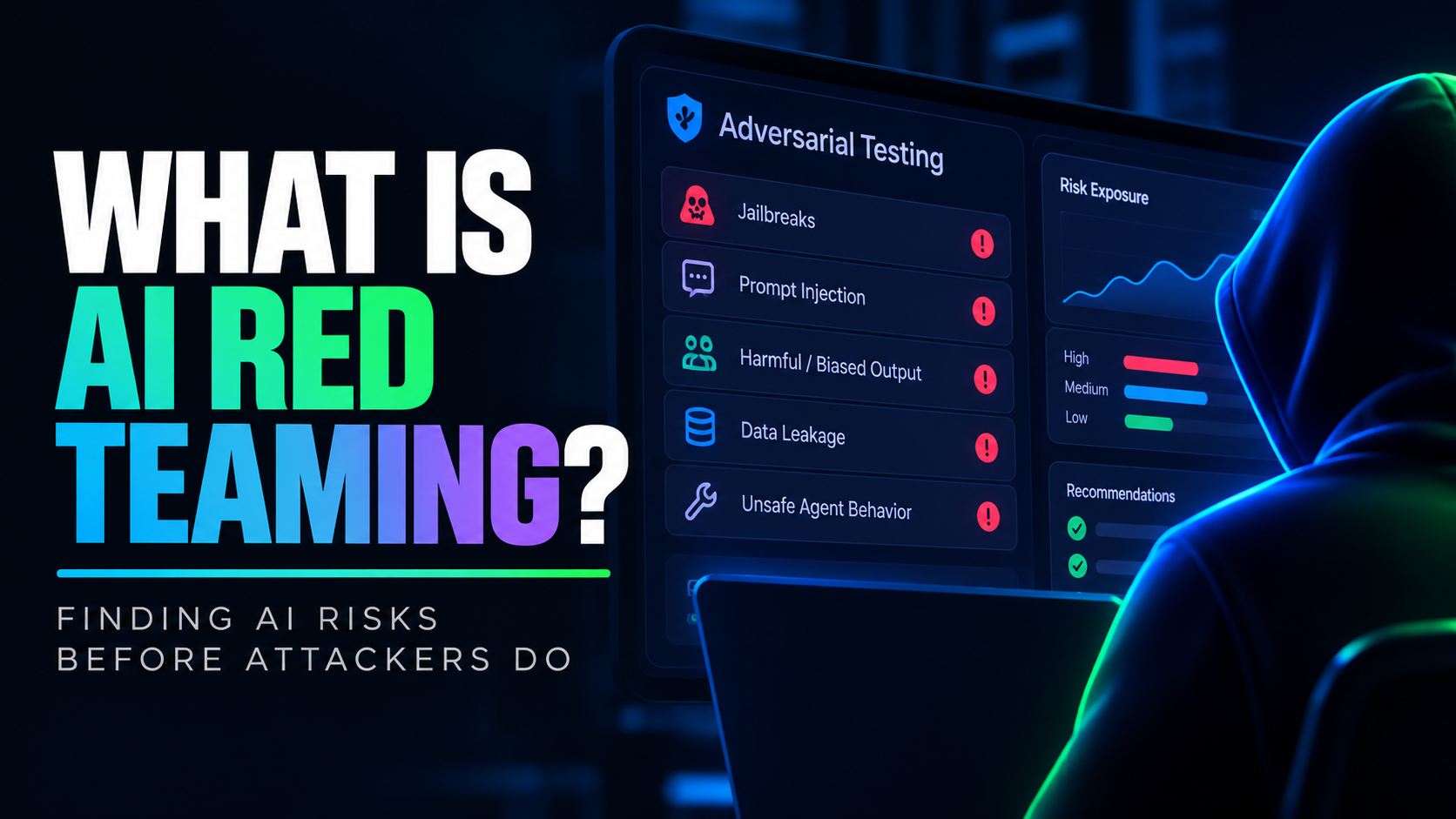
AI red teaming is the practice of deliberately probing an AI system for security, safety, and misuse vulnerabilities by simulating the techniques a real adversary would use, before deployment or as part of ongoing post-launch testing. It borrows its name and structure from cybersecurity red teaming. Still, it applies it to failure modes unique to AI: jailbreaks, prompt injection, harmful output generation, bias, and unintended tool use by agents.
Key facts about AI red teaming:
- Definition: structured adversarial testing of an AI system to surface security and safety weaknesses before real attackers or real users find them
- Origin: adapted from military and cybersecurity red teaming, formalized for AI through efforts like the NIST AI RMF and frameworks published by major AI labs
- What it tests for: jailbreaks, prompt injection susceptibility, harmful or biased output, data leakage through the model, and unsafe agent tool use
- Who does it: internal security and safety teams, specialized red-teaming vendors, and increasingly automated red-teaming tools that run adversarial prompts at scale
- Not the same as: ongoing production monitoring, which detects live misuse after deployment rather than testing for weaknesses before or during a release
How is AI red teaming different from traditional cybersecurity red teaming?
Traditional red teaming targets infrastructure and code: it tries to breach a network, exploit a known vulnerability class, or escalate privileges through a system with deterministic behavior. AI red teaming targets a probabilistic system whose behavior is shaped by training data no tester fully controls or fully understands. That changes what "finding a vulnerability" means. A traditional red team finds a specific exploitable flaw; an AI red team maps a distribution of failure conditions, since the same adversarial prompt may fail nine times and succeed on the tenth, and success may vary across model versions, temperatures, or minor prompt rewordings a human would consider equivalent. That is why AI red teaming reports typically describe failure rates and attack-surface categories rather than a fixed list of patched vulnerabilities.
What does an AI red team actually test for?
Jailbreaks and safety bypass. Attempts to get the model to produce content it was trained to refuse- harmful instructions, restricted material- through creative reframing, role-play scenarios, or multi-turn manipulation that a single-turn filter would miss.
Prompt injection susceptibility. Testing whether the model can be redirected by instructions embedded in content it processes rather than typed directly by a user, which is especially important for any AI system connected to external content like email, documents, or web pages.
Harmful or biased output. Probing for outputs that discriminate, misinform, or cause harm across demographic groups, sensitive topics, or edge-case queries a standard test suite wouldn't surface.
Data leakage and memorization. Testing whether the model can be induced to reveal training data it should not expose, system prompts, or information from other users' sessions in a shared deployment.
Unsafe agent behavior. For AI systems with tool access, testing whether an agent can be manipulated into taking unauthorized actions, exceeding its intended scope, or chaining permitted actions together into an unintended outcome.
Robustness under adversarial input. Testing the model's stability against inputs specifically crafted to confuse it, contradictory instructions, adversarial suffixes, and encoding tricks, rather than typical user queries.
Who performs AI red teaming, and how?
Three approaches are used, often in combination:
Manual expert red teaming. Security researchers and domain specialists craft adversarial prompts by hand, drawing on knowledge of known attack patterns and creative probing. This surfaces novel failure modes automated methods miss, but it's slow and doesn't scale to test every model update or configuration change.
Automated red teaming. Tools that generate and run large volumes of adversarial prompts against a target model, often using another AI model to generate attack variations, scaling coverage far beyond what manual testing can achieve, though generally better at finding known categories of failure than genuinely novel ones.
Crowdsourced and bug-bounty red teaming. Opening testing to a broader population of external researchers, sometimes through formal bug-bounty programs, to surface the long tail of failure modes that any single internal team, however skilled, would take much longer to find alone.
Mature programs run all three in layers: automated testing for broad, continuous coverage, manual expert testing for depth on high-stakes systems, and external programs for the failure modes internal teams are structurally unlikely to find on their own.
When should AI red teaming happen?
Red teaming is most valuable at three points, not just once before launch: pre-deployment, testing a model or application before it goes live, which is the most commonly discussed use case; after significant changes, since a new model version, a changed system prompt, or a new tool integration can reopen failure modes that were previously closed; and on an ongoing cadence in production, because adversarial techniques evolve and a system that passed red teaming six months ago may be vulnerable to attack patterns that didn't exist then. Treating red teaming as a one-time pre-launch gate, rather than a recurring practice, is the most common gap between how organizations describe their AI red teaming and how it actually protects them.
How does AI red teaming relate to AI security monitoring?
They're complementary, not redundant. Red teaming is proactive and adversarial: it deliberately tries to break the system in a controlled setting before deployment or as scheduled testing, surfacing weaknesses nobody has exploited yet. Monitoring is reactive and continuous: it watches production behavior for signs that a real attacker, or an unmanaged AI tool with excessive access, is already causing harm. An organization with strong red teaming but no monitoring has tested its sanctioned AI systems thoroughly while remaining blind to shadow AI, unmanaged agents, and MCP servers nobody scheduled a red-team engagement against in the first place. Red teaming answers "is this specific, known AI system safe"; monitoring and discovery answer "what AI is actually running, and is any of it already being misused." Organizations need both: red teaming for the AI they built and know about, discovery and monitoring for the far larger footprint of AI actually in use across the business.
What frameworks guide AI red teaming?
The NIST AI Risk Management Framework's Measure function includes adversarial testing as part of ongoing risk assessment, and NIST has published more specific guidance on generative AI red teaming through its Generative AI Profile. Major AI labs including OpenAI, Anthropic, and Google have published their own red-teaming methodologies and, in some cases, opened structured red-teaming programs to external researchers. The OWASP Top 10 for LLM Applications functions as a practical checklist many red teams test against directly, since it catalogs the most common LLM-specific vulnerability categories, including prompt injection, in a format suited to structured testing.
FAQ
What is AI red teaming in simple terms? It is deliberately testing an AI system by simulating attacks and misuse attempts, jailbreaks, prompt injection, and harmful output, before real attackers or real users encounter those weaknesses in production.
Is AI red teaming the same as penetration testing? They're related but not identical. Penetration testing typically targets infrastructure and application-layer vulnerabilities with deterministic exploits. AI red teaming targets the model's behavior itself, which is probabilistic, so it tends to map failure rates and categories rather than find and patch a fixed list of exploits.
Do I need AI red teaming if I'm not building my own model? Yes, if you're deploying AI in any form: a chatbot built on a third-party model, an agent with tool access, an AI feature in your product. The underlying model's training is out of your control, but how your application prompts it, what data it can access, and what actions it can take are all testable and are exactly what red teaming probes.
How often should AI red teaming happen? At minimum, before deployment and after any significant change to the model, system prompt, or tool integrations. Higher-stakes systems, especially agents with real-world access, warrant an ongoing testing cadence rather than a one-time pre-launch check, since adversarial techniques continue to evolve after launch.
Does red teaming replace the need for AI monitoring? No. Red teaming tests specific, known AI systems before or during deployment. It does not detect unmanaged shadow AI, unauthorized agents, or MCP servers that were never scheduled for a red-team engagement in the first place, which is what continuous discovery and monitoring are built to catch.