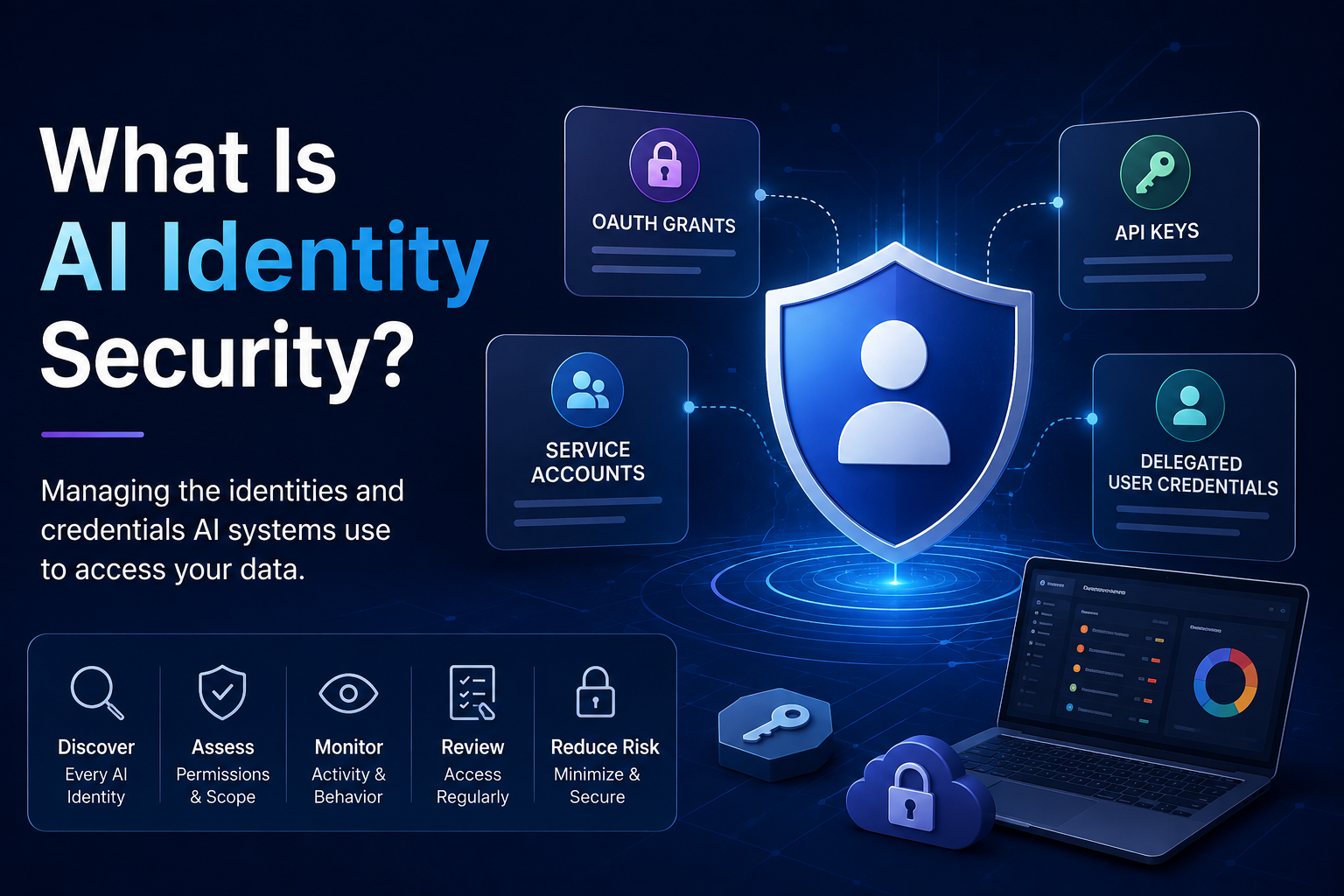
What Is AI Identity Security?
AI identity security is the practice of managing and controlling the identities that AI systems use to access enterprise data and applications: the OAuth grants, API keys, service accounts, and delegated user credentials that agents, copilots, and integrations run on. It exists because most AI doesn't have its own identity. It borrows one, usually a human's, and that borrowed identity is where the real risk sits.
Key facts about AI identity security:
- Definition: the discipline of discovering, mapping, and governing the identities and credentials AI systems use
- Core problem: AI mostly runs on delegated human identities (OAuth tokens, API keys) rather than dedicated machine identities
- Top risks: identity sprawl, over-scoped OAuth grants, orphaned tokens, audit-log blindness, OAuth app abuse
- Primary controls: identity inventory, scope minimization, token expiry, dedicated service identities, continuous access review
- Relationship to IAM: extends traditional identity and access management to cover non-human, AI-driven access patterns IAM was not built for
Why does AI need its own identity discipline?
Traditional IAM was built around a simple model: a human logs in, IAM verifies who they are, and access policy governs what they can do. AI breaks that model in three ways.
Delegation replaces authentication. When an employee connects an AI tool to Gmail, Slack, or Salesforce, they typically authorize it through OAuth. The AI doesn't log in as itself; it acts as that employee indefinitely, until the token is revoked. IAM sees a login event from the human and nothing that distinguishes the AI's subsequent activity from theirs.
One identity, many AI consumers. A single employee's identity can sit behind a dozen connected AI tools, each with its own scope and risk level, none of them visible to security or IT as separate entities.
Machine-speed, non-human behavior on a human account. An agent querying a CRM 300 times an hour, or reading every file in a shared drive overnight, produces activity that looks anomalous for a person but is normal for the agent using their credentials. Behavioral anomaly detection tuned for humans misreads it, or misses it.
The result is what practitioners call AI identity sprawl: a growing, largely untracked population of AI-driven access grants layered on top of the human identity graph.
What are the main AI identity security risks?
Over-scoped OAuth grants. Consent screens default to broad permissions because broad is easier to build against. An employee approving a note-taking app frequently grants full mailbox and calendar access when the app needs neither.
Orphaned identities and tokens. AI tools connected for a project, a trial, or by an employee who has since left the company keep their access. Nothing in a standard offboarding checklist revokes AI-tool OAuth grants the way it deactivates an email account.
Audit-log blindness. Because AI acts under human identities, logs cannot distinguish "the employee did this" from "an AI tool the employee authorized did this." This corrupts incident investigation: a data access event attributed to a person may actually trace to a connected AI agent.
OAuth app abuse and malicious consent screens. Attackers register malicious OAuth applications disguised as legitimate AI tools and phish employees into granting access, a technique that bypasses passwords and MFA entirely since the attacker never needs the employee's credentials, only their consent click.
No lifecycle management. Human identities go through onboarding, periodic review, and offboarding. AI-tool identities typically go through none of these, since most organizations have no process that treats an OAuth grant to an AI app as an identity to manage.
What is AI identity governance?
AI identity governance is the policy and lifecycle layer on top of identity security: deciding which AI tools may request access, what scopes are acceptable for what data classes, who approves new grants, and on what schedule access is reviewed and revoked. It mirrors traditional identity governance and administration (IGA), extended to cover AI as a requester category alongside human employees and traditional service accounts. Where identity security answers "what access does this AI have right now," governance answers "who decided it should, and when does that decision get revisited."
How do you secure AI identities in practice?
Five controls form the practical baseline:
- Inventory every AI-driven identity and grant. Pull OAuth application data from Okta, Microsoft Entra, Google Workspace, and similar identity providers to find every AI tool with delegated access, including ones granted outside any approval process.
- Map effective scope. For each grant, determine what it actually permits, not what the tool claims to need. A "read calendar" scope on some platforms bundles broader access than the label suggests.
- Right-size and prefer dedicated identities. Replace personal-token delegation with scoped service accounts or dedicated machine identities wherever the platform supports it, so access is attributable to the AI tool, not blended into a person's activity.
- Set expiry and review cadence. Treat AI-tool access grants like privileged access: time-bound and included in periodic access reviews rather than reviewed only at initial approval.
- Monitor for anomalous AI behavior. Baseline normal usage per AI tool and alert on deviations, since volume and pattern anomalies are often the first sign of a compromised token or a misconfigured agent.
How is AI identity risk discovered at scale?
Manual review of OAuth grants across every identity provider, SaaS admin console, and endpoint doesn't scale beyond a handful of tools. Continuous discovery correlates identity-provider logs, network traffic, endpoint configuration, and cloud audit data to build a live map of which identities AI tools use and what each can reach. AIBound approaches this as part of its broader AI discovery layer: every AI app, agent, and MCP server it finds is mapped to the identities and OAuth scopes behind it, graded A to F on risk, and fed into existing IAM and GRC systems, so identity teams get AI-specific risk without standing up a parallel process.
AI identity security vs. AI agent security
They overlap heavily but answer different questions. Agent security asks what an autonomous system does, its goals, actions, and behavior. Identity security asks what it can do, the credentials and permissions underlying that behavior. An agent audit without an identity audit tells you the agent behaved oddly; an identity audit without an agent audit tells you a token has broad access but not whether anything is misusing it. Mature programs run both against the same underlying inventory.
FAQ
What is AI identity security in simple terms? It is managing the credentials, OAuth grants, and access permissions that AI tools and agents use, since most AI does not authenticate as itself but instead borrows a human employee's identity.
Why can't standard IAM tools manage AI identity risk? Standard IAM tracks human logins and traditional service accounts. AI tools mostly act through delegated OAuth grants tied to a human identity, so their activity is invisible as a distinct category until it is specifically discovered and mapped.
What is AI identity sprawl? AI identity sprawl is the growing, largely untracked accumulation of AI-driven OAuth grants and API keys across an organization, as employees connect AI tools faster than any review process can track them.
What is an OAuth app risk in the context of AI? It is the risk that a malicious or over-permissioned application, sometimes disguised as a legitimate AI tool, gains standing access to company data through a consent grant, bypassing passwords and MFA since it never needs the victim's credentials directly.
How is AI identity risk different from data leakage risk? Identity risk concerns what an AI system is permitted to access; data leakage concerns data that has actually left the organization. An over-scoped identity is a leakage risk waiting to happen, while leakage is often the realized consequence of unmanaged AI identity.