What Is an AI Security Platform?
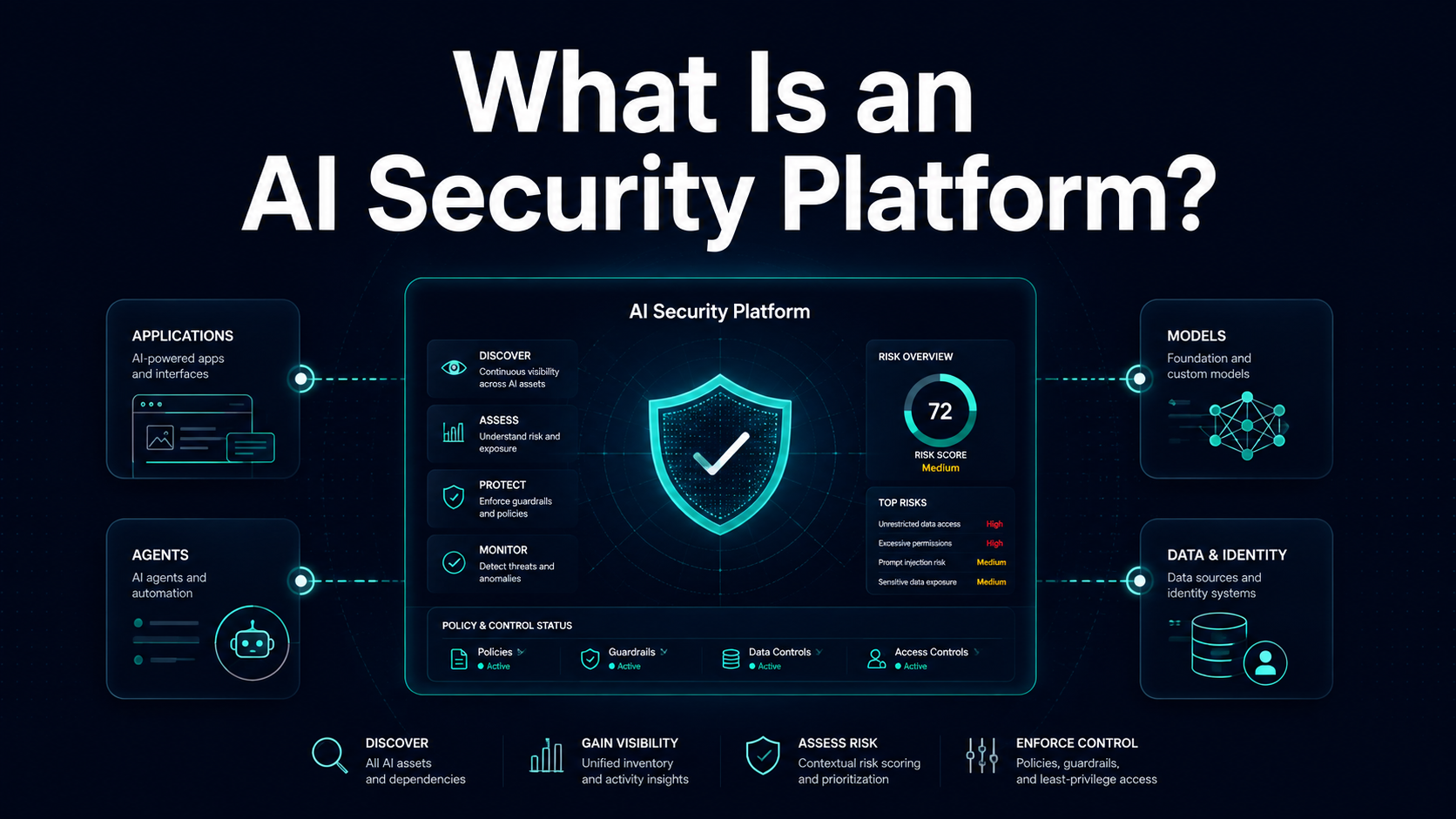
An AI security platform is software that discovers every AI application, agent, and model in use across an organization, assesses the risk each one poses, and enforces policy to control that risk. It exists because the tools organizations already run- CASB, DLP, EDR, and SIEM- were built before AI adoption exploded, and none of them was designed to answer "what AI is running here, and what can it access?"
Key facts about AI security platforms:
- Core functions: discovery, identity and data-access mapping, risk scoring, policy enforcement
- Deployment model: most modern platforms are agentless, correlating existing browser, endpoint, network, and cloud telemetry rather than requiring new agents on every device
- Buyer categories: security teams (risk reduction), compliance/GRC teams (regulatory reporting), IT leadership (adoption enablement)
- Adjacent but distinct categories: CASB (sanctioned SaaS only), DLP (data-pattern matching), traditional IAM (human identities only), GRC software (documentation and workflow, not discovery)
- Buying signal: if the honest answer to "how many AI tools are in use in our organization" is "we don't know," a discovery-first platform is the correct starting category
What does an AI security platform actually do?
Platforms in this category generally perform four functions, in sequence:
- Discovery. Continuously find every AI application, browser extension, agent, and MCP server in use, sanctioned or not, by correlating telemetry the organization already generates rather than requiring new endpoint agents or a manual survey.
- Identity and data mapping. For each discovered AI resource, determine which human or machine identity it operates through, what OAuth scopes or API permissions it holds, and what systems and data it can reach.
- Risk scoring. Grade each AI resource on a consistent scale using factors like vendor security posture, data handling and training practices, permission scope, and usage context, so security teams can prioritize the handful of genuinely dangerous tools instead of drowning in an undifferentiated list.
- Enforcement. Allow, restrict, or block specific AI tools based on their risk grade and organizational policy, ideally through the security stack already in place rather than requiring a separate control plane.
How is an AI security platform different from adjacent tools?
This category gets confused with several adjacent ones, and buyers frequently purchase the wrong tool for the actual problem:
CASB (Cloud Access Security Broker). Manages sanctioned SaaS applications an organization has explicitly onboarded. Most AI risk originates in tools nobody sanctioned, which is exactly what a CASB can't see.
DLP (Data Loss Prevention). Detects structured data patterns, credit card numbers, SSNs, leaving through known channels like email and file transfer. Misses unstructured content pasted into a chatbot and has no concept of an AI agent's OAuth-based access.
Traditional IAM/IGA. Manages human identities and the service accounts IT explicitly provisions. Most AI tools operate through delegated OAuth grants tied to a human's identity, invisible to IAM as a distinct category until specifically mapped.
GRC/AI governance software. Manages policy documentation, risk registers, and compliance workflow for AI systems that have been manually registered into the platform. Strong on process and audit trail, weak on ground truth, since it governs the AI someone remembered to register, not the AI actually in use.
EDR/endpoint security. Detects malware and endpoint threats. It can see installed AI applications and browser extensions as part of general endpoint inventory. Still, it wasn't built to assess AI-specific risk like OAuth scope or model training behavior.
An AI security platform's differentiated value is sitting across all of these signal sources and answering a question none of them was built to answer alone: which AI is actually in use, what can it reach, and how risky is it.
What should you look for when evaluating AI security software?
Discovery breadth and method. Does it cover browser, endpoint, network, and cloud, or just one layer? Does it require deploying new agents, or does it work agentlessly off telemetry already collected? Agent-based approaches typically mean slower rollout and gaps on unmanaged or BYOD devices.
Time to value. How long from connecting the platform to a usable AI inventory. Agentless platforms that reuse existing telemetry typically deliver a first inventory within about 24 hours; agent-based deployments often take weeks to reach meaningful coverage.
Risk scoring transparency. Is the risk grade explainable (specific factors like data access, vendor posture, permission scope) or a black-box score nobody can defend to an auditor or a board.
Enforcement path. Can the platform restrict or block a tool through existing infrastructure (identity provider, browser policy, network controls), or does it only report risk and leave enforcement as a manual follow-up?
Framework alignment. Does the platform map its findings to NIST AI RMF, ISO 42001, or EU AI Act risk tiers directly, which matters materially for compliance and audit teams, or does it produce risk data in a format that has to be manually translated for reporting.
Coverage of non-chatbot AI. Many platforms discover sanctioned SaaS AI features well but miss agents, MCP servers, and open-source models running on endpoints. Ask specifically how each of these is covered, since this is where the newest and least visible risk concentrates.
Do you need a platform, or does your existing stack cover this?
Existing CASB, DLP, EDR, and SIEM tools remain necessary; they are not being replaced. The honest test is whether any of them can currently answer, with confidence, how many AI tools are in use across the organization right now, including ones nobody approved. Most security teams cannot answer that question from their current stack, which is the specific gap this category exists to close. AIBound is built for that gap directly: agentless discovery across browser, endpoint, network, and cloud telemetry, A-to-F risk grading across a registry of more than 50,000 cataloged AI applications, framework-aligned reporting for NIST and the EU AI Act, and enforcement through the security stack an organization already runs, with a first inventory typically ready within 24 hours of connecting.
FAQ
What is the difference between AI security software and AI governance software? AI security software focuses on technical discovery, risk assessment, and enforcement, the ground truth of what AI is running and what it can access. AI governance software focuses on policy, documentation, and workflow, the organizational structure around AI use. Mature programs run both together, with security supplying the data governance reports on.
Can a CASB replace an AI security platform? No. A CASB manages sanctioned SaaS applications the organization has explicitly onboarded. Most AI risk originates in unsanctioned, shadow AI tools that a CASB has no mechanism to see.
Do AI security platforms require installing agents on every device? Not the modern ones. Agentless platforms correlate telemetry already generated by browsers, endpoints, networks, and cloud environments, avoiding the deployment overhead and coverage gaps that agent-based rollouts create on unmanaged devices.
How fast can an AI security platform show results? Agentless platforms that reuse existing telemetry typically produce a full AI inventory with risk grades within about 24 hours of being connected. Agent-based approaches generally take significantly longer to reach comparable coverage.
Is an AI security platform only useful for large enterprises? No. Shadow AI and ungoverned agents accumulate in organizations of any size once employees start using AI tools, and smaller organizations often have less existing security tooling to catch it manually, making discovery arguably more valuable relative to their smaller security team.