How Should Security Teams Prioritize AI Risk Without Chasing Thousands of Alerts?
Published:
August 20, 2026
Niall Browne
Summary
Security teams can reduce AI alert fatigue by prioritizing risks based on context—not isolated findings. This article explains how identity privilege, data sensitivity, external exposure, autonomy, business criticality, and blast radius can be combined to identify the AI risks most likely to cause material business impact.
Key Takeaways
AI risks should be prioritized using contextual scoring rather than flat alert severity.
Identity privilege, sensitive data access, exposure, autonomy, and business impact should be evaluated together.
“Toxic combinations” reveal when several moderate findings converge into a critical AI risk path.
Different AI assets—agents, models, MCP servers, browser extensions, and developer tools—require different risk criteria.
Risk tiers should be explainable and connected to specific actions such as monitoring, restricting, remediating, quarantining, or blocking.
AI risk should be continuously rescored as applications, identities, permissions, models, connectors, and policies change.
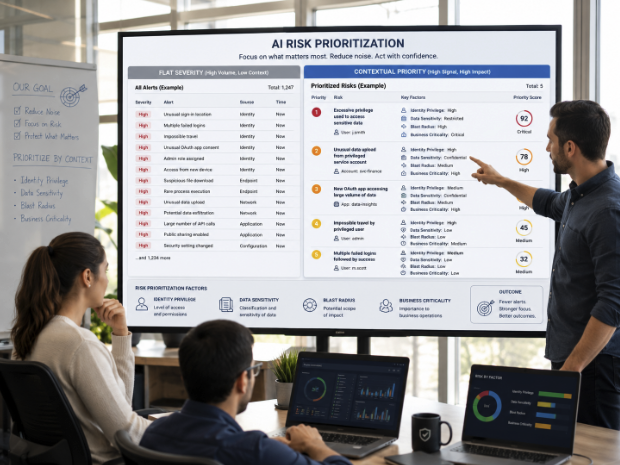
Enterprise security teams do not need more undifferentiated alerts. They need to know which AI risks can actually cause material business impact. As AI spreads across browsers, endpoints, cloud workloads, SaaS applications, developer environments, models, agents, and MCP integrations, the number of individual findings can grow quickly. If every finding is treated as equally urgent, AI security becomes another source of alert fatigue.
AIBound’s Guardian announcement describes a living AI risk registry that profiles 50,000+ AI applications across multiple risk dimensions. The key concept isn't the catalog size itself. It is the ability to connect application intelligence with enterprise context so teams can determine which resources deserve immediate action.
The same principle appears in AIBound’s YouTube video, 5 Steps to Discover, Score, and Prevent High-Risk AI. Discovery comes first, but scoring and prevention only become useful after identity and data connections are understood.
Direct Answer: Prioritize AI Risk by Combining Asset Intelligence With Business Context
Security teams should prioritize AI risk by moving from flat alerts to contextual scoring. Instead of asking whether an AI tool has a vulnerability, an exposed endpoint, a broad permission, or sensitive data access in isolation, the team should ask how those conditions interact. The most urgent risks are usually toxic combinations: multiple high-impact conditions converging on the same AI resource or workflow.
A model exposed to the internet is one finding. A privileged service account is another. A sensitive data repository is another. If the same AI workflow combines all three and can act autonomously, the business risk is much higher than any individual alert suggests.
Why Flat AI Alerts Produce the Wrong Priorities
Traditional security systems often generate findings within their own domain. Endpoint tools see software. Identity platforms see accounts and grants. Cloud security products see workloads and permissions. Data-security tools see sensitive information. Network products see destinations and traffic. Each alert can be valid and still fail to explain the complete risk.
AI workflows cut across those boundaries. One workflow may begin in a browser extension, call an external model, use an agent, authenticate through a service account, access an internal data store, and trigger an action in a SaaS platform. If those events are assessed independently, the security team sees fragments rather than an attack path.
This is why prioritization must be based on relationships. Context tells the team whether an alert is merely interesting or operationally dangerous.
1. Build a Living AI Inventory Before You Score Anything
Risk scoring is only as good as the inventory beneath it. The organization should continuously discover AI applications, models, agents, extensions, plugins, MCP servers, internal APIs, embedded SaaS features, and automation workflows across browsers, endpoints, network activity, code environments, cloud accounts, and enterprise applications.
Each inventory record should capture owner, purpose, users, environment, model or application, identity, permissions, data categories, connected systems, external exposure, autonomy, approval status, vulnerabilities, compliance posture, and last review date.
AIBound’s Control Plane overview emphasizes a sequence of discovery, identity mapping, connection mapping, risk measurement, and prevention. That sequence is valuable because it prevents teams from assigning a score before they understand what the resource can actually reach.
2. Classify the AI Asset Type
Different AI resources create different failure modes. A public chatbot, coding assistant, autonomous agent, browser extension, model API, MCP server, local model, and retrieval system should not share one generic risk template.
Applications: consider vendor controls, data handling, account type, and user behavior.
Models: consider hosting, provenance, fine-tuning, exposed endpoints, and data access.
Agents: consider autonomy, tool access, identity, memory, and action permissions.
MCP servers and plugins: consider exposed capabilities, authorization, ownership, and supply-chain risk.
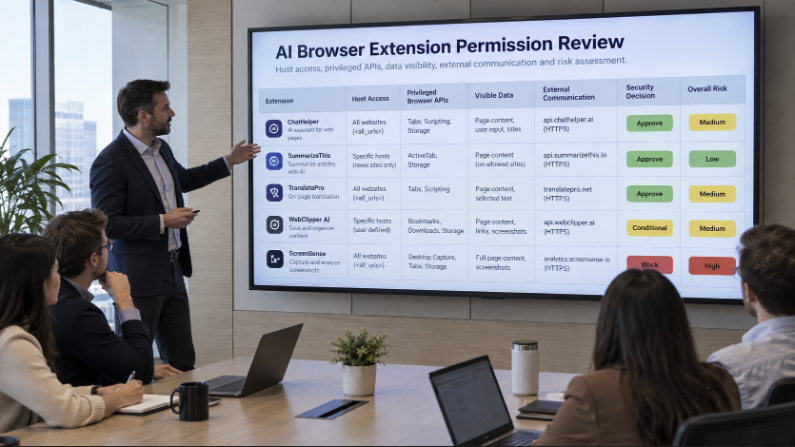
Browser extensions: consider page access, data capture, external communication, and update behavior.
Asset classification helps security teams avoid false equivalence. A low-risk summarization assistant and a production deployment agent should not be scored using identical assumptions.
3. Score Data Sensitivity
Data context is one of the fastest ways to separate ordinary productivity use from material exposure. Security teams should distinguish public data, internal operational data, confidential business information, intellectual property, source code, credentials, financial information, personal data, regulated records, and highly restricted secrets.
The score should reflect both access and actual use. An agent technically capable of reaching a sensitive repository may be lower risk if strong policy enforcement prevents that path. The risk increases when the workflow actively retrieves, indexes, summarizes, exports, or modifies sensitive information.
4. Score Identity Privilege and Effective Permissions
AI systems often inherit the authority of a user, service account, API key, OAuth application, or cloud role. That authority defines the potential impact of a compromised or manipulated workflow. Security teams should therefore score effective permissions, not merely the intended role name.
Read-only versus write, delete, deploy, transfer, or approve.
Single-system versus cross-system access.
Named employee identity versus shared or machine identity.
Short-lived versus persistent credentials.
Least-privilege scopes versus broad administrative scopes.
Human approval versus fully autonomous action.
AIBound’s risk model is designed around this connection between the AI resource, identity, and reachable data. That relationship is what turns a generic application rating into an enterprise-specific risk assessment.
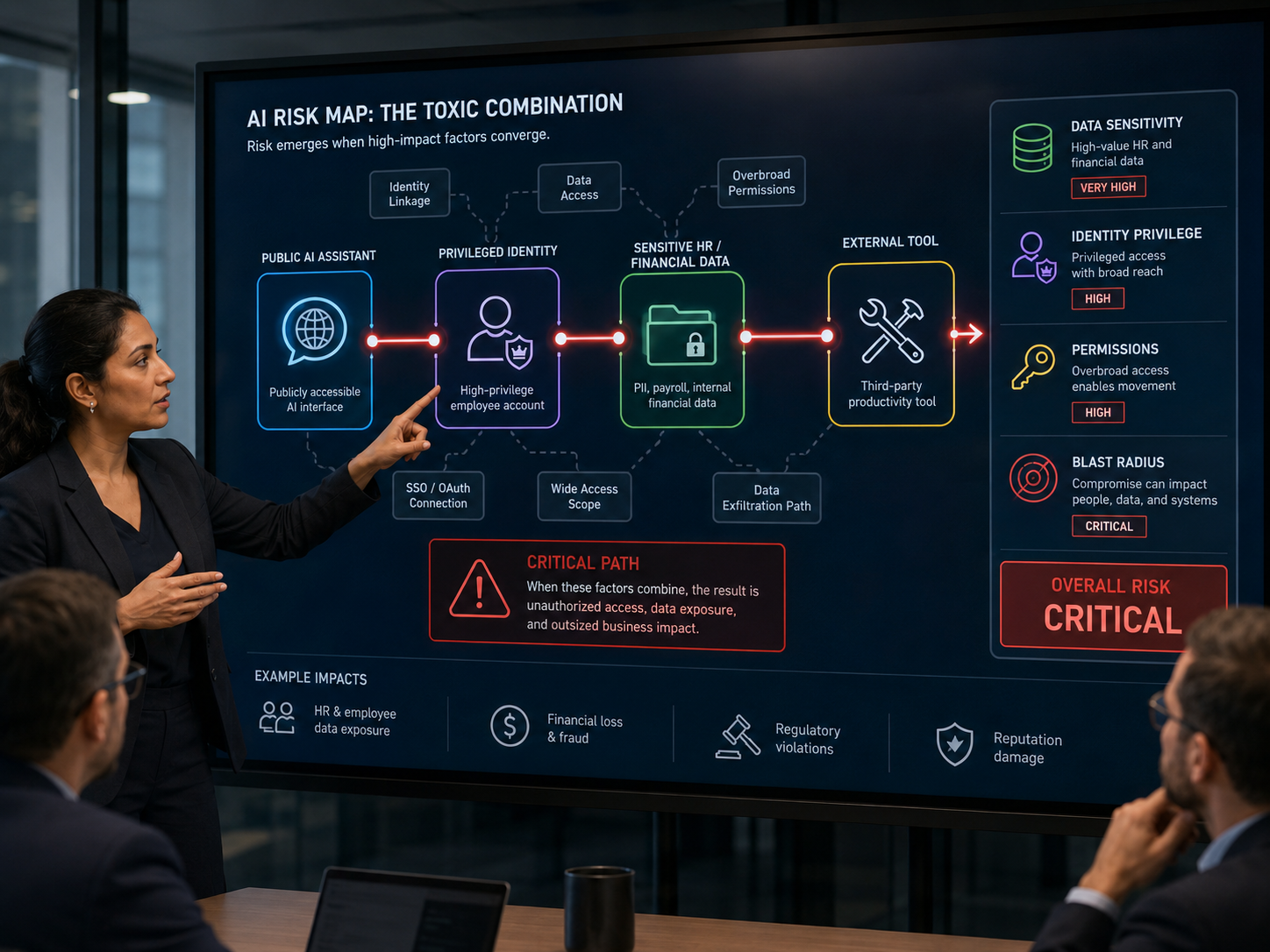
Figure 2. Multiple moderate findings can converge into one critical AI risk path.
5. Add External Exposure and Attack-Path Context
External exposure changes the probability and blast radius of misuse. Review whether the AI resource is internet-facing, accessible to third parties, connected to public webhooks, dependent on external model providers, or reachable through unmanaged browser extensions or third-party MCP servers.
The same internal agent can have a different risk profile if it suddenly exposes an API publicly or connects to a new external service. Risk scoring must therefore update as architecture changes.
6. Add Autonomy and Action Severity
Autonomy matters because the system may be able to convert a bad instruction into a real-world action without waiting for a person. Score what the AI can do and how much human oversight exists.
Can the AI only recommend an action, or can it execute it?
Does a person approve each sensitive action?
Can the agent create payments, send external messages, deploy code, change access, delete records, or modify production?
Can the workflow repeat actions at scale?
Does the downstream system enforce independent limits even if the AI asks for more?
High autonomy is not automatically unacceptable. It becomes much more important when combined with privileged permissions and sensitive systems.
7. Score Business Criticality and Blast Radius
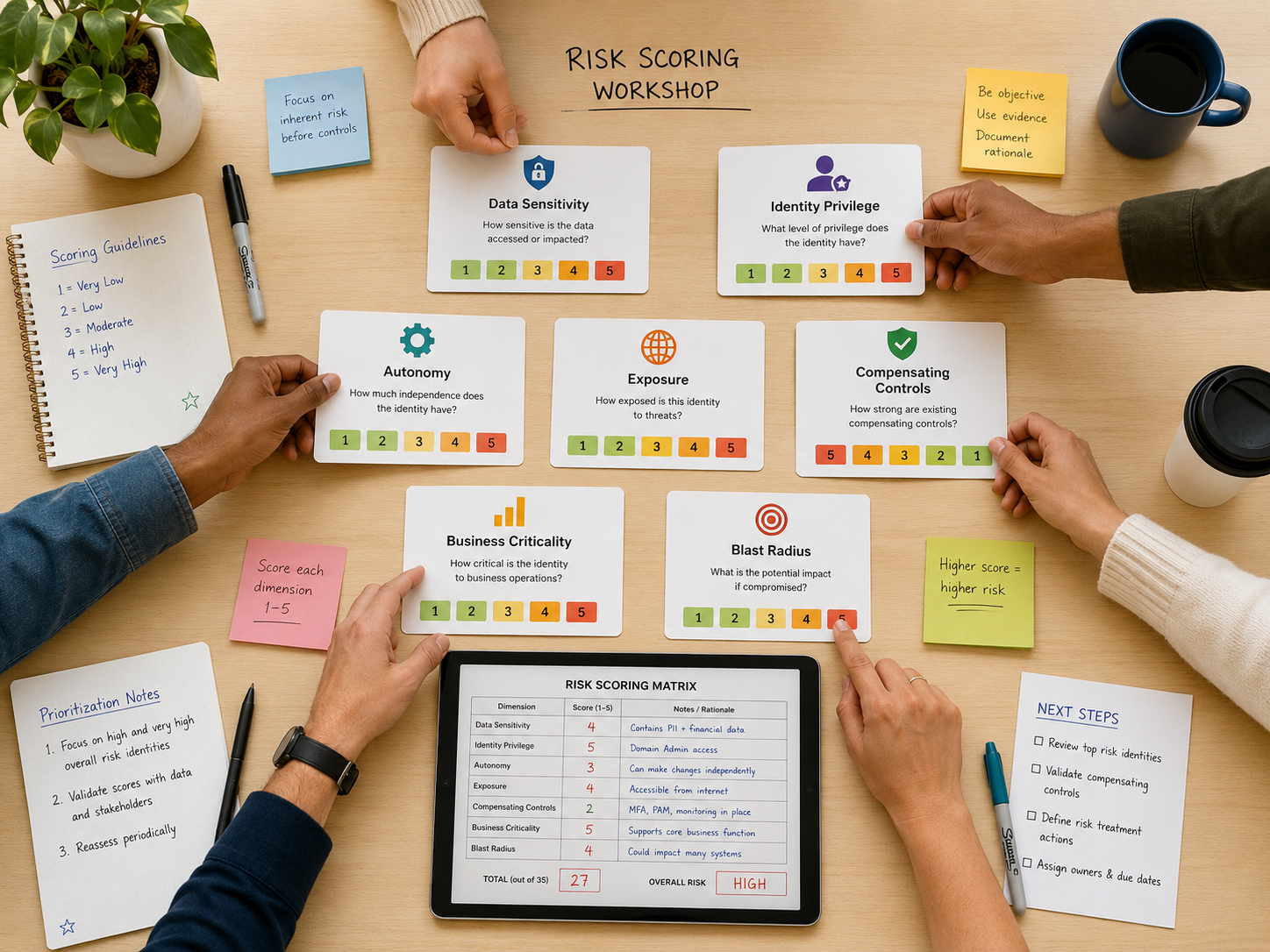
Technical severity is only one part of priority. Security leaders also need to understand how many users, customers, business processes, records, systems, or regulatory obligations could be affected.
A low-level issue in an internal experiment used by two developers differs from the same issue in an agent that supports revenue operations across the entire enterprise. Blast radius helps translate technical findings into business language that executives and application owners can understand.
Figure 3. A defensible risk score should show the contextual dimensions driving urgency.
8. Identify Toxic Combinations
Toxic combinations are the heart of contextual AI risk prioritization. A toxic combination exists when several conditions reinforce one another and create an attack path or impact level far more serious than any condition viewed alone.
A public model endpoint connected to confidential customer records.
An autonomous agent using an administrative identity across production systems.
A browser extension that can read internal pages and send content to an external model.
An MCP server with broad OAuth scopes and no named owner.
A coding agent with repository write access plus access to deployment credentials.
A third-party skill that can read secrets and communicate with an unknown external endpoint.
AIBound’s article on moving from telemetry to action makes this point clearly: enterprise AI risk requires understanding relationships between models, data sources, APIs, identities, and infrastructure. That relationship map lets teams prioritize real business risk rather than chase isolated signals.
9. Create Explainable Risk Tiers
Every priority should be explainable. Security analysts and business owners should be able to answer why a resource received its grade, what factors contributed most, which control would reduce the score, and what evidence supports the decision.
A practical tier model can separate informational, monitored, elevated, high, and critical risk. The highest tier is for resources with a credible path to material business impact, not merely a long list of low-severity findings.
NIST’s AI Risk Management Framework is useful here because it encourages organizations to govern, map, measure, and manage AI risk as a continuous process. The framework does not prescribe one scoring formula, but it reinforces the need for structured, documented, and context-aware decisions.
10. Connect Risk Scores to Specific Response Actions
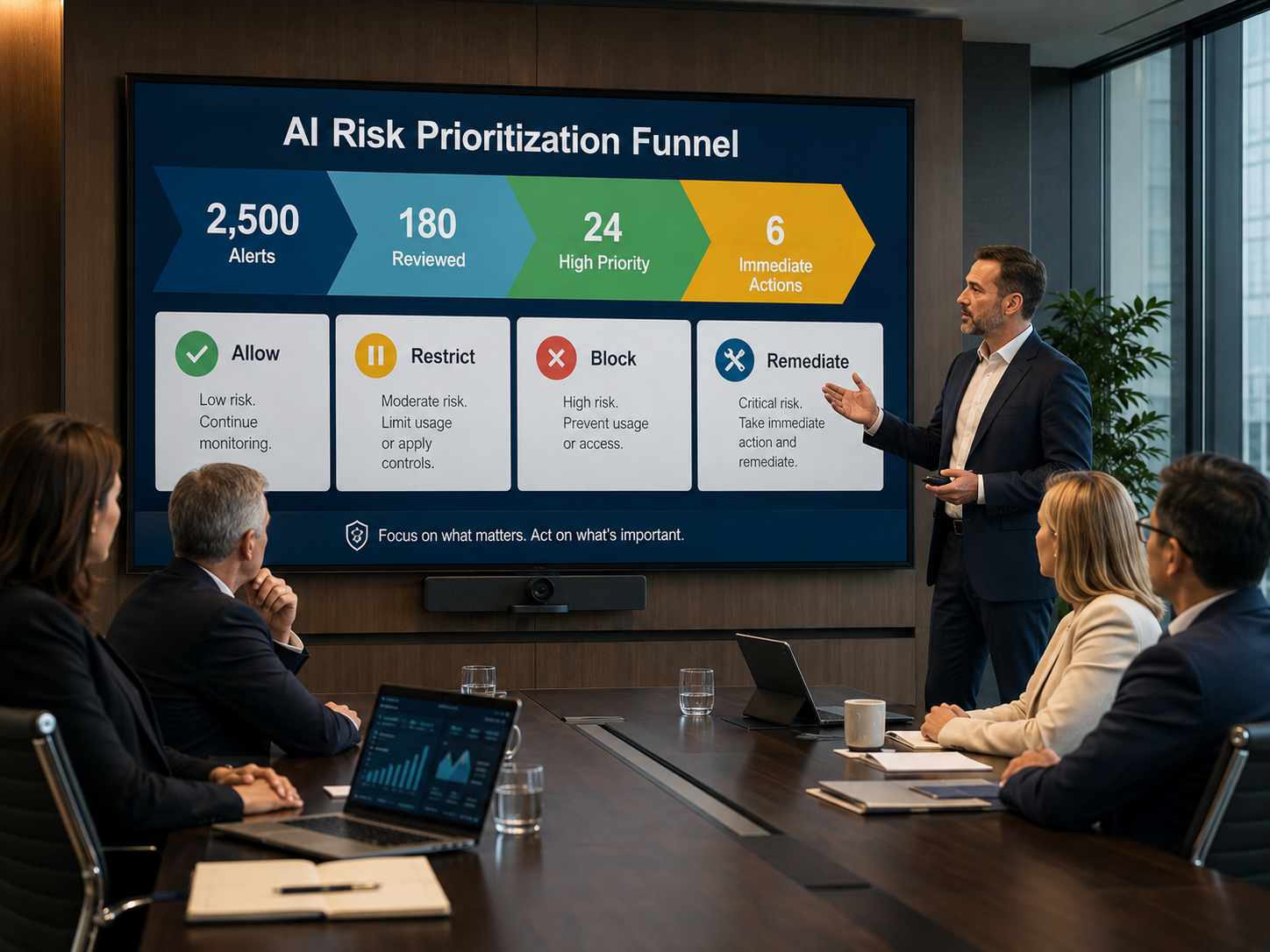
A score is useful only when it changes what the organization does. Define response playbooks for each tier. Low-risk resources may simply be monitored. Elevated risk may require ownership confirmation or narrower permissions. High risk may require enterprise authentication, human approval, or restricted data access. Critical toxic combinations may justify immediate blocking, token revocation, isolation, or incident response.
AIBound’s Guardian and control-plane positioning is built around this move from risk intelligence to action. The broader lesson for security programs is that prioritization should reduce response time, not create another dashboard that analysts must interpret manually.
Figure 4. Effective prioritization filters broad AI intelligence down to the few exposures that require action now.
A Practical Prioritization Workflow for Security Operations
Discover AI resources continuously across browser, endpoint, network, cloud, code, and SaaS environments.
Enrich each resource with owner, identity, permissions, data sensitivity, connected systems, external exposure, and autonomy.
Classify the resource type so the correct risk factors are applied.
Identify combinations of privilege, sensitive data, exposure, and autonomous action.
Estimate business criticality and blast radius.
Assign an explainable risk tier and document the strongest contributing factors.
Trigger a predefined response: monitor, review, restrict, remediate, quarantine, or block.
Continuously rescore when applications, identities, models, connectors, or policies change.
Metrics That Show Whether Prioritization Is Working
Total AI resources discovered versus resources with complete context.
Percentage of high-risk resources with a named owner.
Number of toxic combinations identified.
Critical findings per 1,000 AI resources.
Mean time from critical finding to containment.
Percentage of critical risks reduced through permission changes or data controls.
False-positive rate for escalated AI findings.
Percentage of AI resources automatically rescored after material changes.
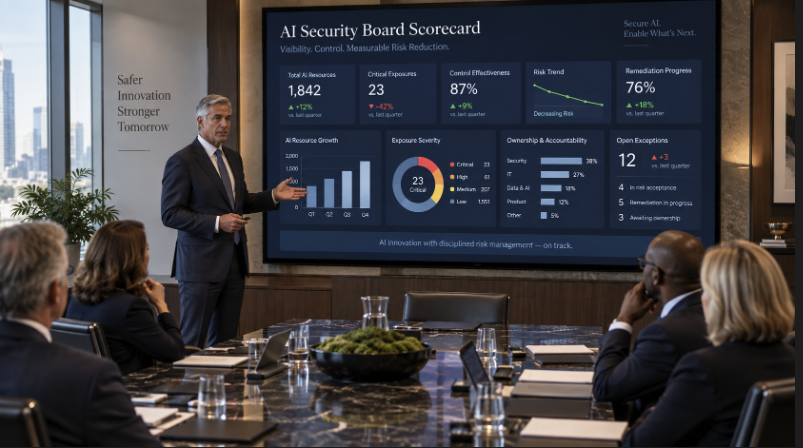
Trend in total critical exposure over time.
Frequently Asked Questions
Is a large AI risk registry enough on its own?
No. External intelligence helps classify applications and services, but enterprise priority depends on local context such as identities, permissions, data, ownership, architecture, and business impact.
Should every unapproved AI tool be high risk?
No. Unapproved means the resource still needs review. It may be low risk, or it may become high risk depending on what it can access and do. Context should determine the response.
What is the fastest way to reduce alert fatigue?
Correlate findings before escalation. If the security program can group an exposed AI resource, a privileged identity, and sensitive data into one attack path, analysts can investigate one meaningful case instead of three disconnected alerts.
How often should AI risk be rescored?
Continuously where possible. AI environments change rapidly as vendors add features, employees install extensions, agents gain tools, OAuth scopes expand, and models or connectors change.
Conclusion
AI security will not scale if every discovered application, model, agent, connector, permission, and data exposure becomes an independent priority-one alert. The organizations that manage AI risk well will build a relationship-aware model that explains how those elements combine.
The objective is simple: identify the few AI exposures most likely to cause meaningful harm, act on them quickly, and allow low-risk innovation to continue. Contextual scoring, toxic-combination analysis, and continuous reprioritization give security teams a practical path from visibility to action without drowning in alerts.